


A version of this article has also appeared on 1517.
When I was growing up, one of my family’s most cherished Christmas Day traditions included reading the nativity story from Luke’s Gospel. I still have fond memories of waiting rather impatiently as Mom sat us down to hear Dad read the words of Luke 2 aloud while my siblings and I eagerly eyed the pile of presents under the tree. The older I get, though, the more nostalgic I become for those mornings, as my dad would finish reading, and we’d all have to wait just a bit more as he’d get Andy Williams’s Christmas album queued up on the stereo. Christmas and nostalgia are, in many ways, two sides of the same coin. Whether it is a parent or Charlie Brown’s friend Linus, the verses that occupy the Bible’s “Christmas Story” are easily some of the most familiar verses in the entire canon.
1. The Lord’s Scandalous Nativity
I wager it is nearly impossible to calculate the number of times you have heard readings of Luke 2. Even still, I wonder if we let the scandal of this account truly grip us or enthrall us the way that Luke intended. In this case, familiarity is not our friend. As Mark I. Wegener wisely admonishes, “We should first be warned against reducing the passage to a sentimental appeal for people of goodwill to be nice to each other during what is now euphemistically known as ‘the holiday season.’”1 Luke’s reporting of the events of Jesus’s birth is so factual that we are often inclined to focus on those factual and historical details. While there’s nothing wrong with that per se, those aren’t the only things we are meant to notice as this nativity story unfolds. After all, what is occurring here is nothing less than the culmination of thousands of years of waiting, hoping, longing, and prophesying.
Instead of leaving humanity to reckon with its sin, scorn, and shame on its own, God the Creator issued a seminal promise that there was one who would take care of all that for them (Gen. 3:15). Throughout all the long centuries afterward, it was precisely this promise that tethered God’s people to any smidgen of hope, even as the days seems to envelop them in thickening darkness. Although they didn’t know when or how those who belonged to Yahweh could trust that his word would one day come true. However, no one could have expected it to come true like this.
2. The Humble Arrival of Heaven’s King
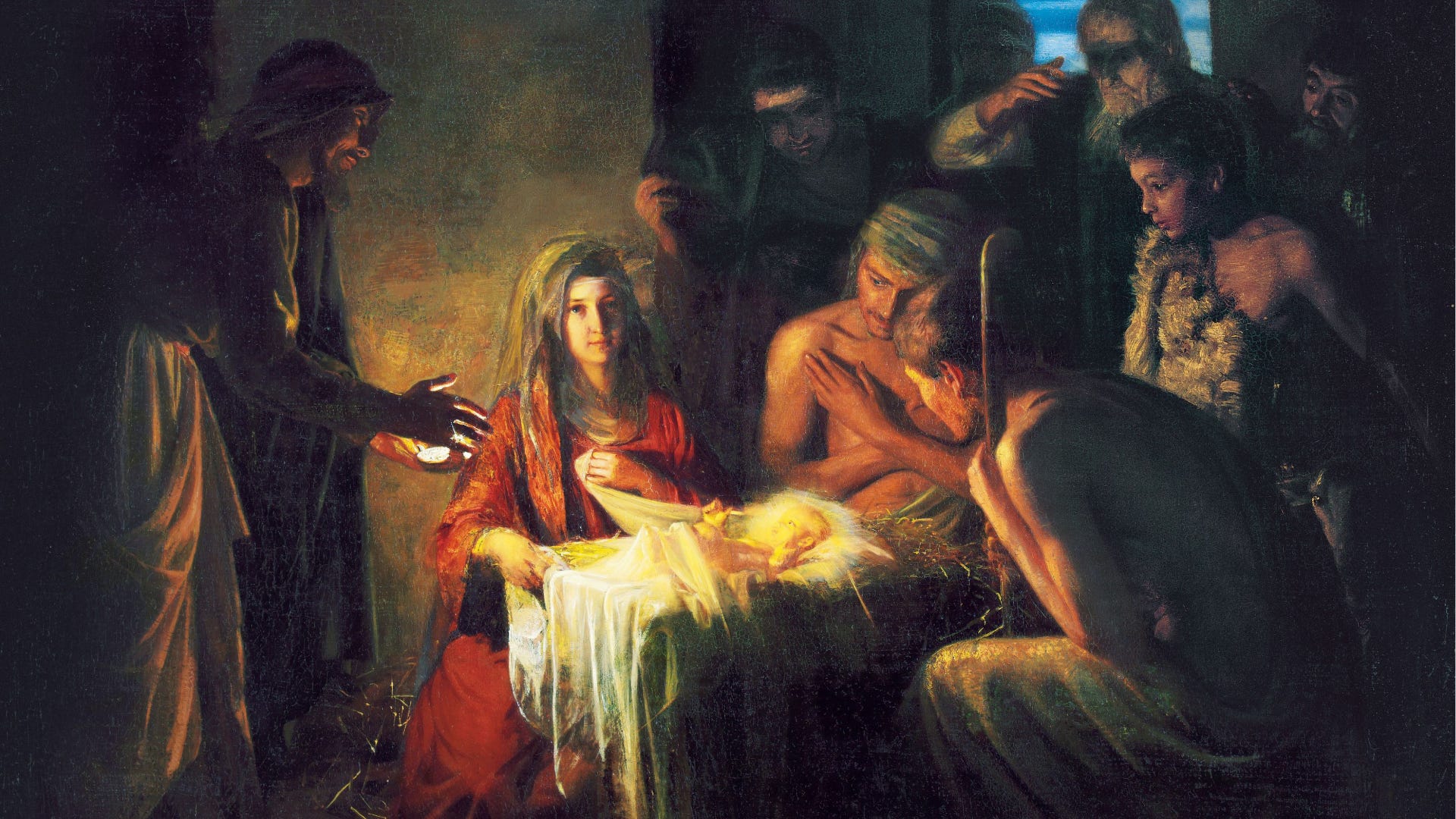
On the surface of it, Jesus’s birth is so very ordinary. There’s nothing overly strange or extraordinary about Luke’s account (Luke 2:1–7). A poor husband and his (very) pregnant wife are obliged to travel from Nazareth to Bethlehem as part of Caesar’s census. As the little town swarms with travelers going this way and that, these two peasants are forced to find another place to sleep since “the inn” was booked and all the guest rooms occupied, forcing them into the “stables,” if the traditional myths are to be believed. Once there, the young wife goes into labor and gives birth to a beautiful baby boy. Although it wasn’t ideal, babies had been born in far worse conditions before. (Jochebed would surely have something to say about that, cf. Exod. 2:1–10.)
There they were, Mary and Joseph, in a stall (fatnē) for a delivery room, staring pensively at their newborn son, perhaps with some extended family gaping over their shoulders. While they understood, at least in part, what had just occurred, no one else seemed to notice or care.
No fanfare accompanied this birth.
No “pomp and circumstance,”
No parade or royal announcement marked the arrival of the world’s Lord and Savior.
It was all so ordinary.
The facts of Jesus’s birth leave little to be wondered at, corresponding to Isaiah’s prophecy concerning Israel’s Messiah, where he declares, “He had no form or majesty that we should look at him, and no beauty that we should desire him” (Isa. 53:2). There was nothing about this event, in and of itself, that would signal something miraculous had occurred. A mom had given birth to a baby boy, and as any mom would do, she swaddled him as he took his first few breaths of earthly air and filled the room with newborn wails. (I’ve never understood the notion that Jesus’s birth was completely “silent.” As endearing as the lyrics are to the beloved carol “Away in a Manger,” the idea that the “little Lord Jesus” made no sounds of crying when he exited his mother’s womb is an example, I think, of failing to hold the Lord’s divinity and humanity in faithful tension.)
Despite how “matter-of-fact” this all sounds, how overlooked and unremarkable this all was, and the fact that no one in the general vicinity seemed to notice, except for a few grungy shepherds, all of heaven was riveted by what had taken place in that lowly stable. Even though “The City of David” was unaware of who had been born that night, heaven knew. Indeed, the whole host of heaven saw what took place and rejoiced. “And suddenly there was with the angel,” Luke records, “a multitude of the heavenly host praising God and saying, ‘Glory to God in the highest, and on earth peace among those with whom he is pleased!’” (Luke 2:13–14).
What makes the angel’s announcement to the gobsmacked shepherds so intriguing is that they almost entirely reframe Jesus’s birth by giving it its necessary context. The angel says that the baby in the manger is none other than “Christ the Lord.” The long-sought-after and long-hoped-for Messiah had arrived — as an infant, no less — and the shepherds would know it was him when they saw the “sign” — namely, a baby “lying in a manger” (Luke 2:12). As the shepherds ventured into Bethlehem, they found the scene just as the angel had told them (Luke 2:16), a sight which filled with an uncontainable measure of joy and euphoria (Luke 2:20).
But what’s our sign? Since we aren’t able to enter Bethlehem and search high and low for a newborn sleeping in a makeshift cradle, how are we to know that the good news of the birth of the Lord’s Christ is true? Mainly, because Luke’s record of Christ’s nativity is all about fulfillment.
3. Promises Kept in Bethlehem
Luke’s Gospel is known for its precision, which makes sense since he was a doctor. But the details Luke includes in this nativity story are not here merely for “historical color” or contextual accuracy. Rather, they are included to showcase the prophetic fulfillment of Jesus’s birth. Indeed, everything that transpires here was previously prophesied about; none of this is happenstance or circumstantial. It’s all providential.
Augustus, to be sure, was proud as a peacock for implementing his imperial registration decree. This was an ingenious tactic for tightening his already vice-like grip on Rome’s government. But little did Caesar know that his census was, in fact, operating within God’s government and was fulfilling God’s decrees. Seven hundred years before this proverbial “silent night,” a prophet named Micah foretold the precise location of the Messiah’s birth (Micah 5:2). Since Bethlehem was King David’s hometown, it makes sense that Israel’s true and better ruler would hail from the birthplace of its best king. “It just so happens” that Mary and Joseph are both from “the house and lineage of David” (Luke 2:4). (This, by the way, is why Jesus’s heritage is carefully preserved in two separate genealogies, cf. Matt. 1:1–17 and Luke 3:23–38.)
Caesar’s census demanded that everyone return to their ancestral home to “register.” Consequently, when Mary and Joseph left Nazareth for Bethlehem, they were not only following Caesar’s word but also fulfilling God’s. They returned to the place of their forefathers, where “it just so happens” that Mary goes into labor. This, of course, is no accident; this is all unfolding according to God’s word and will. The Lord’s Christ (Luke 2:26) would be a member of the royal family and a native of the “royal city,” entitling him to a rightful claim to perpetuate the House of David (Isa. 9:6–7). Israel’s ruler would be a Bethlehemite and would sit on David’s throne, from which he would establish an “everlasting kingdom” of perfect justice, equity, and righteousness, coinciding with God’s covenant with David himself (2 Sam. 7:12–13, 16).
All of this, to be sure, is information Mary knew.
Due to the existence of a particular Christmas song, there is often a lot of back and forth about what she did or didn’t “know” about her newborn son.
We don’t have to wonder too much, though, since the Bible tells us.
When Elizabeth was six months pregnant, the same one who trumpeted her miraculous conception visited Mary, bearing more natal tidings (Luke 1:26–33). The angel’s message is dripping with good news, not the least of which is the fact that young Mary is the one who will bring forth a Son of the Most High God. For thousands of years, Mary’s ancestors had been telling and re-telling the story first told to humanity’s forebears — a story all about how the “Seed of the Woman” would rise up and snuff out all forms of evil and injustice (Gen. 3:15).
Every devout Hebrew maiden likely would have grown up wondering if it might have been them, if they would be the one whose offspring would realize God’s promise. As the generations came and went, this promise became a faint “whisper of hope,” that is, until an angel suddenly appeared to a young Jewish virgin who was betrothed to a carpenter in the backwoods town of Nazareth.
4. Maternal and Paternal Responses to the Incarnation
Mary’s life was never the same after this encounter. She would become the Theotokos, the “Mother of God.” For as overwhelming as the angel’s message was, though, Mary didn’t question its content, just its process. “How will this be,” Mary inquires, “since I am a virgin?” (Luke 1:34). It’s worth pausing to consider the fact that she didn’t say, “What are you talking about?” Instead, she asked, “How’s that going to work?” Mary was familiar, to a certain degree, with those ancient oracles. Her literary acumen didn’t amount to much, though, seeing as she was at a biological disadvantage since she had never been intimate with a man before. The heavenly messenger, of course, had an answer for that, too:
The Holy Spirit will come upon you, and the power of the Most High will overshadow you; therefore the child to be born will be called holy — the Son of God. (Luke 1:35)
The baby growing in Mary’s belly was no ordinary zygote. He would be her son, but he would also be “the Son of God,” “conceived by the Holy Spirit,” as the early church fathers put it. What was taking place in Mary’s womb was nothing short of a miracle of grace: an embryo that was both human and divine. “Don’t worry about the biological hurdles,” the angel seems to say, “because nothing is impossible with God” (Luke 1:37). This coheres with Isaiah’s earlier prophecy, where he declares:
Therefore the Lord himself will give you a sign. Behold, the virgin shall conceive and bear a son, and shall call his name Immanuel. (Isa. 7:14)
This verse has been explained to death, with many scriptural “experts” intuiting Isaiah’s intent in a way that leaves its messianic tremors in ruins. For my own part, I put no stock in any exegesis that identifies Isaiah’s prophetic offspring as anyone other than the Lord’s Christ. Not only is the angel’s message to Mary reminiscent of Isaiah’s oracle, with the same term for “virgin” (parthenos) appearing twice in one verse (Luke 1:27; cf. Isa. 7:14, LXX), but also the angel’s message to Joseph is layered with the same sense of prophetic fulfillment.
Jesus’s earthly father is easily one of the most forgotten participants in the Christmas story. However, don’t give him “afterthought” status. Joseph was a “just” (dikaios) and honorable man who, much to his surprise, found out that his soon-to-be wife was suddenly pregnant. What’s more, he knew that if he went on Jerry Springer, he wouldn’t be the father. His betrothed had gone to visit her cousin Elizabeth, who was also surprisingly pregnant, only to return to Nazareth with an unmissable baby bump. People were talking, and rumors were swirling.
But while Joseph had nearly decided to “quietly” divorce Mary and get out while he was ahead, an angel appeared to him in a dream to tell him to hold his horses. “Joseph, son of David,” said the angel, “do not fear to take Mary as your wife, for that which is conceived in her is from the Holy Spirit. She will bear a son, and you shall call his name Jesus, for he will save his people from their sins” (Matt. 1:20–21). Mary’s story was true. She hadn’t been unfaithful. Indeed, the infant growing inside of Joseph’s fiancée was no less than Immanuel. “All this took place,” writes Matthew, “to fulfill what the Lord had spoken by the prophet: ‘Behold, the virgin shall conceive and bear a son, and they shall call his name Immanuel’ (which means, God with us)” (Matt. 1:22–23).
5. Grace Is At Work in Unnoticed Places
Even though it was shrouded in mystery, scandal, and controversy, the Lord’s birth was perfectly realized according to God’s word and will. Unbeknownst to the rest of the world, God’s promises of peace and redemption were taking shape — in particular, the unassuming shape of a newborn baby. “No one noticed,” Martin Luther attests, “or was conscious of what God was doing in that stable.”2 No one other than a motley crew of shepherds gave even a second thought about what happened that night. No one else even seemed to care that Bethlehem played host to the Messiah. But even though no one else was paying any attention, God was working. “The simplicity of Luke’s story,” Mark I. Wegener concludes, “conveys a sense that God is up to something, that what is being offered in the birth of Jesus is something of God’s own self.”3 Indeed, in a feeding trough that served as a makeshift cradle was nestled the Savior of the world. Immanuel, God with us, had come at just the right time (Gal. 4:4–5).
As the first-century world grew darker and more uncertain, with half the world under the tyrannical thumb of Caesar, God himself took on flesh and tabernacled in the womb of a Jewish virgin so that his word of promise might be fulfilled. One by one, Luke’s record of Jesus’s nativity sets up prophetic dominos only to leave them all toppled in the wake of the angel’s announcement: “Fear not, for behold, I bring you good news of great joy that will be for all the people. For unto you is born this day in the city of David a Savior, who is Christ the Lord” (Luke 2:10–11). One of my favorite Scottish orators, Alexander Maclaren, put it like this:
The eternal, self-communicating personality in the Godhead, passed voluntarily into the condition of humanity. Jesus was born, the Son of God came. Only when we hold fast by that great truth do we pierce to the centre of what was done in that poor stable, and possess the key to all the wonders of His life and death.4
What appears so very ordinary, therefore, is, in reality, suffused with the extraordinary grace of God, which capsizes all of mankind’s wisdom and logic. The Son of the Most High God is there with a feeding trough for a bed. This, of course, is by design, too, since Jesus was sent to save the world from sin (Matt. 1:21). As Mary caresses her newborn and cradles him in her arms, she kisses his forehead. But little did she know that that same forehead would one day drip with blood from a crown of thorns as her newborn atones for all of humanity’s sins. Every sinner can trace their salvation back to this moment when the Savior was born in accordance with the Word of God so that all of God’s words would be realized. Immanuel is here. The Savior has come. Joy to the world, indeed.
Mark I. Wegener, “Luke 2:1-20,” Interpretation 48.4 (1994): 395.
Martin Luther, “Sermons on Gospel Texts for Advent, Christmas, and Epiphany,” Sermons, Vols. 1–8, edited by John Nicholas Lenker (Grand Rapids, MI: Baker Book House, 1988), 1:138.
Wegener, 396, emphasis mine.
Alexander Maclaren, Expositions of Holy Scripture, Vols. 1–17 (Grand Rapids, MI: Eerdmans, 1944), 9:1.48.