



Due to its position almost directly above the Earth’s northernmost axis, the North Star, a.k.a. Polaris, appears fixed in the heavens while its neighbors seem to be in constant motion. Although it does move, the North Star’s movements are so imperceptible to the human eye that it has served as a reliable point of reference for pilots and pioneers for eons. Maintaining a sense of direction when traversing through treacherous terrain or sailing across vast open seas is all about finding “true north” by pinpointing Polaris and tracking one’s course accordingly. Those who are lost are, therefore, urged to find this point on the horizon to find their way again. This is not only true navigationally but also spiritually. After all, there is only one fixed point of reference for those who are trudging through life’s existential and spiritual ennui — namely, the Word of God. Indeed, God’s Word is the North Star of our faith.
1. The Word Is Our True North
Any attempt to steer one’s life, with all of its ebbs, flows, and uncertainties, without God’s Word, is like trying to sail across the Pacific Ocean blindfolded. You are left hopelessly adrift, with no lodestar to guide you home. What is it, though, about the Word that makes it our “true north”? For starters, it has nothing to do with the moral, ethical, or even the historical legacy of the biblical canon. Even though the Christian Scriptures do contain moralistic incentives and God’s divine ethic for life, this isn’t what makes it so enduring, nor is this what endears us to its message. What makes the Word the lodestar of our faith is its revelation of God’s promises to us and for us. Instead of a loosely compiled compendium of ancient stories, God’s Word is a purposeful book with a particular theme tying every narrative thread together — namely, it’s a story that centers on and revolves around the God who makes and keeps his promises for those who keep breaking them.
This, for the most part, is and has been the defining story of all those who have put their faith in God, from Father Abraham to the saints of today. Indeed, the reason the church exists is because the promises of God are true and abiding. But even though his promises are unchanging, it is, perhaps, a splendid thing that the way in which these promises are portrayed and applied has changed. For millennia, the religious life of God’s people was realized through the ritual sacrificing of animals on altars, with bloodshed serving as the currency for pardon. The place where God’s people gathered, therefore, was a place of smoke and viscera, as day after day, priests would supervise the propitiatory deaths of hundreds of lambs, bulls, and goats (Heb. 10:11). For my own part, I’m glad that Sunday mornings aren’t accompanied by the sights and smells of gutting beasts and burning incense. Nevertheless, it’s no accident that the Christmas story effectively begins right there, in the middle of the smoke and blood of the Temple.
2. The Story Begins in Smoke and Blood
As Zechariah, the priest, went about his regular priestly duties, he was suddenly visited by an angel of the Lord, who proceeded to inform him that his barren wife was now pregnant (Luke 1:8–13). The baby in his wife’s belly would be named John, and he would be the one who would go before the Lord “in the spirit and power of Elijah” (Luke 1:17). It is this event that sets in motion the chain of events that culminates in the nativity of the Christ of God. But have you ever stopped to consider why the priests had to deal with so much blood and smoke? Why is that? Where did that come from? The bulk of the Old Testament, of course, relays a series of fairly grisly details about the specific function and execution of the Temple sacrifices.1 But where did that system originate? Who instituted all these ritual sacrifices? Who made it so that “religion” was synonymous with blood?
3. The Story of Cain and Abel
The answer to these questions is found at the beginning of the biblical record, in the story of Adam and Eve’s sons, Cain and Abel (Gen. 4:1–8). Questions permeate this “tale as old as time.” For instance:
Why exactly did Cain kill Abel?
Why were they offering sacrifices?
Why was Abel’s offering accepted but not Cain’s?
What gives?
Simply put, this whole scene is about worship. The phrase “in the course of time” (Gen. 4:3) suggests a divinely appointed time for worship and fellowship. This wasn’t a random occurrence. Rather, this was something Cain and Abel had done before and likely did regularly.
did regularly. They both ventured to the proper place at the proper time to commune with their Creator in the proper (Gen. 4:3–4). (Some Bible scholars have even suggested that the “place of worship” was the very spot that was being guarded by the cherubim, cf. Gen. 3:24.) Although it is left unsaid, it is understood that Cain and Abel were instructed to do this by their parents since the old way of communing with God was no longer possible. Due to that fateful choice, which resulted in “The Fall,” Cain and Abel never experienced the level of intimacy with God that their parents did. Instead, they were forced to reckon with the fallout of their decision to believe in the serpent’s words rather than God’s words.
Accordingly, these two sons of Adam approach the Lord for the express purpose of worshiping him, but the manner of their approach is vastly different. Cain comes bearing an offering from “the fruit of the ground,” an offering stemming from his own labors. Meanwhile, Abel comes bearing an offering from his own flock, a firstborn lamb. Whereas God accepts and approves of Abel’s sacrifice, he doesn’t accept or even “regard” Cain’s. This causes Cain’s anger and jealousy to boil over and get the better of him, so much so that he ends up murdering his brother in cold blood (Gen. 4:5–8). But lest you think that God the Father was just being a petty deity, the Lord’s disregard for Cain’s attempted offering stems from two related reasons:
(1) It was an offering he cultivated and collected: Cain, who is described as a “worker of the ground,” enters God’s presence with an offering from the “fruits” of his own toil and sweat.
(2) It was an offering from “the fruit of the ground”: All Cain had to offer was the pulp of a harvest he tilled and tended.
In other words, there was no blood involved.
As Cain approached the Lord, he was consumed by his own efforts and what he could do to gain God’s acceptance. Cain wanted to worship the Lord on his own terms, which is why God turned his back on him. By way of contrast, of course, Abel’s offering was accepted. “The Lord did have regard for his offering,” Moses tells us (Gen. 4:4). This is because Abel understood, to a certain degree, what “true worship” required. As the anonymous writer of Hebrews says, “By faith Abel offered to God a more acceptable sacrifice than Cain, through which he was commended as righteous” (Heb. 11:4). Abel’s offering was “more acceptable” since his involved blood — specifically the blood of the firstborn of his flock.” This, to be sure, is an acknowledgment that although he deserved to die as the son of those who rebelled, an innocent lamb is dying in his stead.
As the lamb’s blood poured over that altar, it was meant to serve as a visible gesture that the penalty of death was being taken for him. The encapsulation of Abel’s hope and worship, therefore, is expressed in someone else’s blood, covering all of his sins and shortcomings. In this way, we are made to see the vestiges of what the writer to the Hebrews would later articulate, that “without the shedding of blood there is no forgiveness of sins” (Heb. 9:22). But how does this help us figure out the origins of the sacrificial system?
The question hanging over this account is, Who told Abel this is how God is supposed to be worshiped? Who taught him how to approach the Lord this way? If Abel “offered to God a more acceptable sacrifice by faith,” where did his faith to do that come from? Again, the text doesn’t explicitly say this, but since we know that “faith comes from hearing, and hearing through the word of Christ” (Rom. 10:17), it is safe to assume that he learned about this from his parents. This raises another question: Where did Adam and Eve get this from? From none other than God himself.
4. The First Gospel Sermon Ever Heard
In what is, perhaps, the most overlooked yet most evocative verse in the Pentateuch, God gives Adam and Eve a graphic lesson on how to approach him before they are kicked out of the Garden for good — namely, by killing two innocent animals and using their hides for new robes. After he’s finished cursing the serpent and detailing Adam and Eve’s painful consequences, God gives his creatures “garments of skins” to “clothe them” (Gen. 3:21). To be sure, these animals were not sacrificed for sport or steak, but for salvation. God used these skins to make for Adam and Eve what they couldn’t make for themselves — namely, a covering sufficient enough to conceal their shame.
In the immediate aftermath of Adam and Eve’s decision to eat the fruit of the tree, they become engulfed with guilt, shame, and dread, so much so that they attempt to hide from God and dress themselves up with matching fig-leaf rompers (Gen. 3:7–8). This, of course, is an entirely impossible endeavor since no amount of “fruit of the ground” can conceal their sin. Accordingly, God gives them a demonstrable sign of how they are restored by paying for their guilt, covering their shame, and dissolving their dread in one fell swoop. In giving them “garments of skins,” he’s not just making them modest, he’s making them righteous. In fact, he’s giving them a visceral emblem of his word of promise.
I will put enmity between you and the woman, and between your offspring and her offspring; he shall bruise your head, and you shall bruise his heel. (Gen. 3:15)
On the heels of “The Fall” and the fracturing of the created order, God proceeds to curse Satan by reminding him that one from among the very creatures he corrupted would bring about his undoing. This verse has been called the “protoevangelium,” a.k.a. “the first gospel,” for good reason since it is this precise promise that has filled the people of God with the hope of deliverance for thousands of years. Martin Luther calls Genesis 3:15 the “fountainhead of God’s promises,” the spring from which all his other promises emerge. English evangelical Anglican cleric Charles Simeon puts it like this:
As the oak with all its luxuriant branches is contained in the acorn, so was the whole of salvation, however copiously unfolded in subsequent revelations, comprehended in this one prophecy; which is, in fact, the sum and summary of the whole Bible. And on this promise all the Saints lived, during the space of 2,000 years: yes, all from Adam to the time of Abraham were encouraged, comforted, and saved by this promise alone, illustrated as it was by sacrifices appointed by the Lord.2
Every sinner from Adam and Eve to Cain and Abel to Abraham to Isaac to Jacob to Moses to David to Zechariah to you and me has clung to this promise of salvation, graphically portrayed in the Garden of Eden for them. The perennial hope of those who belong to and trust in God has always been tethered to the promise that God was sending a Restorer to make everything right again. Indeed, the whole sacrificial system that plays such a central role in the culture and life of the Israelites finds its origins right here, when God clothed Adam and Eve with animal skins in the wake of their sin. This moment, according to Arthur W. Pink, constitutes “the first Gospel sermon ever preached on this earth, preached not by word but by symbol.”3 He continues:
It was the first Gospel sermon, preached by God Himself, not in words but in symbol and action. It was a setting forth of the way by which a sinful creature could return and approach his holy Creator. It was the initial declaration of the fundamental fact that ‘without shedding of blood is no remission.’ It was a blessed illustration of substitution — the innocent dying in the stead of the guilty.4
All creation reverberated with the first notes of good news when God gave the ones who sinned against him a preview of how he would fulfill his promise to deal with their sin.
A sacrifice was made, and blood was shed.
But it wasn’t Adam and Eve’s.
It was blood that belonged to their substitute.
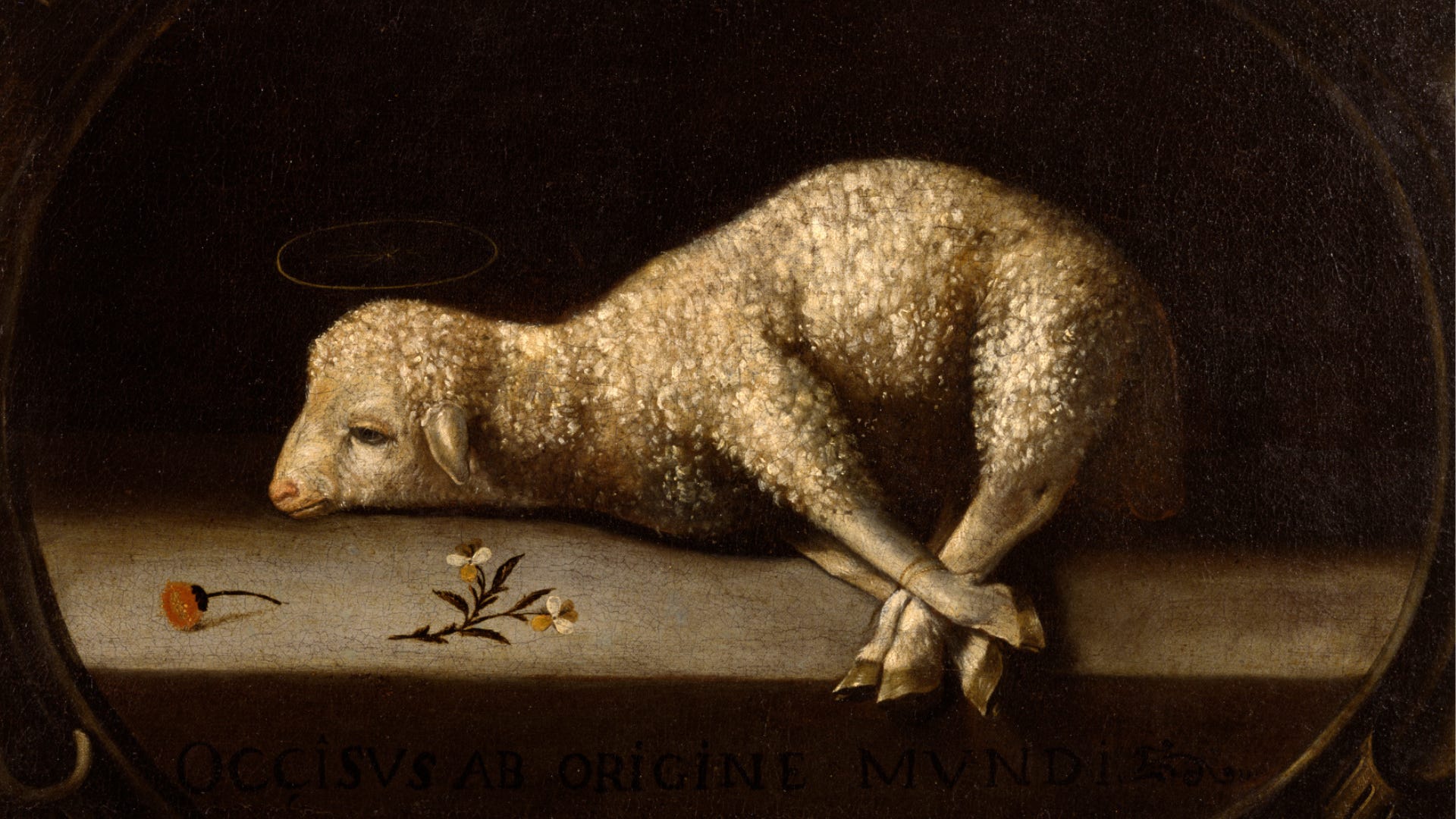
That is, to a lamb that died in their place.
5. The Lamb, the Cross, and the Clothing of Grace
God’s method for restoring and redeeming all of mankind is revealed when he freely gives Adam and Eve what they could never make for themselves. This becomes the pattern of grace God inscribes on the rest of history. “The covering of the nakedness of our first parents with the skins of these animals,” notes Robert S. Candlish, “represented the way in which sin is covered, by the imputed worthiness of the great Sacrifice, — the righteousness of the Lamb slain for its remission.”5 It is this word of promise that is carried forward all the way to that chilly night in Bethlehem when the Lord was “born in the likeness of men” so that he might humble himself “to the point of death, even death on a cross” (Phil. 2:7–8). The Christ of God, who would eventually fulfill the promise to crush the head of the serpent, entered the world as a helpless infant. He comes to Earth to fulfill what was promised and previewed just outside of Eden, where an innocent lamb was killed to provide a covering for mankind’s sins.
Just as God the Creator made “garments of skins” for Adam and Eve to “clothe them,” so, too, does Christ our Savior clothe us in garments of salvation that he provides for us. “I will greatly rejoice in the Lord,” says the prophet Isaiah, “my soul shall exult in my God, for he has clothed me with the garments of salvation; he has covered me with the robe of righteousness” (Isa. 61:10). God’s word of promise — and more specifically the long-hoped-for promise of Advent — has become a reality in the person of Jesus, who ascended the cross to shed his blood and, thereby, accomplished for sinners who no amount fig leaves ever could. The promise is sure. The Word is fixed. The Lamb has been slain. Your sins are covered. Joy to the world, indeed.
We often forget just how much blood is involved during the days of Christmastide. Brad East’s article for Christianity Today, “The Blood Cries Out at Christmastime,” covers this topic at length.
Charles Simeon, “Genesis to Leviticus,” Horae Homileticae: or Discourses (Principally in the Form of Skeletons) Now First Digested into One Continued Series, and Forming a Commentary Upon Every Book of the Old and New Testament, Vols. 1–21 (London: Holdsworth & Ball, 1832), 1:36.
Arthur W. Pink, Gleanings in Genesis (Chicago: Moody Press, 1922), 63.
Pink, 44.
Robert S. Candlish, The Book of Genesis Expounded in a Series of Discourses, Vols. 1–2 (Edinburgh: Adam & Charles Black, 1868), 1:81.
I had not previously made the connection between fig leaves used by Adam and Eve, and the fruit of the ground offered by Cain. Highlights our need for a sacrifice to be made for us and righteousness imputed to us.