


A version of this article originally appeared on Mockingbird.
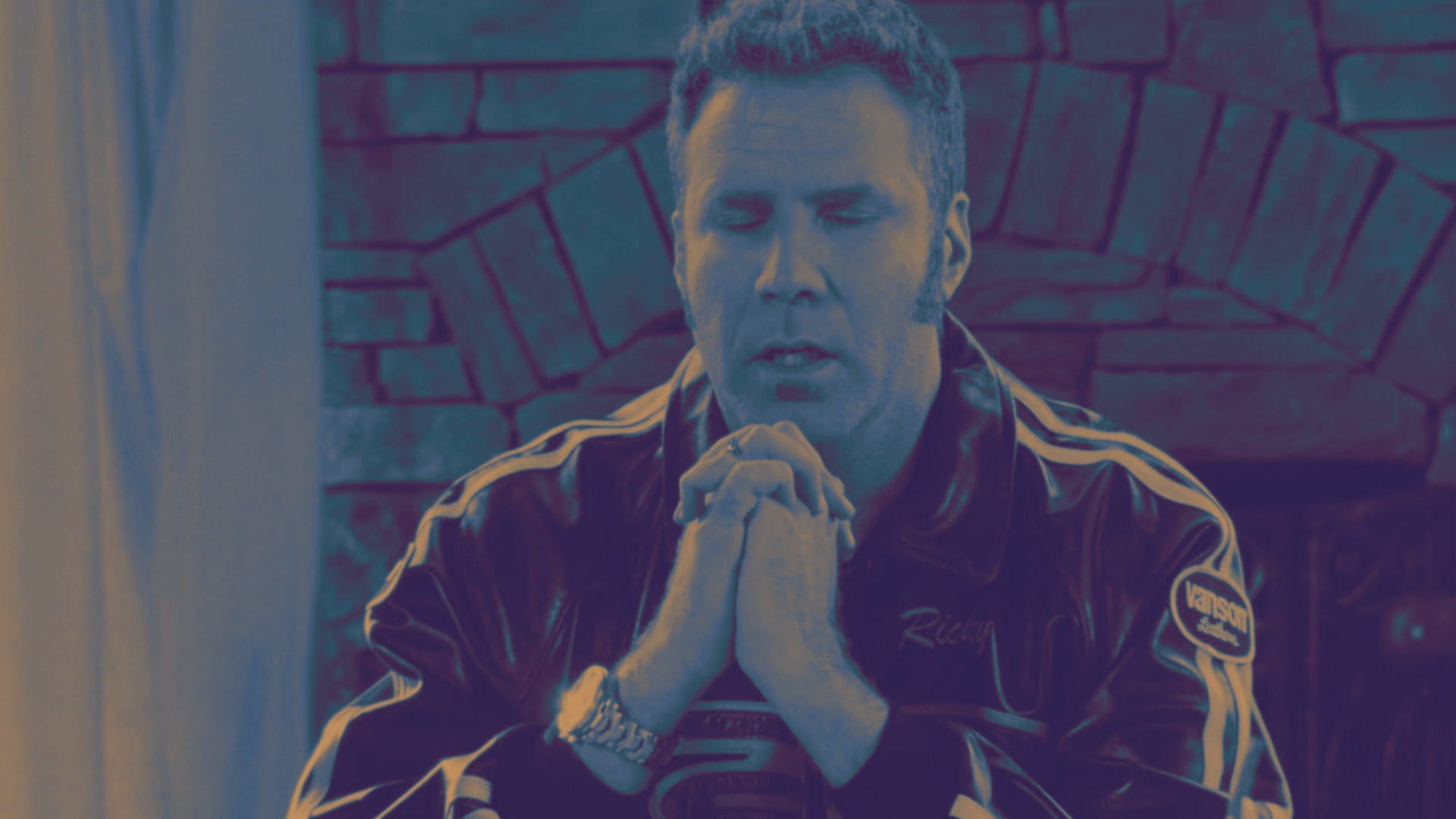
What kind of baby was Baby Jesus? Without digressing into the theological sinkhole that is Rick Bobby’s prayer to “tiny, infant Jesus” in Talladega Nights (who just so happens to be his favorite Jesus), have you ever really considered the infantile humanity of Christ? We do so, collectively, whenever the calendar flips to the holiday season, kicking into high gear songs, thoughts, and images centered around the “Christmas Jesus,” who entered into this world like any other baby, through a birth canal.
I don’t mean to speak so flippantly or cavalierly, but the prayer scene from Talladega Nights (which I won’t link to, to spare you the coarse language) is, in many ways, a comedically heightened version of a long-standing debate. There are some who’d prefer you not pray to Dear Lord Baby Jesus, since that seems too reductive of his majesty, identity, and authority as the risen Son of God. Others swing the pendulum to the opposite emphasis, prioritizing his humanness to such a degree that it leaves one with the impression that his goodness was the result of him tapping into the secret of divinity.
Both ends of that spectrum are blind alleys. And though I don’t wish to turn this into an academic essay surveying the devious Christological diminutions of Nestorianism, Eutychianism, and Apollinarianism, and the like, which precipitated the Council of Chalcedon in 451 A.D., especially since I’ve already done that, whenever Jesus’s incarnation is re-scrutinized and/or reinterepreted, a cavalcade of gross diversions rears their ugly heads. Modern revisions to understanding the historical Jesus or the true Jesus are little more than fresh remixes of worn-out heresies that amount to incendiaries that unsettle aspiring disciples as they strive to follow hard after God (Ps. 63:8 KJV). “To dichotomize either God from Christ or Christ from us,” John C. Clark and Marcus Peter Johnson write, “is to rip God’s saving acts and benefits from their ontological mooring in the humanity of our Savior, stripping the incarnation of its tremendous soteriological, mediatorial significance.”1 Put more succinctly, the slightest revision to the incarnation ruins the whole thing.
And there’s the rub. Deconstructing the mystery of the second person of the Trinity assuming the corporeal realm cripples the marvel of it all. Whether motivated by sentimentality or systematics, parsing the incarnation only serves to reveal that we’re all wannabe mathematicians at heart. The common Christological adage that Jesus is simultaneously one-hundred percent human and one-hundred percent divine ruptures the algebraic logic by which we make sense of the world. We’re incentivized to discern the math at work behind the scenes, to tinker with the integers of the incarnation in hopes of arriving at the right interpretive equation. But the mystery of the Word become flesh isn’t so tidily calculated. There are no neat formulas or fractions by which to decipher its resonance. And yet, the annual inquiry of “What kind of baby was Baby Jesus?” emerges out of a metastasized fascination with siphoning Christ’s “self-emptying” (Phil. 2:7) into statistical cubbies.
The aspiration to peer behind the mystery is noble, to be sure. Who wouldn’t want to solve the enigma of the one who spoke galaxies into existence, having to have his diaper changed and get burped on Mary’s shoulder? How does that even work? The fact is, though, the incarnation isn’t a puzzle that beckons cryptologists to assemble. Rather, it’s the mystery that bids shepherds and sinners to behold their infinite infant King and Savior. There in the cherubic likeness of a swaddled newborn is found the Reconciler of all things. As such, Christ’s assumption of human flesh doesn’t conform to the categories of our intellectual capacity, no matter how intricately or even theologically we define them. Rupturing such notions is the bare “mystery of godliness” that the eternal Son “was manifested in the flesh” (1 Tim. 3:16). Eschewing our terribly inaccurate equations, then, we conclude with the church fathers that what wasn’t assumed cannot be healed. The arithmetic might remain out of reach, but grace abounds in the glad tidings that a brother like us has been born for us (Heb. 2:14–17), who himself is able to send all of death and hell to flight.
This is why Ricky Bobby’s iconic dinner supplication has become a holiday tradition all on its own. His vested interest in the “eight-pound, six-ounce newborn infant Jesus” may seem like the convergence of comedy, modernity, and anthropology. His preference for this Jesus (against the others) mirrors our inclination to preserve a version of Jesus that suits us — a cuddly, approachable Jesus that we can stoop down to embrace if we so choose. We’d rather have the manger detached from all that business about the Messiah who must suffer for the sake of bedraggled humanity and on the third day rise from the dead. But the Word become flesh refuses to be so neatly partitioned. The incarnation is a supernatural wonder that exceeds the laws of metaphysics, let alone space and time, imbuing us with an ever-deepening awe that draws us further up and further in, where the spectacle of Good Friday and Easter Sunday actually sets sinners free. Instead of an exhibition of an angelic god or some deified man, the cross is the apotheosis of the God-Man whose condescending compassion drew him from heaven to this mortal frame. Garbed in the same frail flesh as us, he, the Crucified God, effects our redemption.
Discerning the composition of the Word become flesh has frustrated saints from Bethlehem to Nicaea to Chalcedon to Talladega. You or I likely won’t fare much better than our forebears in articulating what has always been beyond us. “The incarnation,” Clark and Johnson conclude, “is a divine invasion of the organic structure and stream of human heredity, wherein God the Son attacks sin in its concrete reality by penetrating the depths of our actual fallen human existence, cleansing our corruption at its root and eradicating our estrangement from God in his very person.”2 And yet, Ricky Bobby’s prayer gets closer to the truth than perhaps even he knew. The “eight-pound, six-ounce newborn infant Jesus, don’t even know a word yet, just a little infant and so cuddly,” is, nevertheless, “still omnipotent.” Therein is the mystery, the unforeseen quotient that comes out of nowhere, illuminating the yawning caverns of our souls with the light of grace. Thus, the only fitting answer to “What kind of baby was Baby Jesus?” is to join the choir of shepherds and sinners who confess that the one post-partum Mary held in her arms holds onto them, now and forever.
John C. Clark and Marcus Peter Johnson, The Incarnation of God: The Mystery of the Gospel as the Foundation of Evangelical Theology (Wheaton, IL: Crossway, 2015), 112.
Clark and Johnson, 113.
Thanks for sharing the necessary Word with such clarity. Reading your book on our family vacation to warmer weather. Blessings to you and your family.