



Although it’s somewhat of a pastoral trope to suggest that each Sunday’s sermon text is among the most important to know and understand, I do reckon Paul’s Christological rhapsody in Philippians 2 to be one of the most crucial portions of Scripture, both theologically and ecclesiologically. Paul’s letter to the church at Philippi is unique for a number of reasons, not the least of which is that it largely lacks the doctrinal invectives that appear in letters such as those to the Corinthians or the Galatians. The bulk of Philippians is positive rather than polemical, additive instead of argumentative. Apart from the calling out of two ladies in Chapter 4, Paul’s writing is favorable to the Philippian believers.
The apparent disunity of Syntyche and Euodia did pose a threat to the ministry of the church, though, which is why the apostle was apt to mention disagreeable parties by name in a public letter that was likely read and shared among other church bodies as well. This wasn’t to bring undue shame on the individuals in question. Rather, it was to emphasize the gravity of disunity if left to fester. Like gangrene, it gets worse as it’s left alone and not dealt with. But instead of merely calling it out and urging better behavior, Paul offers a more profound understanding of unity and the humility that fuels it by pointing the church to the one who epitomized both, the Christ of God.
So if there is any encouragement in Christ, any comfort from love, any participation in the Spirit, any affection and sympathy, complete my joy by being of the same mind, having the same love, being in full accord and of one mind. Do nothing from selfish ambition or conceit, but in humility count others more significant than yourselves. Let each of you look not only to his own interests, but also to the interests of others. Have this mind among yourselves, which is yours in Christ Jesus, who, though he was in the form of God, did not count equality with God a thing to be grasped, but emptied himself, by taking the form of a servant, being born in the likeness of men. And being found in human form, he humbled himself by becoming obedient to the point of death, even death on a cross. Therefore God has highly exalted him and bestowed on him the name that is above every name, so that at the name of Jesus every knee should bow, in heaven and on earth and under the earth, and every tongue confess that Jesus Christ is Lord, to the glory of God the Father. (Phil. 2:1–11)
The Christo-centric hymn of Philippians 2 is, we might say, the aspirational end of faith. After conveying what it looks like for sinner-saints to participate in the Spirit together, Paul proceeds to show what sustains that participation, even when such obstacles as “selfish ambition or conceit” threaten to undo the comfort and love enjoyed by the koinōnia itself. The church’s sustenance is the word of the gospel, which expresses the mind of Christ, dissolving self-interest and fostering deference. And although it might be tempting, pastors and theologians undersell Paul’s objective when they approach this text merely as a model of humility.
Yes, unity and humility are exemplified by what Paul articulates. But more pointedly, this entire anthem announces what’s given when the Word is preached. “Have this mind among yourselves,” he writes, “which is yours in Christ Jesus” (Phil. 2:5). It isn’t merely an objective to pursue; it’s a gift that’s yours already, by faith. The natural inclination to consider oneself more significant than others isn’t remedied through mere training or self-discipline. More often than not, regimented sanctification breeds a righteousness of one’s own, which Paul considers to be on the same level as refuse (Phil. 3:8–9).
What’s ultimately needed, therefore, is a righteousness that comes from God and depends on faith. In other words, the church needs the gospel, which is precisely what Paul gives them, even as he enlarges the church’s understanding of what was involved to make the gospel possible. This leads the apostle to consider Christ’s self-emptying, or what theologians now refer to as the kenosis.1 Who knows how much ink has been spilled communicating how to properly understand what is meant when Paul says that Christ “emptied himself”? From the earliest ecclesiastical period, though, the nature of God’s Son has been the subject of debate, criticism, and censure, which, ironically enough, is the exact opposite of Paul’s letter.
I dare not presume to think that this discussion can be resolved through a pastoral reflection published on Substack. However, it’s crucial for the church to treasure its Christology and treat the Word’s revelation of the Word become flesh among the most vital and vivifying. This means eagerly asking and answering Jesus’s question, “Whom do you say that I am?” (Matt. 16:15). “Is he really God’s Son,” R. C. H. Lenski inquires, “or only partly God’s Son or only a man and not even partly God’s Son?”2 While this might seem esoteric or devoid of Paul’s point, this isn’t merely debate fodder for seminarians and scholars; it’s indispensable for the life of faith. Lenski says it like this:
This is not a squabble among theologians; this is an issue involving the life or the death of every Christian’s faith in his Savior. Centered on the humiliation of Christ, it automatically involves the whole saving work of Jesus wrought out here on earth and equally his exaltation. To state it in brief, the whole Christian faith is the real issue.3
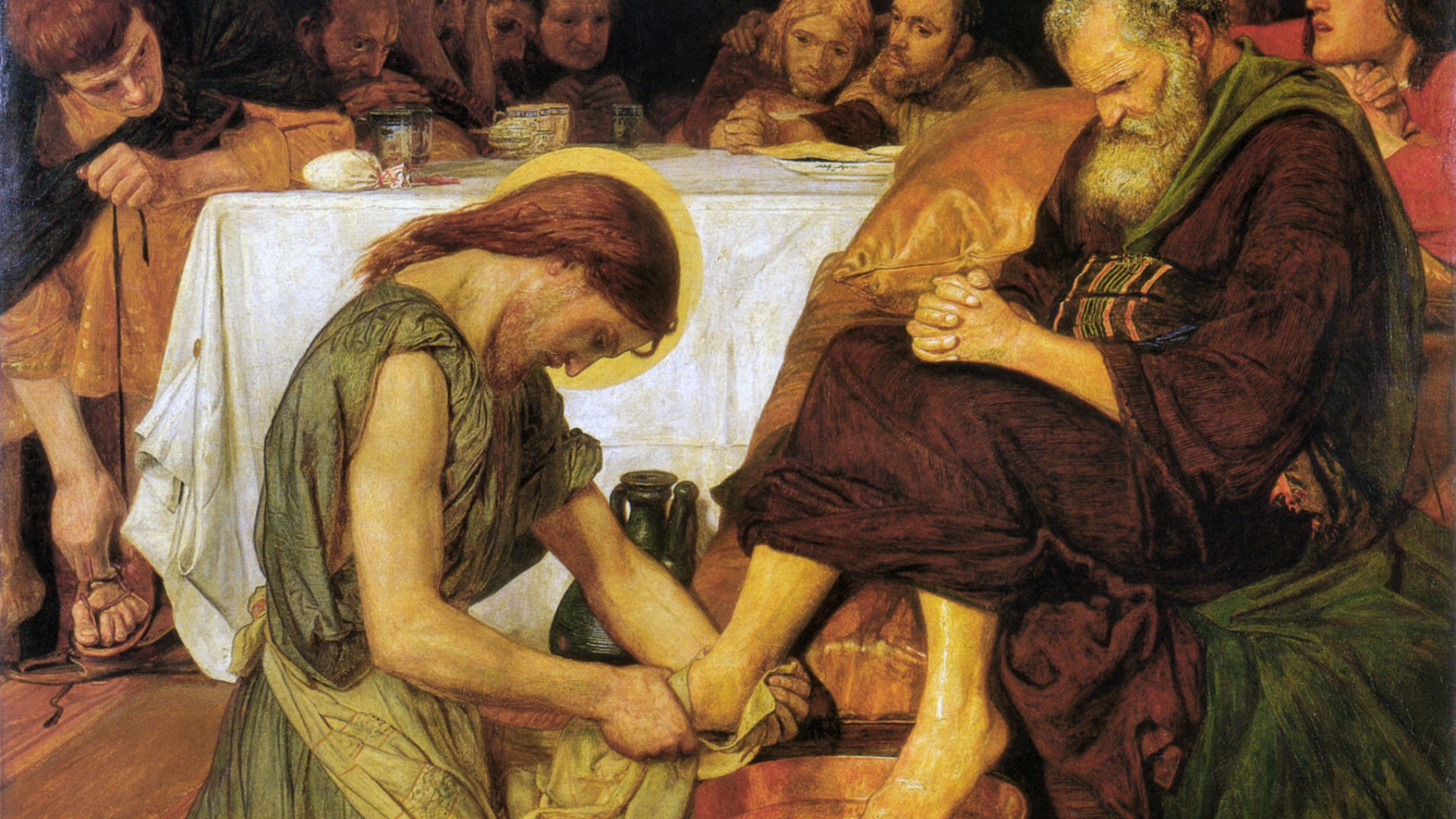
In other words, the issue at hand — unity in the local church — isn’t merely solved by petitioning church members to lay down their arms and quit being so self-interested; it’s resolved by the one who voluntarily went to the cross both as the world’s reconciliatory substitute and the embodiment of deferential love and humility. Far from an unfortunate end to a life taken too quickly, the cross was the God-man’s willing self-abasement. “He did this himself to himself,” Lenski notes. “Thus all was voluntary, prompted by his own infinite love.”4 And, of note, this isn’t creaturely or angelic love that’s on display, but the love of God. Lenski continues:
He who was the Son of God, equal with God, he who communicated his divine attributes to his human nature so that all the Godhead dwelt in him bodily (Col. 2:9), he died, died hanging on a post of wood, died as one accursed, hanging on wood, the mark of being accursed. Of his own volition. Hence this is the most noble act the world has ever seen; hence it is full of infinite merit, all this is to be bestowed upon us. This is the mystery of the gospel, into which even the angels of God delight to look. This is the historic gospel fact which the gospel attests and publishes in all the world. This is the fact that saves to the uttermost all those who embrace it in confidence and rest their very soul upon it.5

Intimately intertwined within Paul’s admonition for those strong-willed women and the Philippian church writ large to embrace humility and unity is a Christological confession that latches onto the deity of the Son. “A Jesus who is devoid of one attribute of deity,” Lenski says, “is no more the Son of God than a Jesus who had only one nature while he lived on earth, was not at all the logos, was only Joseph’s natural son.”6 If Jesus were only the latter, then the church would gather in vain, and its members could go on living lives of crass self-interest. But as it is, and as we confess, the Son “emptied himself,” not by losing one whit of his deity, but by taking on the garb of humility itself in the “form of a servant” who willingly dies for those he loves.
Long before Nicaea’s or Chalcedon’s first draft, the apostle Paul perceived what was at stake if the church tinkers with Christ’s identity. Namely, everything. But pointedly, and in Euodia and Syntyche’s case, the unity that enlivens, enriches, and allows ministry to not just endure, but to thrive. Thus, the kenosis isn’t just a doctrine the church is called to defend; it’s the word that empties us of ourselves and binds us to each other by giving us the Christ of God who gave us everything.
Grace and peace.
By “self-emptying,” I don’t mean that Christ gave up his deity, but that it was “veiled.” See John M. G. Barclay’s essay, “Kenosis and the Drama of Salvation in Philippians 2” in Kenosis: The Self-Emptying of Christ in Scripture and Theology, edited by Paul T. Nimmo and Keith L. Johnson (Grand Rapids: Eerdmans, 2022).
R. C. H. Lenski, The Interpretation of St. Paul’s Epistles to the Galatians, to the Ephesians, and to the Philippians (Minneapolis, MN: Augsburg, 1961), 772.
Lenski, 772.
Lenski, 784.
Lenski, 785–86.
Lenski, 773.