



I recently preached two sermons on the same trio of chapters from the Book of Exodus.1 Chapters 11, 12, and 13 are, of course, a rich reservoir for theological reflection, what with God’s most overt sermon concerning Christ being acted out among his people. Waxing eloquent on the scenes of the first Passover is nothing new, but what struck me through my studies on these chapters is the repeated refrain of “the blood,” which occurs six times in Chapter 12 alone (Exod. 12:7, 13, 22–23). That blood would feature in a divine ritual sacrifice should come as no surprise; however, the emphasis on the saving vitality of the blood is teeming with good news, even for us New Testament Christians. Then, as now, we are constrained to confess that it is blood alone that has, as J. Alec Motyer says, “the astonishing power to solve the problem of acceptance before God.”2 Nothing else even remotely comes close to the atoning sufficiency of the blood of the lamb, which was manifest in Moses’s day and in Paul’s, as much as it is in ours.
It’s not the most popular sentiment, but there’s no avoiding the fact that Christianity is a bloody religion. Even as the Levitical rites and laws are further codified, one would be hard-pressed to find as much stress put on the life-source of a living creature anywhere else. The Passover was a meal, yes, but one that was always prefaced with the ritual daubing of blood on doorposts. “The blood that was smeared around the doors of the Israelite houses,” Motyer continues, “was a visible token that a life had been laid down in that place. Entering and remaining behind that door signified the personal appropriation by faith of all that the shed blood meant and had accomplished.”3 What was protecting and preserving every participant had nothing to do with them. Although they were bound to follow the ceremony as prescribed to a “T,” no one in their right mind would’ve put any ounce of saving efficacy in one’s ceremonial obedience. The lamb’s roasted carcass would certainly make sure of that, but so, too, would the blood. As John Cumming once said, “Our safety rests, not upon the strength of our confidence within, but the efficacy of the shed blood of the Lamb slain, that is without.”4
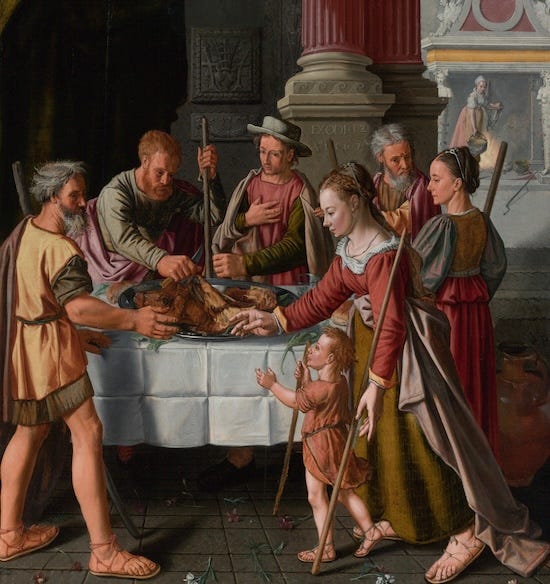

I think about the smells that must’ve accompanied this meal. The aroma of a lamb roasting over an open fire with bitter herbs and unleavened bread baking in the oven surely had a particular scent. The same could be said, though, about the viscera that the head of each household would let flow from the innocent, unblemished lamb. As gory as that scene surely was, a divine statement was being made, gesturing to the locus of reconciliation between the sinner and his Creator. From everyone seated at the table on the first Passover night to the young lad centuries later who watched as his grandfather rehearsed its every movement, the same truth was on display — namely, that the blood is an effectual cleansing for everyone. Period. “There is no case,” Charles Spurgeon once proclaimed in a sermon from 1858, “which the blood of Christ cannot meet; there is no sin which it cannot wash away.” Motyer agrees, writing, “Even the seemingly most hazardous situation still finds those who have sheltered under the blood of the lamb safe in the Lord’s care, and moving according to his predetermined plan.”5
This, in and of itself, is another example of the prophetic undercurrent of Exodus 12. Along with the obvious parallels between the Passover lamb and John the Baptist’s Lamb of God, the blood of both was that from which God’s people derive their hope, meaning, and salvation. Of course, the original lamb, along with every subsequent sacrificial main course, was only able to typify the redemptive work that God in Christ came to accomplish. After all, the blood of “Christ, our Passover,” is that which actually, fully, and finally cleanses sinners from all the sins that cling to their very souls (Heb. 10:11–14; 1 John 1:7). This is where the first Passover and the true and better Passover, which is Christ, diverge, since “Christ, our Passover,” puts an end to the bloodshed by having his own blood shed for all who would believe. The blood-letting of the lamb had to be repeated, year after year, as did the plastering of blood on the door frames. But, as the gospel tells us, the blood of the Lamb of God was splattered on a cruciform frame “once for all,” never again needed to be repeated. Motyer puts a fine point on this when he writes:
At Calvary, by ‘the sacrifice of the body of Jesus Christ once for all’, everything that God required to be done, and we sinners needed to have done on our behalf, was accomplished, and accomplished so finally, fully, and effectively that the sins of those for whom he died are not even remembered in heaven (Heb. 10:10-18). No further sacrifice for sins is possible (Heb. 10:18). Such a work of salvation needs no repetition and requires no re-presentation. It cannot be amplified; it can only be remembered.6
And remember it, the church does through the Word and the Sacraments. We aren’t made to remember by recapitulating a bloody sacrifice; we’re made to remember by hearing, tasting, and receiving the words of grace and promise that motion to a bloody Savior, whose marred and mutilated form now sits enthroned in the heavens as both Lord and Christ. And, remarkably, it is the blood of the King that will be our anthem throughout the ages, even in glory (Rev. 5:9–12). What John the Baptist did is what the church will do forever: exalting the Lamb of God who was slain to accomplish our salvation. “The precious blood of Jesus,” Michael P. V. Barrett says, “shed in His sacrificial death appeases the wrath of God, quenches the fire of judgment, and washes away the guilt of sin.”7 All those ceremonies and sacrifices converge in Christ, the one who bleeds that we might be redeemed.
Grace and peace to you, my friends.
J. Alec Motyer, The Message of Exodus: The Days of Our Pilgrimage, Revised Edition, The Bible Speaks Today (Downers Grove, IL: InterVarsity Press, 2021), 121.
Motyer, 126.
John Cumming, Christ Our Passover, or, Thoughts on the Atonement (London: Arthur Hall, Virtue & Co., 1854), 18.
Motyer, 128.
Motyer, 139.
Michael P. V. Barrett, The Gospel of Exodus: Misery, Deliverance, Gratitude (Grand Rapids, MI: Reformation Heritage Books, 2020), 114.