


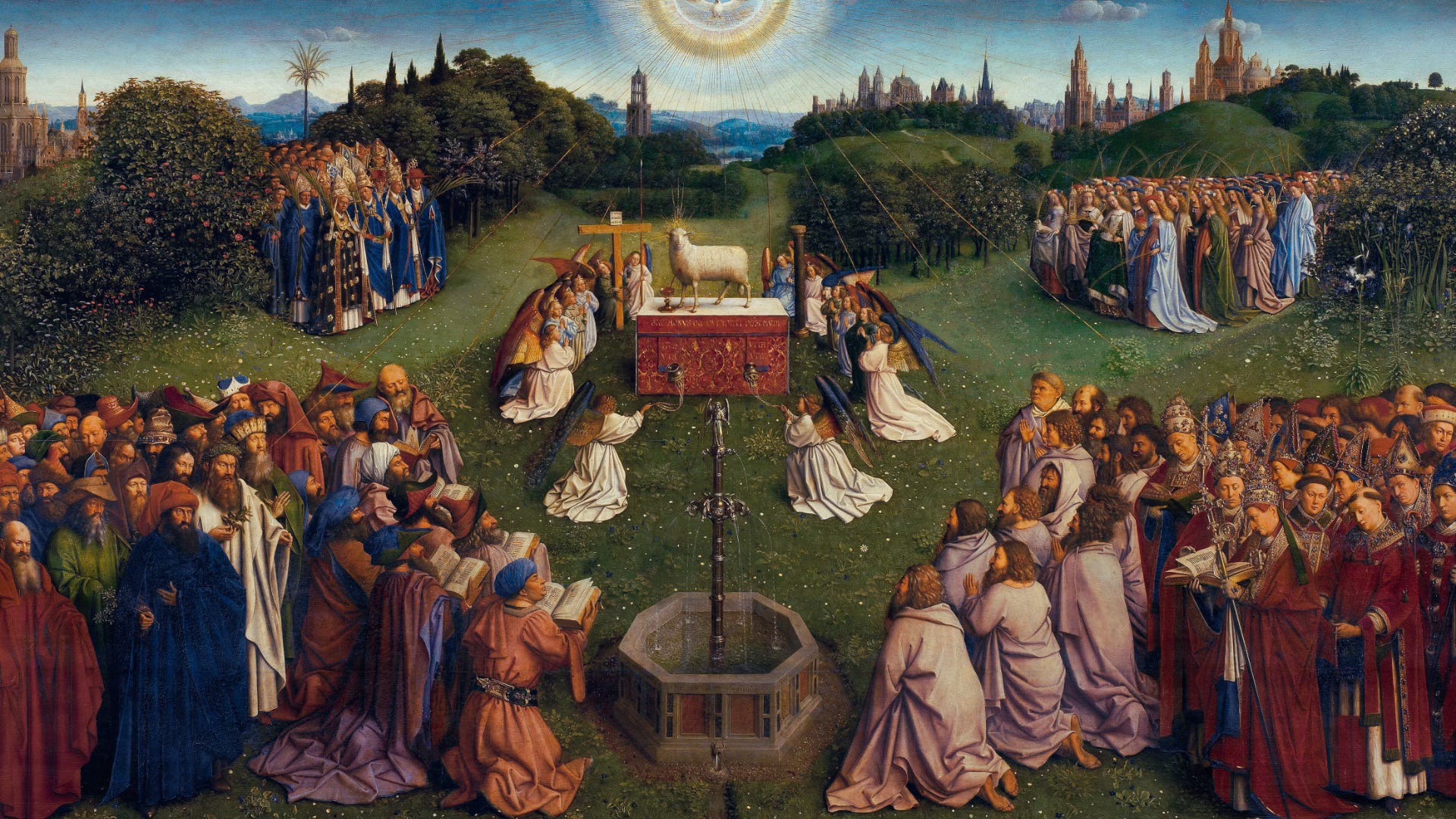
There’s not enough space in this newsletter to capture all the ways that Exodus 12 preaches the gospel to us. Despite how primeval the scenes of the first Passover sound, there’s a timelessness to its essential substance that fixes our gaze on the Lamb that was slain from before the foundation of the world (Rev. 13:8). This isn’t a matter of hermeneutical gymnastics or homiletical buoyancy. From the apostle whom Jesus loved to the apostle of grace himself, the announcement of the gospel can be condensed to “Christ, our passover” without any of its reconciliatory content getting lost in translation. Similar to what Paul says concerning Abraham, who had the gospel preached to him “beforehand” through the Lord’s word of promise (Gal. 3:8), that first Passover dispensed the good news to young and old alike, gesturing to the only means by which sinners are restored to their Creator — namely, by blood (Heb. 9:22; 12:24).
This, of course, serves as the religious scaffolding upon which the identity of God’s people is built, notwithstanding the moment or era in which they live. “Nothing but the blood” isn’t merely a quaint old hymn from the church’s bygone days; it’s the evergreen anthem that encompasses the song of the redeemed. “The Jew learned,” John Cumming (1807—1881) once wrote, “through the sprinkling of the blood of the Lamb that was slain in the midst of Egypt, that without shedding of blood there is no remission of sins, and was taught to anticipate therein that perfect Sacrifice that was to be made in the fulness of the times.”1 Ever since, those who belong to the Lord have been imbued with the hope of everlasting redemption through the outpouring of blood on their behalf. These glad tidings stretch from Egypt down through the ages to today, relieving and reconciling bedraggled sinners to God.
Integral to this announcement of the gospel is the objectivity of the sinner’s hope. In other words, the proclamation of the saving work of Jesus Christ is tendered to sinners far and wide, notwithstanding the quantity or quality of their sins. No matter the mass of burdens and failures one might accumulate, the gospel of God is sufficient to pardon and save. The level of one’s ungodliness isn’t taken into account when the good news that God through Christ “justifies the ungodly” is given to them (Rom. 4:5). And the same was true for those Israelites who had been subjugated to Egyptian tyranny for four centuries. Despite their idolatry and iniquity (Ezek. 20:7–8), relief was offered to them via the blood of the Passover lamb. Cumming goes on to put it like this:
Our safety from the destroying angel, whatever he may be, is not our loyalty, however beautiful; our morality, however pure; our patriotism, however sincere; our conduct, however exemplary. I am not asserting that these things are worthless, or have no place; I am only showing that they do not belong to the place of our justification in the sight of God. I do not say that men are saved without holiness, but I do assert that men are not saved by or on the ground of their holiness. If Christ our passover, it is not what we are in ourselves, but the fact that his atoning blood has been sprinkled on the lintels of the heart, that will constitute our great exemption in the hour of death and in the day of judgment. No inner excellency that we have is our merit; no sacramental rite or ecclesiastical ceremony is the ground of our exemption; there is saving and atoning efficacy only in one element, the blood that was shed on the cross for the salvation of the guilty. It is not carnal, but a spiritual element. It is not touched by sense, but taken by faith. It is not something that we see, but something that we lean on. It is not an earthly element that the human senses may take cognisance of, but a divine fact, the efficacy of which extends through all ages. Here, then, is the ground of our pardon, or our exemption in the sight of God, namely, the Atonement, to vary the phraseology, or the death, or expiatory Sacrifice of the Son of God . . . We see in Christ our passover an atonement for us. He, the innocent One, bore the load and pressure of my guilt; He, the holy One, was clad in my unholy robes; He took my cup, and rank it; He met my curse, and exhausted it; and I am free from the curse of a broken law, because He bore it; and I am entitled to all the blessings of a kept law, because He magnified it, and made it honourable for me.2
Here again, the gospel is dispensed to desperate sinners in the midst of their desperation. Without any regard for the caliber of our ability to believe, the gospel saves, and saves to the uttermost (Heb. 7:25). We aren’t beckoned to conjure the right amount of faith or fortitude before the redeeming vitality of the word of grace can be experienced. Rather, the potency of God’s redemption is bound to the word of his gospel, which redeems even the weakest and feeblest faith. “Our salvation,” Cumming concludes, “is not contingent upon the strength of our faith, but upon the perfection of the Atonement on which that faith leans.”3 Our hope of salvation lies entirely outside of ourselves, in the bloody work of the Crucified One, who forever stands as though slain, gesturing to the wounds wherein our reconciliation is found.
Grace and peace.
John Cumming, Christ Our Passover, or, Thoughts on the Atonement (London: Arthur Hall, Virtue & Co., 1854), 2.
Cumming, 5–6, 9.
Cumming, 10.
I agree with Raju. This is a beautiful reminder. Thank God for all of your writings, Facebook post, quotes that point us away from ourselves and to Jesus Christ’ finished work for us
What a beautiful reminder of the power of the Lamb of God and the hope we have through His blood. Reading this fills my heart with gratitude because it points us back to the truth that our salvation never depended on our goodness but entirely on the sacrifice of Christ our Passover. The Bible says Christ our Passover Lamb has been sacrificed for us 1 Corinthians 5:7. From Exodus to the cross God has been showing us that redemption comes only through the blood. Hebrews reminds us that without the shedding of blood there is no forgiveness Hebrews 9:22 and that Jesus speaks a better word through His blood Hebrews 12:24. What comforts me most is knowing that He saves completely all who come to Him because He lives forever to intercede for them Hebrews 7:25. Our hope is not in the strength of our faith but in the perfection of His sacrifice. Just like the Israelites were sheltered by the blood on their doorposts we too are covered by the blood of the Lamb who takes away the sin of the world John 1:29.
What amazes me is that this same Lamb who was slain is the One who now reigns forever and calls us His own. Revelation says the Lamb is in the center of the throne and He will shepherd us and lead us to living fountains of waters Revelation 7:17. When we feel weak tired or unworthy His blood reminds us that we are accepted redeemed and made new. It is His finished work that gives us the boldness to draw near to God with full assurance of faith Hebrews 10:22. The gospel truly is good news for the broken for the weary and for those who know they cannot save themselves.
Grace and peace to you brother. May the truth of His sacrifice keep strengthening your heart day by day.And I also wanted to say this with respect I tried to text you so many times sir but it feels like you are ignoring us.