



A feature of modern evangelical marketing that I’m sure you’ve come across at some point is the familiar adage, “Religion says ‘Do,’ grace says ‘Done,’” or something like that. The distinction between “do” and “done” is concise enough and catchy enough to serve as something of a slogan to promote the Christian message. Even though it might feel like a piece of modern novelty, this distinction is much older than you might expect. Although I’m not positive where it originated, I was quite pleased to come across it in a mid-1800s treatise by Scottish theologian and clergyman John Cumming, entitled Christ Our Passover. “Faith,” he says, “is not doing something that is not done, but receiving something already done. The old legal system was, Do, Do, Do, till you reach the requisite amount, and then claim the deserved reward; but the evangelical system is, Believe, Believe, Believe, and thou shalt be saved.”1

You might recall that I interacted with Cumming’s book a few months back, especially his seminal treatment of the first Passover and the ways in which it preaches the gospel of Christ to us. I’ve since finished that book, and I’m pleased to say that the rest of his efforts constitute a splendid apologetic of Christ’s atoning death and the necessity to proclaim that work as the means and method of the church’s salvation. “It is the mark of a true Church that it sets forth Christ and him crucified,” Cumming asserts. He goes on to say that “wherever there is a true Church, it will preach Christ, and this alone will make Christians.”2 I understand that “penal substitutionary atonement” (PSA) hasn’t always been viewed favorably in recent times. I’ve even been put on blast on this very platform for insinuating its biblical precedence. To be frank, though, I don’t pay much attention to those who wish to drill holes in the PSA view, not because I’m a curmudgeon (most of the time), but because one has to excise huge swaths of Scripture to make such a case.
By this, I don’t mean to suggest that PSA is the “only” perspective or version of what went down at the cross. I’m not an atonement theory sectarian; I’m more of a pluralist, you might say. From PSA to Christus Victor to moral governmental, each system for understanding Christ’s work on the cross holds weight, biblically, historically, and theologically. The issue, of course, is always how much weight each view can hold. This is, perhaps, where I’m slightly more rigid, in the sense that I would concur that PSA holds significantly more biblical, historical, and theological weight than all the other theories. This isn’t meant to invalidate them; just prioritize them. With that in mind, Cumming’s words in Christ Our Passover are better received, since the bulk of his project reads as a plea for churches and church leaders to find renewed and unashamed joy in preaching and sharing Jesus’s vicarious death and resurrection for sinners. Cumming puts it this way:
Jesus endured all that we deserved, and paid all that we owed; and that by virtue of the first we are emancipated from the curse of a broken law, and by virtue of the second we are entitled to the reward of a law that we were not able to obey.3
Here, he puts a fine point on his outlook of Christ’s atonement, following what the New Testament conveys regarding Christ’s work in the epistles to the Galatians, Romans, and Hebrews. It’s this work of the Son of God that serves as the church’s primary message, the food on which it feeds and invites other beggarly sinners to partake. There’s nothing more satiating to sinner-saints than the announcement of what Christ has done as their Priest and Representative. Cumming continues:
Jesus became the Great representative Sinner of Christendom, the representative of lost and stray humanity; he took our place, he stood in our shoes, he was arrayed in our responsibilities, and, as humanity gathered up and headed in one, he became the subject of the judgments that all humanity had provoked, and he suffered, the just in the room of the unjust, to bring us to God.4
All of this, of course, brings me to consider yet again the all-important doctrine of imputation, which is intimately related to the substitutionary atonement perspective. I will resist the urge to digress on this point, especially since I did that already in my article for Themelios, “From Logizomai to Luther: The Great Exchange and the Development of the Imputed Righteousness.” But I can’t get over just how crucial understanding imputation is for Christian living. As far as formative doctrines go, I’d say discerning the biblical merits of Christ being made sin for the likes of us so that “we might become the righteousness of God” is up near the top of the list (2 Cor. 5:21). Gone are the pressures to make it on your own. In their stead, there is only relief — the relief of knowing that your identity is rock-solid and steady because of him. The exhaustion of check-list-spirituality and overbearing piety has evaporated. All that’s left is what the Son has done while standing and dying and rising again in our place. Here’s how Cumming expresses it:
Imputed sin was the cause of Christ’s agony; imputed righteousness is the ground of our everlasting joy. The sin that was on Jesus was external to him; the righteousness that is on us is external to us. When Jesus died upon the cross, there was nothing in him worthy of death; when you and I, reader, shall be admitted into glory, there will be found nothing in us worthy of eternal life. He died with sin on him, not in him; we shall be glorified with righteousness upon us, not in us; and just as God smote him because of our sin upon him, God will glorify us because of his righteousness upon us. His was death-deserving sin imputed to him, ours is heaven-deserving righteousness imputed to us. When he suffered for sin, all the shame was ours; when we shall be glorified for righteousness, all the glory will be his. Sin upon him brought him to the cross, righteousness upon us will lift us to heaven and everlasting happiness. God looked at Jesus, and saw my tainted fleece, whilst he shut his eyes to the innocent Lamb that was under it; so God will look at us, and shut his eyes to the stray sheep, and look only at the spotless and glorious righteousness that is upon us. What a perfect and complete prescription is the Gospel of the Son of God!5
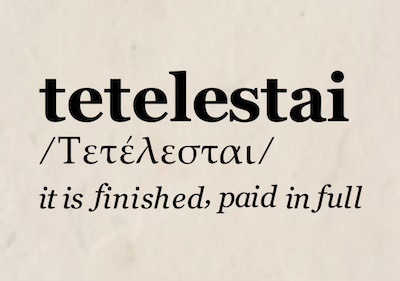
We, the hell-deserving, have heaven-deserving righteousness placed on us like a thermal blanket on a hyperthermia victim. This is no stray holdover of Protestant dogma. This is the biblical motif from Genesis to Revelation. It’s what gives our Christian lives verve and assurance. It’s what clarifies our calling as disciples of God. As we go and preach and make other disciples in Jesus’s name, we do so knowing that the work that releases them from judgment has been finished. Their sins have been imputed to Another. It’s done. There is nothing more to do. Τετέλεσται.
Grace and peace to you, my friends.
John Cumming, Christ Our Passover, or, Thoughts on the Atonement (London: Arthur Hall, Virtue & Co., 1854), 168.
Cumming, 124.
Cumming, 137.
Cumming, 162–63.
Cumming, 163–64.
The do vs. done language dates back at least to Luther's theses for the 1518 Heidelberg Disputation: "The Law says, 'Do this,' and it is never done. Grace says, 'Believe in this,' and everything is already done."
Thankyou!!