



The Colossians were faced with a dilemma, one that threatened to disrupt their entire community. For however long this church had existed, its pastor (likely, Epaphras) had traced Paul’s example by proclaiming “the word of the truth, the gospel” (Col. 1:5). It was precisely this Word of life, power, and promise that had brought about the seismic change in each of their lives. They had been made new through Christ’s death and resurrection (Col. 3:3). And yet, a new chorus of voices began to surface in their midst — a band of “religious referees” and so-called “spiritual experts” began to offer up “another gospel,” one that was augmented by religious performance and spiritual experience (Col. 2:18). Soon, the congregation at Colossae found itself in crisis, or at least on the verge of one. Through the influence of the syncretists, the gospel had become watered down, so much so that the sufficiency of Christ’s cross and empty tomb was in question.
1. When the Gospel Gets Diluted
Paul’s letter to the Colossians is a direct result of the syncretistic teachers and the lie they propagated, which suggested that one needs something in addition to Christ’s work to live full, faithful, godly lives. This, of course, is ludicrous, especially since the all-powerful one who makes redemption possible (Col. 1:14) and the one by whom and through whom all things hold together is the same one who makes peace for all “by the blood of his cross” (Col. 1:17, 20). To suggest that what the Christ of God did is somehow insufficient or incomplete is to discredit Christ’s identity and God’s name in one fell swoop. What’s more, if Christ is who he says he is, then questioning what his cross achieved is not only senseless, it’s damaging both to your faith and the faith of others.
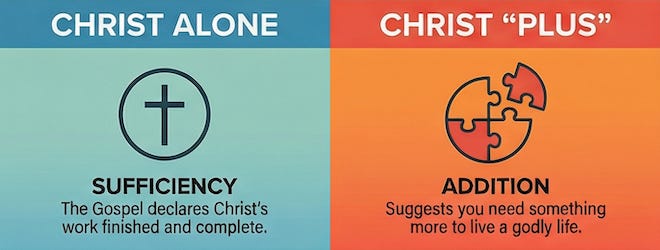
Contrary to the so-called gospel of syncretism, the true gospel of God gives us everything we need. Indeed, the gospel is the gospel precisely because it gives us Christ himself. It is “his divine power” that grants to us “all things that pertain to life and godliness” (2 Pet. 1:3). He is the one who died and rose again so that we might be made alive with him. He assumes your sin as his own and pays for it in full (Col. 2:14). Nothing’s left undone or unfinished. In him, all is forgiven and made right. Through nothing but the unmerited favor of Christ alone, our old selves are dead and buried, and our new selves are raised up with him. “In regeneration,” declares R. C. H. Lenski, “we put on the new man, we receive the new, spiritual life.”1
2. The Overflow of Gratitude
As Chapter 1 of Paul’s letter shows us, the more one recognizes the infinite depth of the gospel of grace, the more one’s life will be one of overflowing gratitude (Col. 1:12). This theme pops up again when the apostle explains what the new life in Christ looks like. “Whatever you do,” he writes, “in word or deed, do everything in the name of the Lord Jesus, giving thanks to God the Father through him” (Col. 3:17). The most telling trademark of those who belong to Jesus is gratitude for what he has done and given to them. To be grateful, of course, means you were the recipient of some form of unsolicited generosity. Something was done for you or given to you that you didn’t earn or do anything to deserve. Paul, without qualification, lets the Colossians know where this gratitude comes from by bookending his exhortation to thanksgiving with the offering of the word of Christ, which takes up abundant residence in the souls of those whom he redeems:
Let the peace of Christ rule in your hearts, to which indeed you were called in one body. And be thankful. Let the word of Christ dwell in you richly, teaching and admonishing one another in all wisdom, singing psalms and hymns and spiritual songs, with thankfulness in your hearts to God. And whatever you do, in word or deed, do everything in the name of the Lord Jesus, giving thanks to God the Father through him. (Col. 3:15–17)

This isn’t merely an admonition for what we do, say, and sing in the church; this is true for everyone everywhere. The more we’re inhabited by the Word, the more we’ll be brimming with thankfulness for God’s unmerited favor. As we are filled with grace, our lives will be overflowing with gratitude, which joyfully spills out onto the lives of others. “The whole activity of this Christian life,” Lenski asserts, “moves in the sphere of the name and revelation of the Lord Jesus, and they are filled with thanksgiving to God through him.”2 The new life in Christ is best understood by imagining an empty glass under a running faucet, where what was bone dry quickly surges with more than enough. The same is true for sinners who repent and believe in Christ’s work for them. Faith in Jesus is like being situated under a faucet that is continually gushing with “grace upon grace” (John 1:16).
3. The Word That Fills Us
Paul leaves no nooks or crannies untouched by this gospel of grace. Everything one says, thinks, or does ought to be filtered through the gratitude-generating announcement of grace. This flies in the face of what the syncretists were promoting, with their creeds and doctrines suggesting that the best and truest experience of the Christian life was lived only as you followed certain guidelines. All this did, though, was lead folks to believe that what Christ did wasn’t enough. The result of this kind of rhetoric doesn’t make for more grateful disciples. Actually, it was making them more restless since they were being led to believe that there was still a bit of truth they needed to discover and discern before they could be made whole. It was this exact assumption that Paul enthusiastically denied throughout his letter, as he showed the Colossians that the word of Christ is all they need. It’s his word that makes them whole, fills them up, and makes them complete (Col. 2:9–10).
Accordingly, with this Word as our foundation, all our relationships begin to take a new shape, one that’s contoured to grace (Col. 3:12–15). Through the free and infinite gift of the one who was crucified and risen for us, God in Christ makes us into a new community, rooted in the Word and filled with the Holy Spirit, which galvanizes us to be more deferential with those around us. Since grace frees us to give the benefit of the doubt, we’re able to treat others with compassion, kindness, and patience. Since Christ has assumed every sin as his own, we don’t have to go around seeking our own form of justice and recompense. Instead, we are free to “bear with one another,” even going so far as to forgive those who wrong us, because we are freely forgiven in Christ (Col. 3:13).
4. Grace-Shaped Unity
This new Christian community doesn’t have to refrain from “putting on love,” even when maligned or mistreated, because God in Christ is our peace, having made peace for us by the “blood of his cross” (Col. 1:20). And the same peace that the Lord Jesus made for us is that which he gives to “rule in our hearts” (Col. 3:15). “Let the Judaizers shout that the Colossians lack Christian completeness and dare not be accorded the prize,” Lenski comments. “The Colossians are to listen to Christ’s own peace speaking in their own hearts.”3 In contradistinction to the syncretistic teachers who saw themselves as the referees of religious experience, Paul maintains that there’s a true and better ruler stemming from the word and work of Christ. This new standard isn’t one of pietistic competition or spiritual performance. Rather, it’s downstream of the justifying and peace-making self-sacrifice of Jesus, whose blood is powerful enough and sufficient enough to bring everyone into “perfect harmony” (Col. 3:14).

The church, therefore, is (supposed to be) a mirror image of God’s kingdom, where all the old barriers that divide us are decimated (Col. 3:11). When churches get out of whack over schisms that threaten to split the whole body, you can be sure that either the gospel has been sidelined or its members are clawing for credit. Friction and tension arise when the completeness of the good news of Christ’s death and resurrection is forgotten. If I forget that everything I need in Christ I have, then I’ll be prone to demand from others what only Christ can give. This is when molehills get turned into mountains and preferences get baptized as dogma. Although we won’t always agree on all things, all the time, those disagreements don’t have to divide us. The same cross and empty tomb by which you are qualified is my qualification, too, just as it is true for those across the political and denominational aisle. This kind of unity is cultivated the more we “seek the things above, where Christ is” (Col. 3:1).
5. The Gospel at Home
This is not only true in the church but also at home. Every relational dynamic — those of husbands and wives and parents and children — is fundamentally altered by God’s good news (Col. 3:18–21). These Pauline “family dynamics” have come under fire in recent years, with the apostle’s words to wives not exactly earning him any popularity contests. Frankly, pastors haven’t always done a good job of communicating what’s meant by “submit” (hupotassō). This isn’t an apologetic for the patriarchy, nor is it a call for unquestioned surrender, all of which has led to one too many imploded marriages. It’s critical that this exhortation is understood in its context, in light of the Spirit’s work in us to renew us “after the image of [our] creator” (Col. 3:10). Paul’s vision of the “renewed family” sees every member delighting in Christ’s unmerited favor, freeing them to delight in who they get to spend life with.
The relational dynamics between husbands and wives — and parents and children — are a picture of grace, a reflection of the gospel. Instead of operating transactionally (“I’ll do this when and if you do that”),4 families become saturated in grace and gratitude. Wives, then, are free to yield to their husbands out of respect for them, knowing they aren’t bowing to a tyrant but mirroring the church’s faithful yielding to Christ the Lord. Likewise, husbands are free to embody the love of the cross, which doesn’t seek its own benefit but dies for the sake of others. It’s not a love of sentiment but of service — the kind of love that gives and gives, and delights in doing so. It’s a love that seeks to imitate, however imperfectly, the gentle and lowly love that’s encapsulated in the incarnation itself. “The rule of Christ,” notes R. C. Lucas, “demands that a man serve his wife as the evidence that he is serving Christ.”5 Children aren’t excluded either, as they are given a calling to trust and obey their parents, knowing that their trust and obedience are ultimately for the Lord (Col. 3:20).
6. Living from Christ’s Fullness
The whole thing — marriage, parenting, the home — is meant to be a living parable of the gospel, a daily reenactment of Christ and his church, characterized by willing self-surrendering. The animating force isn’t reciprocity, effort, conditions, or grit, but pure grace. Paul extends this into places of work, as he applies this to employees and employers (Col. 3:22—4:1). Because the gospel gives us Christ, we don’t have to go hunting for worth or approval in our occupations, in what we do. “All prudential considerations and ulterior motives can be set aside,” Lucas says, “and every wish carried out, not to please or placate a man who cannot be denied, but as the only way in which the rule of Christ can be acknowledged.”6 When we “clock in,” we aren’t working for the applause of earthly managers; we’re toiling for the glory of a truer and better Master, Christ the Lord. He fills us up with his fullness so that we can live in the freedom of knowing that, in him, we already have everything we need.

Consequently, since we are already filled, accepted, and complete in Christ, life isn’t a desperate hustle to “get” something. Life is a gift. It’s grace all the way through, meaning we can give thanks no matter where we are or what we are doing. This is what it means to live soli Deo gloria. It’s a life that is cultivated by the word of Christ dwelling richly in us, permeating every fiber of our being. For that reason, we put God’s word of the gospel on endless repeat, since it is this word that tells us that every ounce of approval, every crumb of righteousness, and every drop of belonging is already ours in Christ. There’s nothing we need that we don’t already possess in him. Sinner, you are complete in Jesus. He is yours, and you are his.
R. C. H. Lenski, The Interpretation of St. Paul’s Epistles to the Colossians, to the Thessalonians, to Timothy, to Titus, and to Philemon (Minneapolis, MN: Augsburg, 1961), 167.
Lenski, 180.
Lenski, 175.
“The type of love that Christians term divine is not transactional,” writes Dave Zahl. “It does not follow an ‘I’ll love you when/if you _____’ formula. Instead, it looks like positive regard that seeks us out in moments of defeat and embarrassment.” Low Anthropology: The Unlikely Key to a Gracious View of Others (and Yourself) (Grand Rapids, MI: Brazos, 2022), 167.
R. C. Lucas, The Message of Colossians & Philemon: Fullness and Freedom, The Bible Speaks Today Series (Downers Grove, IL: InterVarsity Press, 2020), 162.
Lucas, 167.
👏👏👏
Thank you again! Just what was needed for today and tomorrow...