



When Luke 12 opens, the dust was still settling on the mini stampede that had ensued when word spread that Jesus was in town, only for the Galilean Rabbi to begin his teaching tour there with a decimating diatribe against the Pharisees (Luke 12:1–2). It’s hard to capture just how subversive this moment was, especially since we are so accustomed to hearing about how villainous the Pharisees were. But flocking to Jesus to hear words of inspiration or receiving touches of healing, only to then be unnerved by his takedown of the religious aristocracy, would be like going to a Forrest Frank concert to hear “Lemonade,” only for him to open his set with Eminem’s “Kamikaze.” And even then, that might not be subversive enough.
Nevertheless, Jesus’s sermon was eventually interrupted by a very distressed man, a son, we assume, who had recently lost his father (Luke 12:13). Weaving his way through the sea of faces, his solicitation of Jesus’s counsel is expressed more as a demand that Jesus take his side. He’d been unduly wronged, as, for one reason or another, his brother was taking his sweet old time divvying up their late father’s estate. That’s as far as I’m willing to speculate on what motivated this guy to heckle with financial questions in the middle of a sermon, both because Jesus himself barely acknowledges this guy’s predicament before using his situation as an illustration for more teaching, and because I’ve previously written a treatment of this part of Luke 12.
Revisiting this text, though, allows me to concentrate on Jesus’s parable, often referred to as “The Parable of the Rich Fool” (Luke 12:16–21), which follows the Lord’s not-so-subtle insinuation that the assumption that life, meaning, and purpose can be found in the “abundance of possessions” is a fool’s errand (Luke 12:15). As Jesus relays, an anonymous “one-percenter” faces a dilemma in the vein of baking too much cake and not knowing what to do with it all. With harvest coming to an end, this well-to-do landowner takes stock of his yield, which has far exceeded his expectations, and wonders where he’s going to store it all.
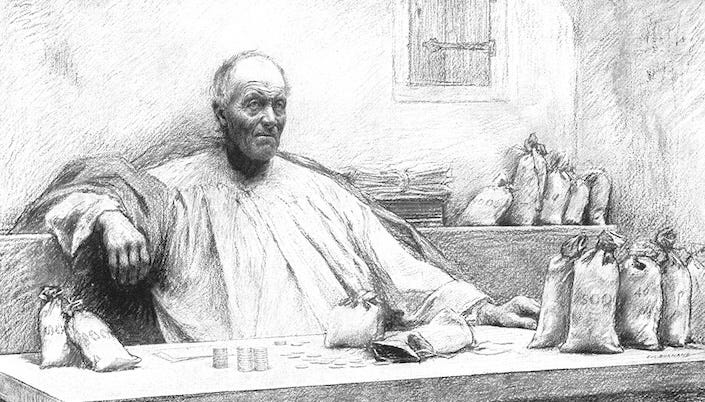
But after a very self-involved conversation with his best friends — he, himself, and him — he opts to just eat all the cake himself and build some bigger barns. Once that was done, he’d be able to relax, with his feet propped up on silos busting at the seams. The problem, of course, wasn’t necessarily that he had a lot of assets, a.k.a. money, at his disposal. Jesus’s point isn’t “rich: bad, poor: good.” Nor is this an invective against the Musks and Bezoses of his day, at least not immediately.1 Instead, Jesus’s initial imposition seems to showcase the folly of living on assumptions.
Wingate University and Baptist Theological Seminary tenured professor F. Scott Spencer incisively articulates the “damnable” folly exhibited by the nameless rich man in a recent essay:
The rich man’s foolishness aligns with his willful ignorance of the source of his abundant harvest, his arrogant presumption that he — not God and God’s earth — is the creative subject of his life . . .
What he has not accounted for, however, is that he has received his entire life and possessions on theological and terrestrial credit: everything comes from God and God’s land will revert back to these life sources in God’s time. Like all creation, the rich man lives on borrowed time and resources. He just does not know it or, better put, he denies knowledge of his finitude and dependence. And that makes him a damn fool.2
The rich fool was foolish because the future he assumed he had was shown to be a whole lot of nothing (Luke 12:20). Notwithstanding how many rows upon rows of fully stocked storehouses he had amassed, what could all those reserves do for him when he stood before the Judge at the End of All Things? Or, as Jesus says elsewhere, “What will it profit a man if he gains the whole world and forfeits his soul?” (Matt. 16:26). Both the jaded brother and the pleased as punch real estate magnate were putting too much stock in obsessing over the earthly goods they either had or hoped to have. And both were deemed fools as a result.
“Life,” Jesus tells us, “is more than food, and the body more than clothing” (Luke 12:23). You and I were created for more than mere accumulation, especially since the law of diminishing returns makes it so that acquiring begets more acquisitions. If one’s heart is set on stockpiling abundant possessions, one is setting oneself up for an exhausting quest to amass “enough,” an objective that’s forever out of reach. This is why Jesus deftly pivots from talking about covetousness to anxiety (Luke 12:21–22). Why? Because both the one who covets and the one who hoards are taking refuge in anxiety’s lie that preparing for the future necessitates acquiring a treasure trove of earthly goods and resources.
Jesus uses the same word for “anxious” three times in his follow-up discourse (Luke 12:22, 25, 26), each of which is suggestive of an undue preoccupation with the stuff of this life. But as he also notes, what was all that anxiety getting them? Well, a whole lot of nothing (Luke 12:25–26). For all the concerned energy that the brother and the farmer were expending thinking about what those resources might do for them, they still couldn’t add even one hour to their lifespans. “If then you are not able to do as small a thing as that,” Jesus presses, “why are you anxious about the rest?” (Luke 12:26).
Anxiety is sustained by the assumption that we know how the future is going to unfold to the point where we begin operating and living according to that assumption. But no one knows how things are going to pan out, and anyone who tells you otherwise is lying to you. I’m not a mental health specialist, but from my experience, this encapsulates my familiarity with anxiety: it’s you lying to yourself in a self-fulfilling prophecy of dread, angst, and barely bearable inner turmoil.
At the risk of oversharing, I don’t want to remember my birthday last year, but I’m worried I’m never going to forget it.

For my thirty-fifth birthday, I witnessed a thirty-one-year-old husband and dad get brutally murdered in front of an audience of thousands, with cameras capturing every second of it for millions more to see. Charlie Kirk’s assassination shook me in ways that are hard to express, not because I agreed with everything he ever said (I didn’t), but because we were barely given time to process what happened before folks were breaking down video clips, analyzing frames, and spinning stories into fully fledged conspiracies. It felt like I was watching the JFK trial unfold in real time, seconds after the shots were fired.
As many have articulated before, watching that was more than a little unhealthy. In my case, it sent me on an anxious bender of mindless refreshing, scrolling, and researching, as I swiftly operated under the assumption that one more video clip or one more headline might finally put all the pieces together and make everything make sense, settling my soul with the knowledge of why it happened, which was just the epitome of foolishness. And while I wasn’t beholden to an undue preoccupation with personal finances, I was subjugated to an undue preoccupation with information, which is not only a dressed-up version of covetousness but is also the premier epidemic plaguing our time.
There’s a certain tedium to reading think-pieces about how the algorithm is ruining our brains that has become a mind-numbing exercise in and of itself. I’m not saying it’s not worth it, though. Kudos to Jonathan Haidt and the consistent reminder of the soul-sucking venture behind all the pixels and likes. But even after watching The Social Dilemma, Twitter/X’s servers are still running, as are TikTok’s, as far as I know. The point is, we’re not short on knowledge or awareness of social media’s ills and the ways it turns FOMO into a debilitating pandemic of judgment and comparison. In that sense, we’re all a bunch of rich fools. We know better, and we doomscroll anyway.
As it turns out, the cure for our souls was never about amassing snazzy stock portfolios or absorbing every last bit and byte of information. The cure has always been a Person.

The good news that actually settles souls, yours and mine, is the same glad tidings to which Jesus alludes in his sermon — namely, that life is ultimately and unfailingly held by a God who not only notices but also cares for flowers and fowl (Luke 12:24, 27). “You are a step up on crows and lilies,” Dale Ralph Davis once quipped, “and you have a Father who knows all about it.”3 And this is what life “consists of”: knowing the one we call “Abba, Father” is also the one who holds the Milky Way in suspension, and it’s in his arms that we are safe, and our souls are made to rest.
God is no ogre, nor is he some ornery dad who hates it when his kids ask for something. The God of the Bible is a doting Father who doesn’t want his kids living in the fog of unchecked worry. He knows what you need, and he’s attentive to all of your burdens and bruises. As the psalmist puts it, he is “mindful” of you (Ps. 8:4). He’s a gentle, resourceful Shepherd who isn’t interested in his sheep becoming preoccupied with anything other than just being his sheep. “Fear and anxiety dissipate,” F. Scott Spencer concludes, “in the strong and loving arms of the good Father-Shepherd.”4 And those arms aren’t pixelated, nor are they just a nice theory, a placebo for our anxious generation. They’re outstretched and nail-scarred as an enduring reminder that yours is a God who’d rather give up his very self than lose you.
Grace and peace to you.
Jesus gets there, eventually, telling his followers to sell and give of what they have since their treasure is situated in heaven anyway (Luke 12:33–34). Billionaires and barn-builders aren’t off the hook; they’re just not the first ones Jesus addresses.
F. Scott Spencer, “To Fear and Not to Fear the Creator God: A Theological and Therapeutic Interpretation of Luke 12:4–34,” Journal of Theological Interpretation 8.2 (2014): 241, 243.
Dale Ralph Davis, Luke 1–13: The Year of the Lord’s Favor, Focus on the Bible Commentary Series (Ross-shire, England: Christian Focus, 2021), 227.
Spencer, 248.