


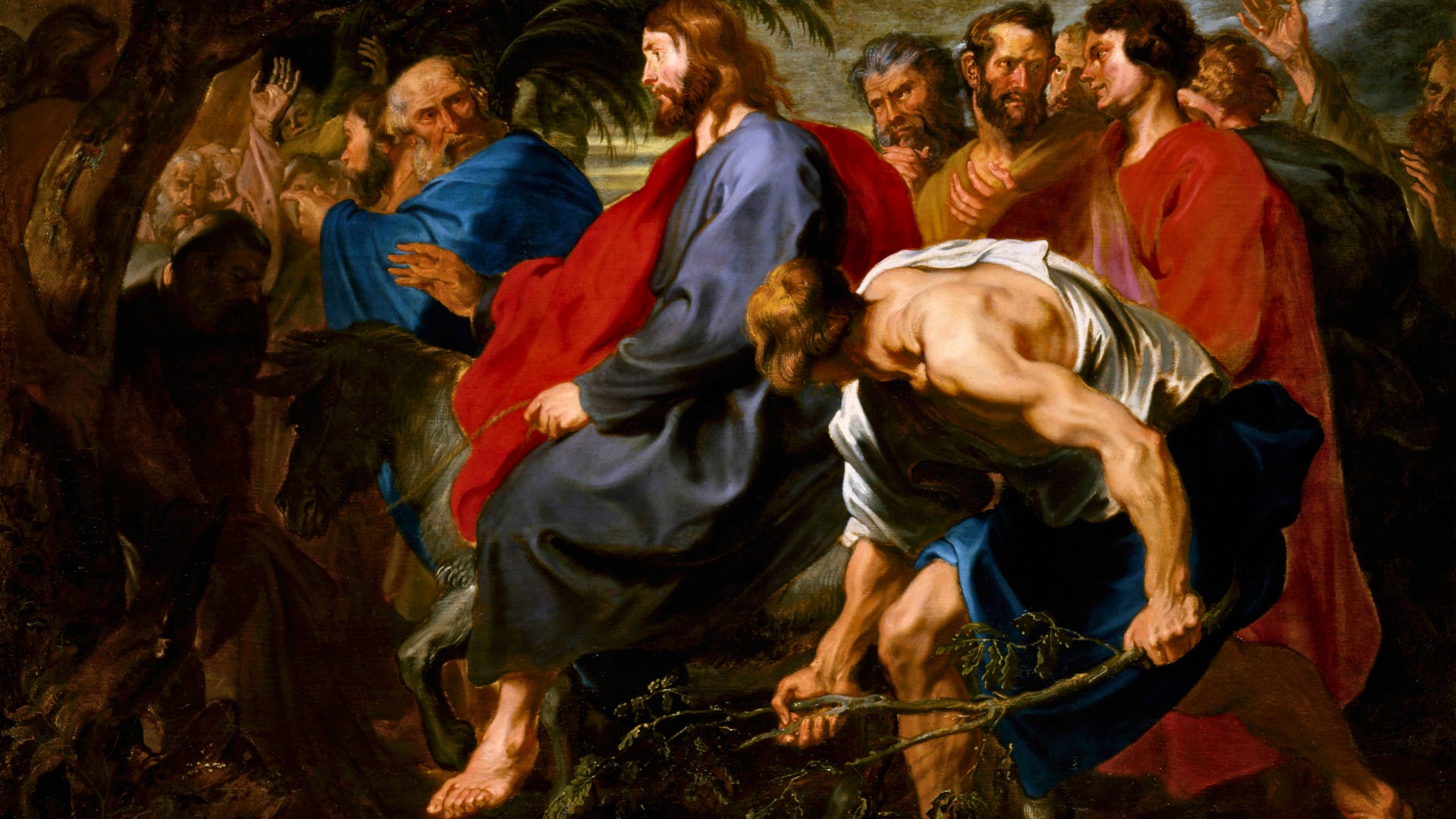
Yesterday was Palm Sunday, a day that marks the beginning of Holy Week, and a day that often sees sanctuaries bedecked with palm branches, commemorating the crowds who waved them and placed them on the ground as the Lord Jesus rode into Jerusalem on the back of a donkey. As quaint as that image may seem, I fear we’ve sanitized what Jesus was doing that day, which, for the most part, is excusable since not even his own disciples understood what it all meant until after their Lord’s death and resurrection (John 12:16). Up till this moment, though, Jesus has eschewed mass acclaim at every turn, withdrawing from the crowd after healing a man near the pool of Bethesda (John 5:13) and, most notably, withdrawing from the crowd after the feeding of the five thousand since he perceived that they were about to force him to be their king (John 6:15).
And yet, that pattern of withdrawing and toning down the hysteria of the masses that often followed him is entirely reversed upon his entry into Jerusalem. Instead of dampening the frenzy, he seems to lean into it (John 12:12–15). While everything he did during his time on Earth was a fulfillment of prophecy, Jesus’s penchant for prophetic realization reaches a fever pitch here. After all, these events unfold no less than five days before the Passover, the highest and holiest of all the Jewish feasts. Jerusalem is abuzz with folks from all over Judea making the trip to celebrate this most significant festival in the City of God. According to some ancient histories, approximately two to three million people would descend on Jerusalem during those days, as friends and neighbors would gather and hastily get everything in order before the big day.
(When I picture “large crowds” in my head, this is what I imagine it was like. This was in Lima, Peru, in July of last year, when we happened to be visiting during Peru’s month-long Fiestas Patrias, leading up to their Independence Day on July 28. I’ve never seen so many people or such vibrant colors in my life!)
Not everyone was there for purely religious reasons, though. Passover had become fraught with political connotations, stemming from the Maccabean Revolt in the second century BCE. This was a zealous Jewish uprising that occurred after the Seleucid king, Antiochus IV Epiphanes, desecrated the Jewish Temple and banned all Jewish religious practices. He even went so far as to build an altar to Zeus there and had pigs sacrificed on it. This was enough to incite a revolution from Jewish patriots, with Judas Maccabeus leading the way, eventually winning Judah’s freedom, rededicating the Temple, and reinstating the Passover in the process.
1. Great Expectations
It was around this time that the Passover festivities became infused with themes of political liberation, especially once Jerusalem fell to Roman control in the first century. In the ensuing decades, as Jews descended on Jerusalem for the week-long festival, Rome would deploy extra legionnaires to put a damper on any thought of revolution before it ever got started. As you might imagine, Passover was a time when tension filled the air. It was a politically and religiously supercharged week, as Roman garrisons readied themselves for any whisper of unrest and Jewish faithful longingly longed for the arrival of their Messiah-King.
Accordingly, the long-foretold Messiah had himself become a cocktail of the hopes and dreams of the Israelites themselves. The words of the prophets fused with the fervor of recent history — the Maccabees — to form a figure who, supposedly, would bring God’s chosen people out of tyranny for good. They desired a king who would come in God’s name to save and deliver them from their oppressors, akin to how they had been delivered from the hand of Pharaoh so many centuries ago. And yet, with all that energy and excitement so thick you could cut it with a knife, Jesus chooses to ride into Jerusalem “on a donkey’s colt” (John 12:15), exactly as the prophet Zechariah had said (Zech. 9:9).
2. Hosanna Hysteria
It didn’t take long for word to spread that Jesus of Nazareth was headed into town, resulting in a large crowd intercepting him along the way and giving him the royal treatment, as folks threw their cloaks on the path in front of him (John 12:12; Matt. 21:7–8). Soon, everyone started a chant from one of the Hallel Psalms, which were traditionally sung during Passover: “Hosanna! Blessed is he who comes in the name of the Lord, even the King of Israel” (John 12:13; Ps. 118:25–26). As the Jerusalem causeway became distended with more and more people, the cries of “Hosanna” or “Save us” grew louder, as the masses eagerly welcomed the arrival of the one who would do as Judas Maccabeus had done, only better, culminating in the restoration of Israel’s glorious kingdom, or so they thought.
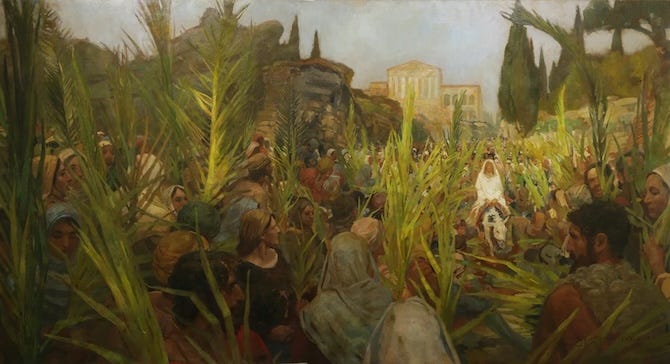
But it wasn’t just the fact that Jesus was riding on a donkey that stirred everyone up like this. The so-called “triumphal entry” was also a frenzied, chaotic affair because of what preceded it by a few weeks — namely, the resurrection of Lazarus (John 11). Hanging over everything that unfolds as Jesus enters Jerusalem is this miracle that everyone everywhere is talking about, so much so that the day before Jesus entered town, a large crowd discovered where he was staying — at Mary and Martha’s home — and assailed the cottage, mainly to see if all the rumors about Lazarus were true (John 12:9). This, of course, only made the Pharisees even more apopletic than they already were (John 12:10–11, 19).
The commotion following Jesus of Nazareth intensified as the day wore on, as no one could get Lazarus’s resurrection, nor Jesus’s procession, out of their heads. They couldn’t stop talking about it (John 12:17–18). The miracle plus the mule-helmed motorcade sent everyone into a tizzy, to the point that even a fringe group of Greeks were curious about him (John 12:21–22). One needn’t be an expert to sense that something was different or that something was about to go down. There was a feeling in the air, and Jesus leaned into that feeling, too, with an ensuing announcement that subverts everyone’s expectations:
The hour has come for the Son of Man to be glorified. Truly, truly, I say to you, unless a grain of wheat falls into the earth and dies, it remains alone; but if it dies, it bears much fruit. Whoever loves his life loses it, and whoever hates his life in this world will keep it for eternal life. If anyone serves me, he must follow me; and where I am, there will my servant be also. If anyone serves me, the Father will honor him. (John 12:23–26)
3. The King Who Dies
Although he was Israel’s King and he was there to bring about their deliverance, and he had come to be glorified, all of those things would only be true and would only be realized if he died first.
It’s not hard to imagine the confusion, angst, and utter dismay that washed over everyone’s faces as they tried to make sense of Jesus’s words. Everyone was energized and filled with enthusiasm at the thought that the Messiah had finally arrived, only for Jesus to throw a wetter than wet blanket on the whole shebang with all his talk about dying, losing, and hating one’s life. Needless to say, this wasn’t the speech everyone expected to hear. But, of course, that’s because he wasn’t the Messiah everyone expected either.
Jesus hadn’t come to check all the boxes of what they believed the Messiah should be or do. He wasn’t there to fulfill all their presuppositions or live up to their projections of what makes someone the Messiah of holy writ. He was there to do the will of his Father, which is what that “hour” was all about (John 12:23, 27). This, to be sure, had nothing to do with the big hand and little hand on a clock, and everything to do with the Godhead’s plan of redemption that was put into motion before the “foundation of the world” (Eph. 1:4). Now was “the proper time” (1 Tim. 2:6) — the “fullness of time had come” (Gal. 4:4) for what the Son of God had taken on flesh to do. And it’s almost exactly the opposite of what they wanted him to do.
4. When Heaven Speaks
As if this moment wasn’t already layered with enough intrigue, a voice booms “from heaven” (John 12:28–30), just as it had at Jesus’s baptism and transfiguration (Matt. 3:13–17; Matt. 17:1–5). It’s the voice of God the Father giving his divine endorsement for all that God the Son was about to accomplish — namely, judge the world, conquer the devil, and draw sinners to himself all in one fell swoop (John 12:31–32). This is precisely what Jesus achieves when he is “lifted up,” which is a euphemism for the cross (John 12:33).
From his twilight conversation with Nicodemus to his dialogue with the Pharisees (John 3:14–15; John 8:28; cf. Isa. 52:13), the Lord Jesus had always been aware that the cross was looming over every step he took. He, the Word who was with God and was God, had become incarnate and entered his creation to be exalted, not on a throne, but on a cross. To be crowned, not with a diadem made of silver or gold, but one made with thorns.
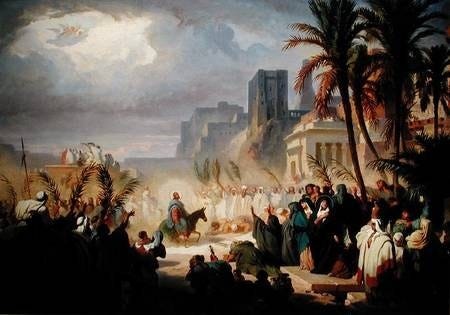
The crowd is obviously puzzled by all this. They just can’t wrap their minds around what a crucified Messiah would look like. “How can you say that the Son of Man must be lifted up?” they perplexingly ask (John 12:34). They couldn’t picture it, let alone get behind it. A crucified Messiah was a contradiction in terms, especially if your hopes were centered on an earthly kingdom. It’s no surprise, then, that this crowd that’s been singing Jesus’s praises is the same crowd that ended up crying for his crucifixion by week’s end. Why? Because he wasn’t the Messiah they were looking for or hoping for. They wanted Judas Maccabeus or, at the very least, Barabbas, who was a known insurrectionist and revolutionary (Mark 15:7) — not this donkey-riding Rabbi from backwoods Galilee.
5. Flipping the Script
What makes the triumphal entry so profound is that it sees Jesus kill two birds with one stone. That is, he’s simultaneously fulfilling prophecy and undercutting everyone’s expectations. If your new leader or ruler strolled into town on the back of a donkey or mule, it’d be very apparent what kind of leader you were getting. Donkeys symbolized peace and humility, a fitting animal to carry the one who described himself as meek and lowly. But, of course, this wasn’t the image anyone had in mind when it came to the Messiah. They wanted a champion riding on the back of a warhorse, the paragon of dominion and might.
But Jesus had no warhorse to carry him, nor any army following him, let alone any plans to lead a coup of the Roman embassy. Put differently, Jesus was purposefully demilitarizing what they thought the Messiah would be and what he had come to do. He wasn’t there to be their political revolutionary, nor was he there to tear down political power structures. Jesus was there for something better, something deeper, and something truer. “In his death,” Bruce Milne attests, “he must take the place of those to whom he has come to bring life. He must die their death in order to free them from death forever.”1 He was there to save the world from sin and death by becoming sin and surrendering to death, for your sake and for mine. He was there to pay sin’s wage by dying so that he could offer those who are dying eternal life. He was there to kick the devil in the teeth by totally undoing his power by leaving death defeated (Heb. 2:14).
And not only did the crowd that day not see that, but they also didn’t want to see it. “Though he had done so many signs before them, they still did not believe in him,” John reports, in one of the saddest verses ever recorded (John 12:37). After all that he told them and showed them, they still didn’t believe. But before we rush to ridicule those in the crowd that day, I dare say that many American churchgoers would have a similar reaction.
6. A Cross-Shaped Kingdom
We who live in the land of the free and home of the brave would rather see Jesus brandishing the colors of a particular party to take the world by force, starting with Pennsylvania Avenue. Let’s bedeck tanks and aircraft carriers with crosses as we bring in the kingdom, right? That isn’t how God’s kingdom works, nor is that how his kingdom is established. As Jesus eventually says, “My kingdom is not of this world. If my kingdom were of this world, my servants would’ve been fighting, that I might not be delivered over to the Jews. But my kingdom is not from the world” (John 18:36). This, G. Campbell Morgan says, “does not mean that His Kingdom is not to be set up in this world, but that the Kingdom of the King can never come according to worldly ideals, by worldly methods, or result in the glamour and glory which is entirely and absolutely of the world.”2
The materialization of the kingdom of heaven on earth isn’t dependent on any earthly material. It comes by way of death and resurrection. Like the tree that sprouts and bears fruit from a seed that dies, so, too, does the kingdom of heaven begin with the Living Seed, who is Christ, dying for us. And the citizens of that kingdom aren’t those who rise up to lead revolutions or defeat every earthly power. Rather, they’re the ones who put all their hope and faith in a Messiah who was crucified and risen again for them.
7. Behold Your Crucified King
And this is why the story of Holy Week, and Easter in particular, still scandalizes us — namely, because it compels us to see Jesus on the cross in all his glory. Only nothing about what we see looks like glory. It looks like shame, embarrassment, loss, and defeat. The kingdom appears to be in utter shambles as its supposed King bleeds and dies a criminal’s death. And yet amid all that blood and meekness is where God is found. This unnerves us because we’d rather find him elsewhere. On a throne, perhaps? Or maybe in a white house? I’m reminded of those words Johnny Cash sang, along with the band U2, in the song “The Wanderer”:
I stopped outside a church house
Where the citizens like to sit
They say, “They want the kingdom”
But they don’t want God in it
I fear Mr. Cash was more prescient than even he knew. We want the kingdom, but we don’t want God, especially a crucified God. Perhaps it’s because we want the benefits of the kingdom — peace, justice, etc. — without submitting to the King, especially a King who is crucified, a “stumbling block to Jews and folly to Gentiles,” and a little bit of both to Americans (1 Cor. 1:23). The King who rode into the city on Palm Sunday is the same King who was ushered outside the city to be put on a cross on Good Friday.
To every sinner and saint, who, like the Greeks who ran up to Philip saying, “Sir, we wish to see Jesus,” the gospel directs our gaze to the one who’s dying and says, “Here he is, the one who saves.” See your Savior, not on a stallion, but on a mule; not on a throne, but on a cross; not in a palace, but in a tomb. “Jesus is King,” Bruce Milne writes. “His kingship is of a unique order. To express it Jesus must disappoint the nationalistic aspirations of his fellow Jews. But King he is . . . He moves majestically forward in procession to his throne, a throne constructed by his enemies, the throne of the cross!”3 There he is, the Crucified One, standing at the center of it all to draw all people to himself, just as he’s drawing you even now.
Bruce Milne, The Message of John: Here Is Your King!, The Bible Speaks Today Series (Downers Grove, IL: InterVarsity Press, 1993), 188.
G. Campbell Morgan, The Westminster Pulpit: The Preaching of G. Campbell Morgan, Vols. 1–10 (Fincastle, VA: Scripture Truth Book Co., 1954), 5:96.
Milne, 181.