


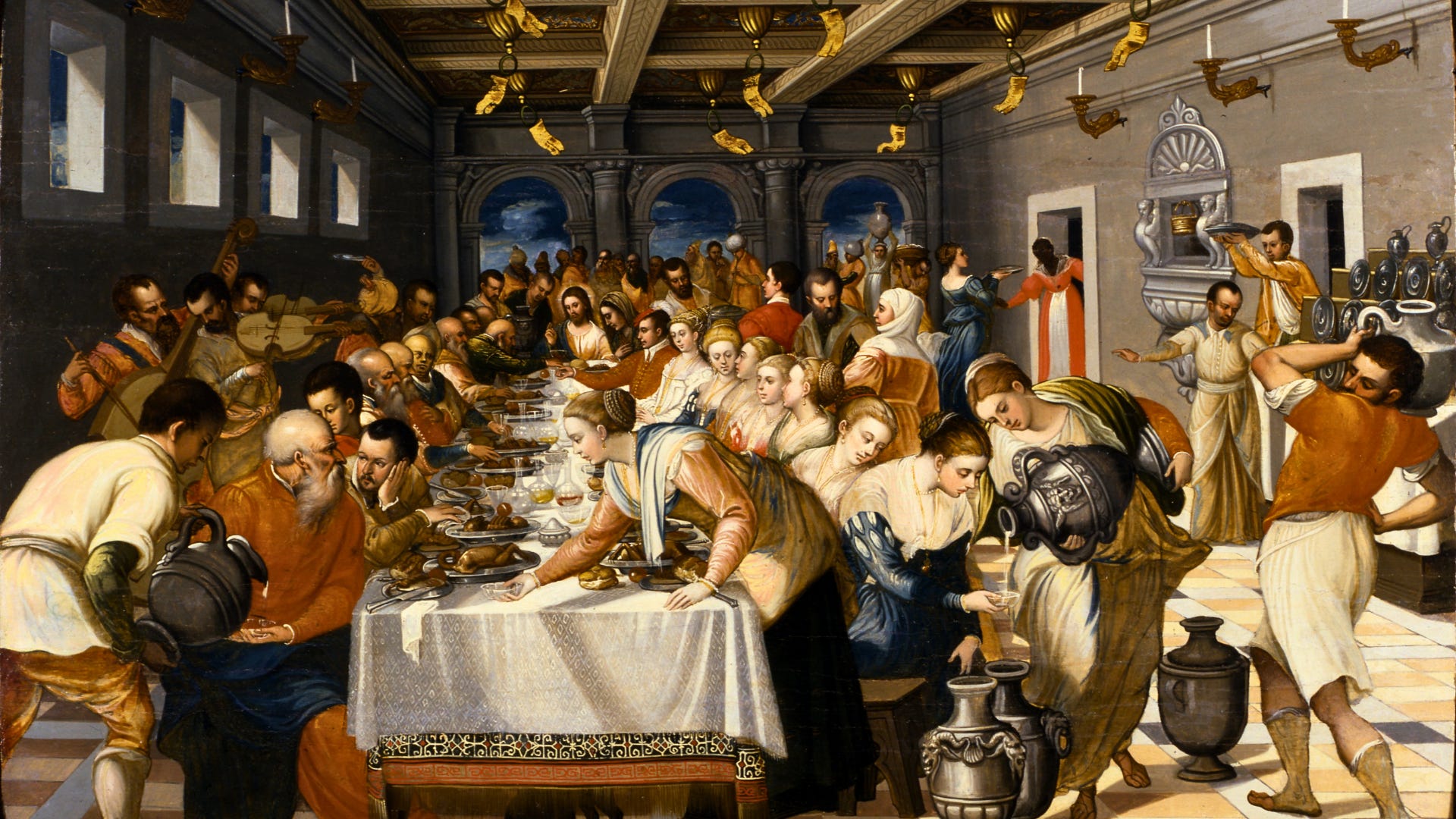
Having recently preached on Jesus’s miracle of turning the water into wine, I have John 2 on the brain, which isn’t a bad thing. I’m not complaining, especially since there are several hermeneutical and/or homiletical threads that I want to highlight here that I wasn’t able to cram into my sermon. One of the unsung skills a preacher has to have is knowing what insights should be left on the cutting room floor and which ones actually serve the sermon he’s writing. This, of course, doesn’t just mean that good preachers are good editors, but kind of.
I don’t mean to imply that sermons are indistinguishable from essays. They’re not. Having been on both sides of preparing a sermon and an academic essay, while there are certainly overlapping elements, there are worlds of differences, chiefly in the Spirit’s filling, or what some old theologians might refer to as “unction.” To offer my own definition of what unction is, it’s the investiture of Christ’s Spirit to convey the Word of Christ with deep emotion.1 If you’ve listened and/or watched one of my sermons, you might notice times when that unction is more or less apparent.
And while it might feel like I’m rambling or digressing, I promise I’m not. What I’m getting at is just that there are some things that live on in print better than they do in homiletical practice. I’ve had to wrestle with this reality several times over the years, editing out sentences or phrases that get a little too cute for their own good. Wordplay is often hard to convey without over-explaining, and by that time, you might as well have skipped it. Sort of like a joke you have to end up deconstructing for someone to finally get it.
With that said, preaching about the miracle at the wedding of Cana brought with it many wonderful exegetical details that I didn’t want to go to waste. The paradigm that made it into my sermon was understanding the jars Jesus used as the critical piece of evidence for understanding what he was doing the whole time. The six stone jars that the Lord gestures toward and directs the caterers to fill with water weren’t random pots collecting cobwebs in the corner. These were jars that were set aside “for the Jewish rites of purification,” which was a topic of debate that seemed to follow Jesus and his disciples wherever they went (John 2:6; 3:25; Mark 7:1–5).
The scandal wasn’t that Jesus and his men were raggedy or failed to practice good hygiene. The point was that Jesus wasn’t interested in playing the Pharisaical game of tethering one’s religious standing in the eyes of God to one’s ability to wash their hands correctly. Hand washing, among other things in the first century, had become more than just something you did to get ready for a meal. It had become a referendum on your piety, one that went well beyond any Mosaic standard (Matt. 15:1–2; Luke 11:37–39). Jesus’s insistence on using these jars and filling them with wine is, as I understand it, a subtle but nonetheless pointed invective on the emptiness or, we could say, “dryness” of the incumbent religious system.
Bruce Milne puts it plainly: “The ‘new wine’ of the kingdom brought by Jesus contrasts with the old wine of Judaism.”2 Or, as Stanley D. Toussaint says, “The old wine had run out, and Christ the Messiah was here to bring the new.” Turning water into wine was no mere wedding party trick. Rather, as Toussaint says, “the miracle shows the old order had run its course; now was the time for a new one.”3 Without his filling, without the new wine of the blood of the Lamb, our religious impulse will be empty, at best. What’s needed is precisely what Jesus provides: himself.
Perhaps the most regrettable thread that didn’t make it into my sermon was connecting the wine at this wedding to the wine of the new covenant, which Jesus identifies as his own blood (John 6:53–56; Matt. 26:27–29). The groom whose wine supply is scarce is eclipsed by the true and better Groom whose wine, which is his blood, never runs out (John 3:29–30). This is the argument Jan M. Kozłowski makes, writing, “The wine Jesus gives to the wedding guests is a type of His blood which will be spilled to save the world.”4
Kozłowski’s essay draws a straight line from the wine to the blood to highlight the soteriological undercurrent of Jesus’s first miracle. It was a calculated and programmatic event that accomplished multiple things at once, chief of which was saving the groom from disgrace and hinting at the salvation the better Groom came to accomplish. This understanding keeps this miraculous event from veering into some other field, keeping this account within biblical theological grounds to perceive its resonance through the lens of the revelation of the Christ of God. E. Ray Clendenen makes this striking assertion plain to see when he writes:
Jesus’s words and actions there intentionally foreshadowed his shedding of blood on the cross for our atonement, which would provide not just external cleansing but internal life and transformation. He was preparing us for his teaching that the Christian life entails our eating and drinking Jesus until at the great marriage banquet we see him face to face . . . Jesus’s words to Mary, and especially his reference to the ‘hour’ of his death are ‘almost unintelligible’ unless he was associating the need for wine with the need for his own sacrificial blood to be shed at the cross in order for us to receive the eternal life he came to provide.5
There are a few other clues within the text that bring this out as well, not the least of which is the day on which this miracle took place. “On the third day,” John tells us, “there was a wedding at Cana in Galilee” (John 2:1). From approximately the midway point in Chapter 1 through Chapter 2, John seems to focus on the first week of Jesus’s public ministry in an intentional way (John 1:29, 35, 43; 2:1, 13). Clendenen’s essay includes a fairly convincing outline suggesting that the miracle at Cana actually occurred on the seventh day of the inaugural week of the ministry of Jesus of Nazareth.6 And much like the first “third day,” Jesus’s last “third day” sees the new wine of his blood poured into stone-dead hearts, making them alive by his grace and resurrection.
But perhaps my favorite detail from John 2 is its prophetic connection to Moses and Elisha, the former of which appears in Richard C. Trench’s nineteenth-century work Notes on the Miracles of Our Lord:
The first miracle of Moses was a turning of water into blood (Exod. vii. 20); and this had its fitness; for the law, which came by Moses, was a ministration of death, and working wrath (2 Cor. iii. 6–9). But the first miracle of Christ was a turning of water into wine; this too a meet inauguration of all which should follow, for his was a ministration of life; He came, the disperser of that true wine that maketh glad the heart of man (Ps. civ. 15) . . . This prophetic aspect of the miracle we must by no means miss. He who turned now the water into wine, should turn in like manner the poorer dispensation, the thin and watery elements of the Jewish religion (Heb. vii. 18), into richer and nobler, into the gladdening wine of a higher faith.7
The full gamut of Jesus’s earthly ministry is seen in abbreviated form in water turning to wine. Contrasted against Moses’s miracle of water into blood, which spoke only of judgment, Jesus’s miracle of water into wine speaks only of grace. This distinction works even better once you remember that John just got through telling us that while “the law was given through Moses; grace and truth came through Jesus Christ” (John 1:17). Just as John’s Gospel itself opens with the sudden incursion of the new upon the old, as God’s Word becomes flesh, we are made to see the same thing within the scene at Cana.
But along with the connection to Moses, there’s another prophetic tie to Elisha, who, in 2 Kings 2, undertakes a prophetic sequence, if you will, that Jesus ultimately fulfills. In brief, the beginning of 2 Kings 2 sees Elisha’s predecessor, Elijah, swept up into heaven on a chariot of fire, graphically depicting the new succeeding the old. After Elisha takes up the mantle as Yahweh’s prophet, he proceeds to demonstrate his capacity for both blessings and curses. In Jericho, he removes the bitter curse from the spring so that the people could drink, while at Bethel, he pronounces judgment on a mob of young men who mocked him and the words on his lips.
Similarly, in Cana, Jesus turns empty waterpots for purification into brimming vats of wedding wine, while in Jerusalem, he pronounces judgment on a bunch of temple merchants who had turned God’s grounds of grace into a marketplace of religion. Elisha’s healing of the poisoned spring coincides with Jesus’s metamorphosis of water into wine. And just as Elisha cursed those who scorned the prophet’s words, so Jesus curses the place where that Word should’ve been heard and honored the most. But what neither Moses nor Elisha could do, Jesus does. He absorbs the curse by becoming a curse so that we might be redeemed (Gal. 3:13) and reconciled to himself.
Grace and peace to you.
For a fuller treatment of this, I’d recommend D. Martyn Lloyd-Jones’s Preaching and Preachers, where he calls unction the “supreme thing,” urging preachers to “seek it until you have it; be content with nothing less.” Preaching and Preachers (Grand Rapids, MI: Zondervan, 2011), 341.
Bruce Milne, The Message of John: Here Is Your King!, The Bible Speaks Today Series (Downers Grove, IL: InterVarsity Press, 1993), 64.
Stanley D. Toussaint, “The Significance of the First Sign in John’s Gospel,” Bibliotheca Sacra 134:533 (1977): 50.
Jan M. Kozłowski, “The Soteriological Dimension of the Sign at Cana of Galilee (John 2,1-11),” Ephemerides Theologicae Lovanienses 96.1 (2020): 140.
E. Ray Clendenen, “Jesus’s Blood at the Wedding in Cana?” Journal of the Evangelical Theological Society 63.3 (2020): 501–2.
Clendenen, 492.
Richard C. Trench, Notes on the Miracles of Our Lord (New York: D. Appleton & Co., 1871), 122–23.