


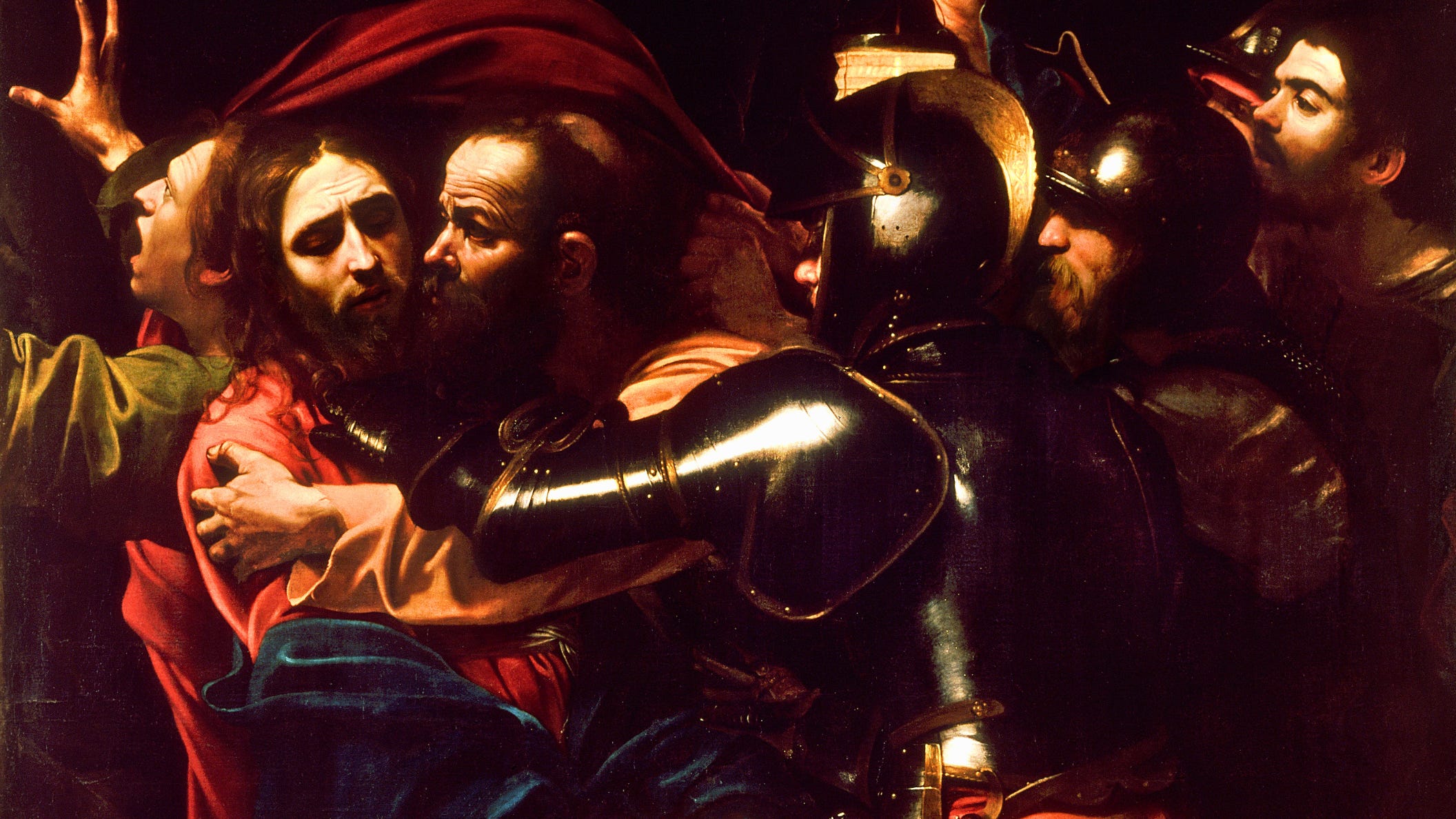
Amid all the corrupt proceedings that result in Jesus’s death, what with the Sanhedrin’s willingness to bend, if not break, several of their own protocols, rushing and tilting the hearings toward a predetermined end, there is a scene that mustn’t be overlooked. From the trumped-up witnesses to the fact that Jesus is cajoled into incriminating himself to the obvious bias of Caiaphas, the high priest (Matt. 26:64–68), the whole thing was an obvious sham from the beginning. We reach peak irony, though, in John’s Gospel, where he tells us that they — the Sanhedrin gentry — “led Jesus from the house of Caiaphas to the governor’s headquarters. It was early morning. They themselves did not enter the governor’s headquarters, so that they would not be defiled” (John 18:28).
1. Delusions of Piety
After the right amount of shenanigans to get him to commit blasphemy, at least as they judge it, Jesus is escorted to Pilate’s house in the wee hours of the morning. But due to their own sense of self-importance and ritualism, the religious aristocrats who put Jesus of Nazareth under arrest don’t dare cross the threshold of Pilate’s house. Why? Well, because they didn’t want to risk defiling themselves on the eve of the Passover feast.
Like a surgeon before an operation, devout Jews would consecrate themselves before the feast got underway.
This was part of the preparation process that occupied those days leading up to the Pascal meal.
Communing or fraternizing with a Gentile was a surefire way to corrupt oneself, leaving one ceremonially impure.
It’s downright laughable that the Sanhedrin are so beholden to their rituals and so blinded by their self-righteousness that they think they can stay clean even as they hatch a plan to murder a rabble-rousing Rabbi from Galilee. “Thus they seek cleansing before God while plotting and scheming the destruction of God’s beloved Son,” as Bruce Milne incisively comments.1 This, among other things, is perhaps the clearest example of misplaced piety. As if “mere ritual” still counts or is still effective to cleanse their souls and make them holy.
2. When Mere Ritual Fails, and Guilt Is Exposed
This scene has many consequences, but chief among them is the ridiculousness of ritual or mere religion as a vehicle for salvation. Every one of those council members could follow the Passover regimen to a T, and they’d still be guilty. No matter how thoroughly they washed themselves, they’d still have blood on their hands, which is exactly the point Peter and Stephen make later on (Acts 2:23; 3:13–15; 7:51–52). Religion can’t achieve redemption, nor can rituals save your soul. It’s as Yahweh says through his prophet Jeremiah, “Though you wash yourself with lye and use much soap, the stain of your guilt is still before me” (Jer. 2:22).
It’s striking to imagine all those self-important religious delegates standing on Pilate’s front porch, demanding he come outside so they can have a confab with him. To his credit, Pilate does just that, weathering the early morning inconvenience and allowing the Sanhedrin’s plan to play out (John 18:29). After he inquires what Jesus’s crime was, the council responds very unconvincingly. “If this man were not doing evil, we would not have delivered him over to you,” they chide (John 18:30), which, to me, sounds like, “He’s bad, just trust us.” But Pilate’s eventual reply tells us everything we need to know about him. “Take him yourselves and judge him by your own law,” he tells them (John 18:31).
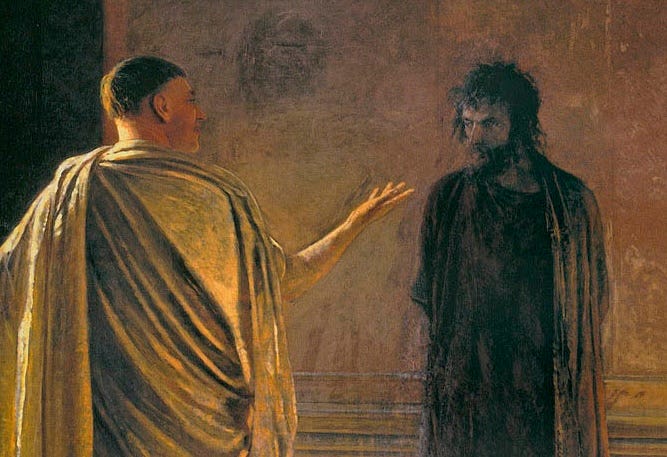
As a Roman prefect or governor, Pilate had little to no interest in upholding the laws of Judaism, which is why his first impulse was to dismissively tell them to go away and handle it themselves. But ever the cold, calculating, and opportunistic politician — one who was known for antagonizing the Jews on occasion — Pilate perceives the Sanhedrin’s endgame (a death sentence) and takes the opportunity to rub their noses in the fact that they are still Roman subjects. After all, capital punishment was outside the purview of the Judean council, which meant they needed his “John Hanock” to make this verdict legit. You can almost see the Cheshire smile awash on Pilate’s face as he forces those desperate councilmen to admit to the “elephant in the room,” i.e., that they wanted Jesus dead.
Moreover, this moment also tells us what the Sanhedrin was actually after. They wanted to get rid of Jesus, but they wanted more than that. After all, this is the same council that had no problem stoning Stephen to death just a few years later (Acts 7:58). Those “scribes and Pharisees” who sat on that council weren’t just out for blood. They were out for humiliation, shame, and the absolute embarrassment of anyone and everyone associated with Jesus of Nazareth. They wanted a “legal” trial (if you can call this that), one that’d put a curse on whatever pathetic following the Lord Jesus had accumulated up to that point. It’s sheer malevolence, vitriol, and hatred, exposing the absolute depths of human depravity.
3. A Plot That Served God’s Purposes
I have to imagine that none of those delegates imagined they had the capacity for conspiracy and murder before this moment. And yet, here they are, feeling quite justified as they subject a carpenter’s son, whom many believed was the Messiah, to the most appalling and horrific way to die ever conceived. “No death was more excruciating, more contemptible, than crucifixion,” historian Tom Holland notes.2 Every bit of shame, ridicule, and agony that accompanied a crucifixion was aggravated by the fact that anyone who was subjected to such an end was the epitome of cursed (Gal. 3:13; Deut. 21:23). And who’d want to affiliate with someone who was accursed?
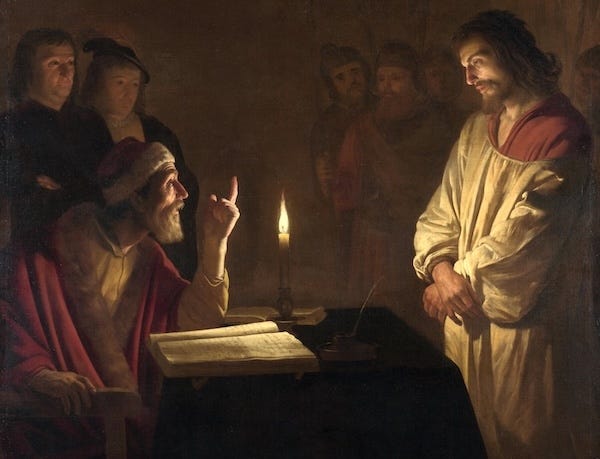
But the point is that Jesus knew what was going on; he knew what the Sanhedrin was up to, and he let it happen anyway. He watched as it all unfolded. He looked on in silence as they deluded themselves into thinking that they would be on the right side of history. Jesus let those dastardly delegates do their worst, knowing full well that what they wished to see is precisely what the world needed. “The authorities,” Bruce Milne comments, “are determined that Jesus should die by crucifixion, i.e., under the curse of God, and they will have their way. In the wonder of God’s grace, however, their wish coincides precisely with our need.”3 As John himself tells us, “This was to fulfill the word that Jesus had spoken to show by what kind of death he was going to die” (John 18:32).
Accordingly, both by John’s and Jesus’s own assessment (John 12:27–33), these events were unfolding “according to the definite plan and foreknowledge of God,” to parrot what Peter would later say (Acts 2:23). This is important to keep in mind, especially since the events leading up to Jesus’s crucifixion could’ve seemed so circumstantial, as if they were just happening. But both before his death and after his resurrection, the cross is seen as a categorical necessity (cf. Acts 3:18; 17:3; 26:22–23).
4. The Cross’s Inevitability
The Lord Jesus understood how all of this was going to end for him. He wasn’t caught off guard when the most religious body of the day conspired to get rid of him, nor was he surprised by the plot to have him crucified, nor was he astonished when the masses cheered for his crucifixion, with all the enthusiasm of a rowdy Philadelphia Eagles crowd. From the moment he was born, Christ knew that his life would end with his body nailed to a tree. The cross was always in the cards. “As Moses lifted up the serpent in the wilderness,” Jesus tells a perplexed Nicodemus by candlelight, “so must the Son of Man be lifted up, that whoever believes in him may have eternal life” (John 3:14–15).
The keyword, of course, is “must,” which means “necessary.” It was a right, proper divine inevitability that this should happen (Luke 24:7, 26, 46). Put differently, what seemed so dour and so unfortunate wasn’t an accident by any stretch of the imagination. God the Father, God the Son, and God the Holy Spirit foreknew that humanity’s rebellion would lead to this. Thus, in the depths of his wisdom and grace, the Triune God allowed these events to unfold so he could become the cursed one for us who are cursed. As St. Paul declares, “Christ redeemed us from the curse of the law by becoming a curse for us” (Gal. 3:13).
The gospel points us to the one on the cross, the guiltless one being bathed in our guilt, the sinless one becoming our sin, and the holy one dying in agony and shame, and tells us, “There is your Savior.” “He who lived as the Holy One dies as the condemned one,” Bruce Milne declares. “He who breathed as the guiltless expires as the guilty.”4
5. Only a Crucified Messiah Will Do
And the point is that this is what your sin demanded — nothing less than this would accomplish salvation. You can’t clean yourself up or remove your own guilt. You can’t be holy enough or good enough, nor do you have the capacity to make yourself right with God. No amount of ritual will work. It’s not powerful enough to redeem you. Only the steep stoop of God’s Son in the flesh, willingly surrendering himself to death, will do. “A crucified Messiah, a Messiah under curse,” Milne continues, “is the only Messiah who can meet our need and reconcile us to the Father.”5 Our only hope is that which the Lord Jesus did, when he “gave himself for our sins to deliver us from the present evil age” (Gal. 1:4).
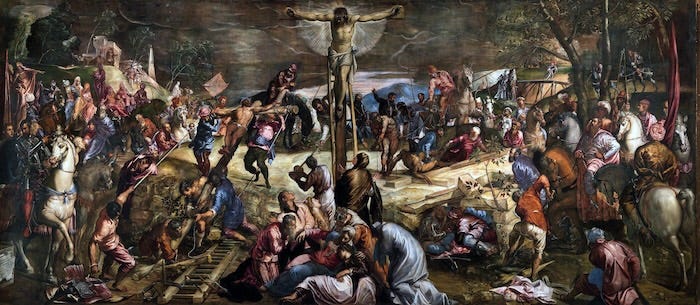
The Christ of God authored our redemption by exposing himself to the grief and affliction of the cross, where he bore our griefs and carried our sorrows, and was crushed for our iniquities so that by his wounds, we might be healed (Isa. 53:4–5). Jesus wasn’t the victim of circumstance. As the rest of the verse in Galatians says, “the Lord Jesus Christ, who gave himself . . . according to the will of our God and Father” (Gal. 1:4, emphasis mine). Or as the prophet Isaiah put it: “It was the will of the Lord to crush him . . . out of the anguish of his soul he shall see and be satisfied” (Isa. 53:10–11).
The Sanhedrin might’ve thought they were winning, fist-pumping as their plan came together, as the devil surely did, when God’s Son was put to death. But the only one who triumphed that day we now call “Good Friday” was the one who was heaving and dying for the sins of the world. As G. Campbell Morgan concludes:
It was only by His Cross; by His whelming in death; by His immersion in immeasurable and unutterable anguish and sorrow; that He could take hold of the poison which had spoiled humanity, and negate it, make it not to be, cancel it, destroy it, and so liberate the fire and remake humanity . . . All things are ours to enjoy because He went to His Cross. It is by way of the tree that the leaves of healing come. It is by way of the Cross that the crown is placed upon our brows.6
Every nail, every taunt, and every agonizing breath was the will of God being carried out for the sake of his people — for you, as you are, even with all your failures, guilt, regrets, and baggage. To every weather-beaten sinner, Good Friday has good news for you: you can’t carry all that sin by yourself, nor forgive yourself, let alone clean yourself up. You can’t, but Christ can, and he did, when he went willingly to the cross with you in mind. There’s nothing left for you to prove or earn, because the Crucified God has already done it all. So look to him and cling to him, trust that all that was necessary for your salvation has already been finished.
Bruce Milne, The Message of John: Here Is Your King!, The Bible Speaks Today Series (Downers Grove, IL: InterVarsity Press, 1993), 264.
Tom Holland, Dominion: How the Christian Revolution Remade the World (New York: Basic Books, 2019), 2.
Milne, 268.
Milne, 263.
Milne, 268.
G. Campbell Morgan, The Westminster Pulpit: The Preaching of G. Campbell Morgan, Vols. 1–10 (Fincastle, VA: Scripture Truth Book Co., 1954), 82, 84.