



A version of this article originally appeared on 1517.
Father Damien, born Joseph de Veuster, was a Catholic priest from Belgium who ended up taking a call to serve on the island of Molokai, Hawaii, in the late 1800s. Now, serving the Lord on the pearly sands of Hawaii as the crystal clear Pacific laps up the coastline doesn’t often garner the same inspirational sympathy as, say, any other locale in the world. But to assume this was a siesta by the sea for Father Damien would be wrong. After all, the island and tribe to which he had been called was a secluded community for those who had contracted Hansen’s disease, a.k.a. leprosy. As you might imagine, Father Damien wasn’t fighting off other potential suitors to serve the Lord in this post. Once you arrived, you never really left.
Thus, instead of spending time at some Sandals® seaside resort, this call meant ministering in a permanent quarantine zone — a place of the living dead. But Father Damien went anyway, earning a reputation as a true servant of Christ as he provided all manner of spiritual, physical, and emotional care for those who were suffering and dying all around him. As was his usual habit, he would open Sunday morning mass with the words, “My dear lepers,” as he summoned them to hear the words that contained eternal life and healing. But one Sunday, everything changed. “My fellow lepers,” his homily began, leaving the room stone cold quiet. As anyone could’ve predicted, Father Damien had contracted leprosy himself, which meant he was no longer ministering to them; he was ministering among them as one of them. The disease took his life in 1889, and he has since been canonized as a saint.
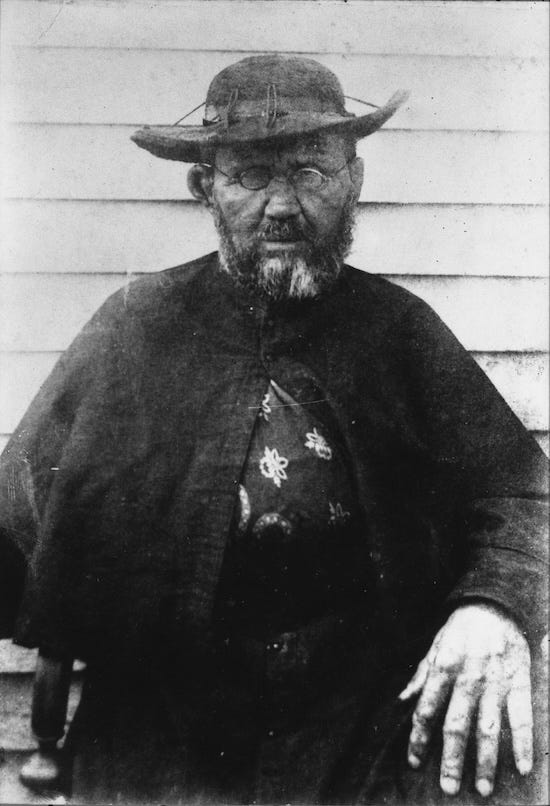
As moving as this story is, it is equally as surprising. After all, those who are clean aren’t often found fully stepping into the place of the unclean. They keep a healthy distance. Doctors, nurses, and surgeons adhere to a strict regimen to ensure they don’t contract whatever virus or affliction they are attempting to rectify. But Father Damien’s compassion seemed to compel him to go straight to where the sick were living out their last days. It’s as true a picture of grace as there ever was one. And yet, it’s eclipsed by an even truer portrait that has Christ at the very center of it.
1. The Scandal Down at the River
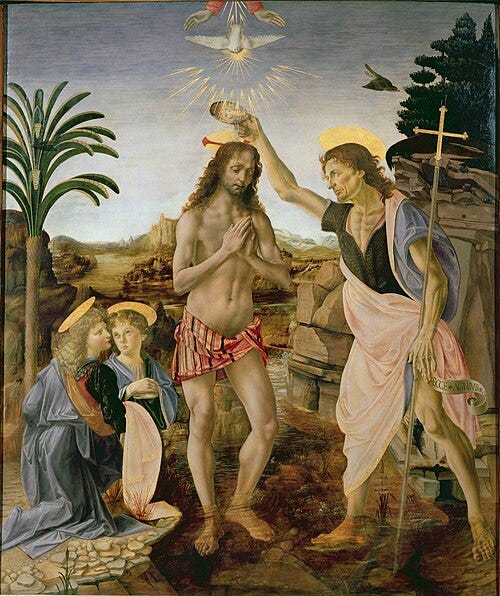
The scene of Jesus’s baptism has captivated and, in some senses, confounded the church for ages. It’s a stunning image — the muse of too many painters to count — as Jesus of Nazareth marches to the famed Jordan River to be baptized by his cousin, John the Baptizer. But what’s so perplexing is the question of why: Why was Jesus there? Why did he insist on being baptized that day? The “what was Jesus doing there” question is one that has spawned all kinds of solutions, for better or worse. But we are right to make this inquiry, especially since it was John’s first reaction, too. “Then Jesus came from Galilee to the Jordan to John,” Matthew tells us, “to be baptized by him.” But John wasn’t really on board with this whole charade, and “would have prevented him, saying, ‘I need to be baptized by you, and do you come to me?’” (Matt. 3:13–14).
Even before the actual baptism, there’s something poignant going on within this rather awkward exchange in the middle of the Jordan. The Teacher of Nazareth has made his way to the place where the Baptizer was famous for practicing a baptism of “water for repentance” (Matt. 3:11). But when he saw Jesus that afternoon, something wasn’t quite right. Something felt off, backwards even. So, he refuses to go along with it. He “prevented him.” And at first glance, John’s resistance might seem like an admirable, reverent, or even pious response. He seems to be “saving” Jesus from the embarrassment of consorting with the wrong sort of folk. If this were a scenario pitched by a pulpit committee to a potential elder candidate, this would be the most impressive response one could offer. It’s deferential without being self-depricating; it’s earnest without being presumptuous. It’s a fitting protest from the one who understood that the Lord must increase and he must decrease (John 3:30).
The Baptizer knew his place, or at least he thought he did. “You don’t need me,” we might reckon his words, “I need you.” This is true, of course. But Matthew clues us into something subtle, albeit serious, when he records that “John would have prevented him” (Matt. 3:14). What’s going on here?
2. When Reverence Becomes Resistance
John’s ministry was one of preparation. He was the voice in the wilderness who was sent to “prepare the way of the Lord” (Isa. 40:3; Matt. 3:3). He was making waves out in the Judean wilderness by preaching and baptizing anyone who’d come to him seeking forgiveness for their sins. Gentile and Jew alike were welcome to join in this visible sermon of cleansing and forgiveness. And while John never claimed he could forgive sins, he proclaimed and pointed to the one who could, and would (Mark 1:4; Luke 3:3). Repenting, confessing, and gesturing toward the King’s coming kingdom were all hallmarks of his platform, which led streams of folks to flock to him to partake of the baptism the Baptizer was offering.
Each one was a sermon in and of itself, in which the baptizee openly declared, “I am not okay; I am desperate for the cleansing of the Coming One.” John was leading a bona fide revival out in the boonies, the likes of which hadn’t been seen since the days of Ezra. And all was well, until Jesus stepped in line.
Why was Jesus there? Jesus didn’t belong in that line. He didn’t have any sins to confess. He had nothing for which to repent, nor was he desperate for the sacramental cleansing found in the waters of the Jordan. “What are you doing here?” John protests. “I need to be baptized by you, and do you come to me?” Jesus should’ve been the one submerging him with Jordan’s watery grace, not the other way around. It was all so wrong; all so backwards, to the point where he couldn’t bring himself to do it at first, opting to act as a deterrent instead of a willing participant. “John would have prevented him.” That is, “John tried to stop him” or “John tried to make him change his mind” or “John tried to dissuade him,” as other translations of Scripture render it. However you put it, John is putting himself in the way. He’s acting as an obstacle.
In a manner of speaking, though, the Baptizer’s words sound not only “not” irreverent, but they also have a theologically logical ring to them. You can almost hear preachers urging their parishioners to emulate John’s honesty and humility. “Go and do likewise,” we might hear them say, but they’d be wrong. Dead wrong. Much like Gideon’s fleece, John’s protest isn’t one to be mimicked by Christ’s sisters and brothers. You see, John’s seeming humility is, in fact, an act of hostility.
3. Why Jesus Entered the Water
What John hadn’t quite pieced together yet was that the Rabbi from Nazareth, who is the very Christ of God, hadn’t assumed human flesh to display how morally superior he was or show everyone the way to a virtuous life. Rather, he had come to be humanity’s substitute.
I was once asked to give a one-word summation of the gospel while on a Zoom call with a dozen or so other pastors. As soon as the question was posed, and even as I listened to a chorus of other responses — some repeated, some not — I immediately knew what my answer would be: substitution. The news that makes the good news so stinking good is that it announces that none other than God Incarnate has stood and died and risen from the dead for me, in my place. He “gave himself for [my] sins to deliver [me],” to parrot Paul’s words (Gal. 1:4).
It’s this moment in the Jordan that kicks off what we know from hymns and theological textbooks as “the great exchange,” the self-giving of God, “His Robes for Mine,” and all that. Of course, Jesus’s baptism is the fulfillment of a cavalcade of other things all at the same time. He’s being consecrated as Israel’s true and better High Priest (Lev. 8:6–12). He’s assuming his role as the Messiah, as was long foretold by the prophets (Isa. 52:15; 53:11; Ezek. 36:25–27; Zech. 13:1). And he’s corroborating the ministry of the Baptizer as the forerunner (Mal. 3:1; 4:5–6). But chief among the things Jesus was doing that afternoon was demonstrating his willingness to identify with sinners as he stood in solidarity with those who needed the cleansing he came to deliver.
In other words, Jesus didn’t enter the water because he was sinful; he entered the water because John was sinful, as was everyone else, as are we all. He found his place in line with sinners, scoundrels, and thieves, not as their example, but as their substitute. “He, the Sinless One, the very Son of God,” R. C. H. Lenski comments, “chooses to put himself alongside of all the sinful ones for whom John’s sacrament was ordained.”1 If John’s baptism was symbolic or sacramental, Jesus’s is its substance and fulfillment (Matt. 3:15–17). “This was the symbolic anticipation of his full and profound baptism on the cross,” Michael Green says, “which lay in the future, when he would taste for everyone the eschatological wrath of God and would proffer to anyone the unspeakable mercy of God.”2

4. The Direction of Grace
Like Father Damien choosing to embrace a dead-end ministry among lepers, Jesus willingly chose to come to where sinners are to save them from their sins. And there he is, with clothes and hair sopping wet, the one who is for you, and with you, your Redeemer. And John, for all his religious zealotry, almost got in the way of that. “John would’ve prevented him.” He nearly hindered him from accomplishing the very thing for which he was sent. And lest you think this is a “John the Baptist problem,” there’s another disciple who seems to have been bitten by the same humblebrag impulse to prevent Jesus from doing something that’s inherently Jesus-like.
In the Gospel of John (different John, by the way), we are treated to one of the most powerful moments in all of Scripture where, one by one, the Incarnate God, who was hours away from being crucified for the sins of the world, wraps a towel around his waist and begins to wash his disciples’ feet. While most were too stunned to say anything at all, leave it to Peter the Impetuous to speak up and point out how backwards it all was. “Lord, do you wash my feet?” (John 13:6). “Hey, Teach, you shouldn’t be washing my feet, let alone anyone else’s. I should be washing yours!” “You shall never wash my feet,” he even goes on to say (John 13:8). If this moment of pious resistance sounds strangely familiar, that’s because it’s an echo of the same pseudo-religious logic of the scene in the Jordan.
This wasn’t how things were supposed to go. This was wrong. But much like John’s objection, Peter’s protest is shrewdly foiled by what Jesus says next: “If I do not wash you, you have no share with me” (John 13:8). Put another way: Apart from my substitutionary service for you, apart from me taking your place, you can’t and won’t get by. This, of course, flies in the face of all our religious instincts.
We so often reverse the direction of grace so that we are the ones with something to offer God through our service for him or devotion to him, as if there is anything we can produce or perform that could impress him or earn the favor he’s so eager to give away for free. If we are honest with ourselves, we don’t want mercy. We want something to earn. We want something we can have a hand in. We want something we can contribute to, which leads us to satisfy ourselves with messages that are loosely Christian but devoid of power.
“Here’s what you need to do.”
“Here’s the way to a better life right now.”
“Just implement these six tips or put these seven practices to work.”
“Here’s the blueprint for soaring spiritual success and getting your life together.”
5. Teacher or Substitute?
When John the Baptizer objected to doing to Jesus what got him his nickname, it actually reveals something homogeneous to all humankind — namely, Jesus the Teacher is far easier to accept than Jesus the Substitute.
There’s a certain charm to the image of a Rabbi from backwoods Galilee inspiring the world to be better and kinder to one another through his teachings. So we focus on that; we reduce the ministry of Jesus to a Teacher giving us good advice and showing us a blueprint for a better life here and now. And to be sure, Jesus does teach us things. He is an exemplary example to follow. But we mustn’t stop there. “Following the example of Jesus,” Michael Horton recently wrote for Christianity Today, “is an important part of discipleship in the Gospels, but it is not the gospel.” If you only ever see Jesus as your example, you’re missing out on what makes the good news so good.
In the early twentieth century, renowned Princeton theologian and scholar J. Gresham Machen noticed something alarming. The church had become more in love with the teachings of Jesus than Jesus himself, the effect of which was making the church’s message one of “mere information.” According to Machen, this left the church at a dire crossroads. “The Church is placed before a serious choice,” he declared, “it must decide whether it will try to trust God as Jesus trusted Him, or whether it will continue to put its trust in Jesus Himself.”3 The Christ of God is not merely our paragon of piety. He is simultaneously the world’s Priest and atoning Sacrifice, who proceeds within the veil to offer up himself for the sins of the world. Here’s how Machen put it:
The Lord Jesus, then, came into this world not primarily to say something, not even to be something, but to do something; He came not merely to lead men through His example out into a “larger life,” but to give life, through His death and resurrection, to those who were dead in trespasses and sins; we are Christians not because we have faith in God like the faith in God which Jesus Himself had, but because we have faith in Him.4

6. The Gospel of God’s Humiliation
What unnerves us and scandalizes us to no end is the notion that Jesus would put himself in our place as the scourge of God, laden with our shame, and bruised and battered for all our sins. That just won’t do. We cannot stand for that. John and Peter couldn’t either, apparently. The former wanted Jesus to stay out of the water, instead of being subsumed by it, and the latter was keen on Jesus keeping his place at the dinner table, instead of stooping to the floor with a towel. Either way, it’s the same satanic impulse seeping through that would rather see Jesus exalted sans humiliation, without all the ensuing pain, suffering, and agony of sacrificial death. But the word of the gospel tells us that redemption comes precisely through that humiliation, especially the humiliation of “death on a cross” (Phil. 2:8).
From first to last, Jesus’s ministry was marked by movements downward. Whether it was down to Earth or down the social status ladder, the Word who took on flesh was always moving toward the broken and the marginalized. He constantly embraced and fraternized with “the last, the least, the lost, the little, and the dead,” that is, those who had nothing to offer in return. It was in their place he stood. His whole life was a substitutionary sacrament, from the cradle to the cross to the empty tomb. And this is what his foremost prophet almost hindered before he even got started. And the point is that we are guilty of making the same attempt.
We are reticent to make too much of God’s word of vicarious grace and all its brilliant freeness, mostly because to do so would be to forfeit what little control we think we have in this life. Pastors are concerned with caring for the souls of those to whom they are called to serve, and rightly so. They are burdened to see their parishioners’ lives blossom, and their faith flourish, which, more often than not, sees them wanting to ensure they are on some sort of upward trajectory. But the gospel of substitution unmoors us from the illusion that there’s such a thing as an ever-ascending religious ladder, the height of which contains “the holiness without which no one will see the Lord” (Heb. 12:14) by giving the very righteousness of God to those who don’t deserve it, along with the Spirit of God who produces his fruits of holiness in us.
To those who can’t get their lives cleaned up or put together, to those who bring nothing but sin in their hands, God in Christ gives everything, even his very self. It all seems so backwards. But amid all the backwardness of this merciful scene of Jesus’s baptism, we are motioned to look upon the cross, where the whole world was turned upside down. What John tried and failed to prevent, even if he meant well by it, was eventually consummated by the one who was crucified for us. Whether it’s the Jordan, where Jesus steps into the water meant for sinners, or the cross, where Jesus steps into the death meant for sinners, the point is that the direction is always the same. What seems backwards to us is just the downward move of grace, to where we are, where Jesus stands where we should.
R. C. H. Lenski, The Interpretation of St. Matthew’s Gospel (Minneapolis, MN: Augsburg, 1964), 126.
Michael Green, The Message of Matthew: The Kingdom of Heaven, The Bible Speaks Today Series (Downers Grove, IL: InterVarsity Press, 2000), 80.
J. Gresham Machen, What Is Faith? (Carlisle, PA: Banner of Truth, 1991), 102.
Machen, 113.