


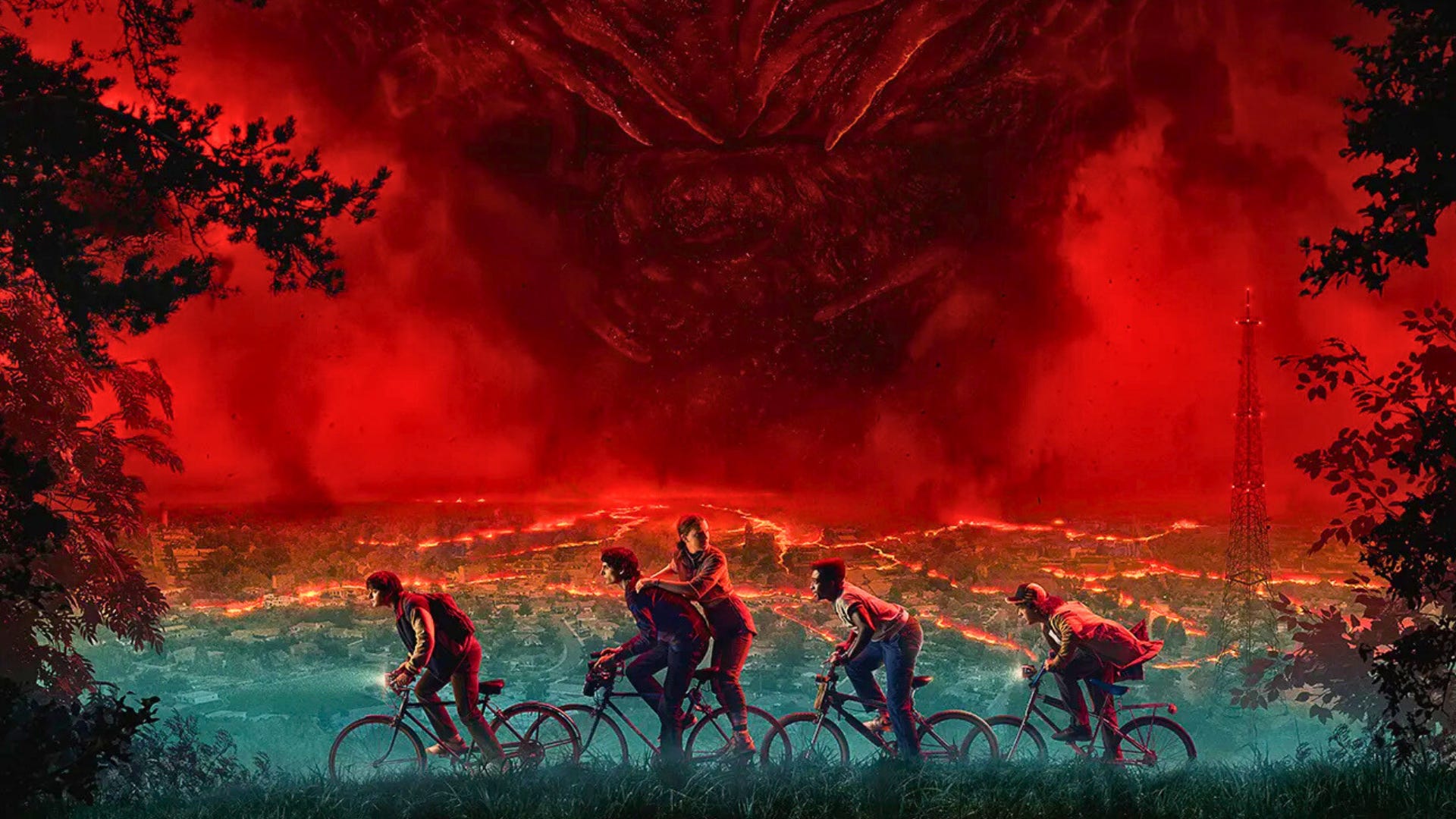
I’ve spent a lot of time trying to figure out how I would approach this piece. I’ve written about Stranger Things and discussed Stranger Things and debated about Stranger Things more times than I care to admit. But after ten years and five seasons, Stranger Things has finally and in some ways thankfully met its end. Although if “Conformity Gate” truthers had their way, a secret ninth episode is dropping any day now. Didn’t you see the clock in the background of that one scene from Season 5? It clearly read 1:07, so we’re getting the true ending on January 7! Only, wait, that’s supposed to be July 1, that’s it! That’s when the real finale is dropping! Get ready, everyone, Vecna lives!
This, of course, is the sort of rhetoric that filled timelines in the immediate aftermath of Season 5, Episode 8, as dissatisfied fans convinced themselves that the ending we got wasn’t the actual ending. Imagine bringing a show to a close in such a sloppy way that you end up causing mass hysteria within your fanbase to the point where everyone is over-analyzing it frame by frame to craft an alternate narrative so that the finale isn’t the true finale. Is that going to be the legacy Stranger Things ultimately leaves behind?
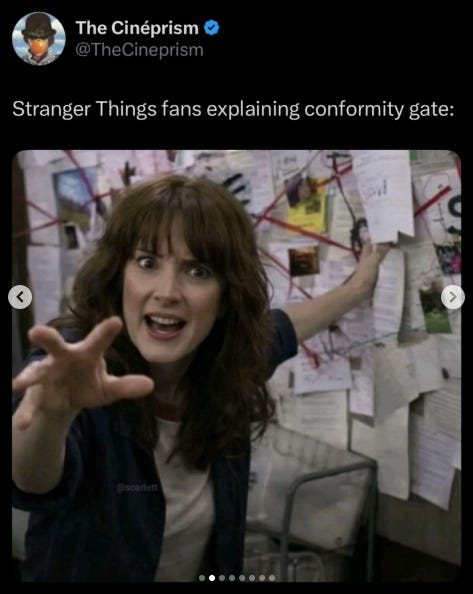
To make matters worse, after what may or may not be the series finale dropped, a special “making-of” documentary was released, in which, among many other troubling revelations, we were privy to one of the Duffer brothers explaining, “You can’t leave anything dangling. You have to wrap everything up.” Audiences immediately picked up on the thick layers of irony with this line (see here, here, here, here, here, and here), especially since Season 5 leaves behind a cavalcade of unanswered questions. For instance:
Why is the realm known as Dimension X or The Abyss completely devoid of the other menacing creatures that have been a staple of the show so far?
Why was the Russian subplot featured so heavily in Seasons 3 and 4, only to be completely irrelevant in Season 5?
How did the Russians even know about the Upside Down?
Why is Jim Hopper shooting and killing military personnel when *checks notes* he himself is a former military personnel?
And why do none of the main cast receive any repercussions for offing dozens of military and government officials throughout Season 5?
How in the world did Dr. Brenner figure out that the Upside Down was a wormhole?!
And what happened to all those pregnant women the government scientists were conducting experiments on when the Upside Down collapsed?
And the one that bothers me the most is how Joyce and Hopper never bring up the fact that they went to high school with Henry Creel, a.k.a. Venca, a.k.a. 001!
Among the many reasons I’ve been struggling to finish this piece is the fact that I was aspiring to head into 2026 with a new outlook on film and entertainment, one that didn’t lead me to resort to nitpicking movies and TV shows to death while watching them. I’ve been known to do that in the past, so much so that it’s hard for me to watch certain media. In the New Year, my goal was to enjoy things for what they are, instead of getting frustrated because my expectations weren’t met. And then Stranger Things 5 was released, and I found myself biting my tongue throughout most of its runtime, which is a long time to bite your tongue, to say the least.
In what is, perhaps, the most frustrating and most telling revelation from the behind-the-scenes doc, Matt and Ross Duffer, along with countless members of the crew, openly admit that Season 5 was being filmed even though the script wasn’t finished yet. And if that’s not alarming enough, at one point, a crew member confesses that while they were filming the series finale, the ending wasn’t written, so no one really knew what they were doing. After two to three years of writing, there was no grand plan to follow. They were sort of making it up as they went along. That’s how it felt, at least.
Now, before you get the wrong impression, I’ve been known to extol my delight in Stranger Things over the years (see here and here). I’ve been a fan ever since I first stumbled across it half a dozen years ago, though my connection to it emerged in a rather strange way. Through the chaos of moving states and switching jobs, I somehow missed Season 1’s debut in 2016 and its follow-up in 2017. And although I don’t remember when or how, after moving to Pennsylvania in the summer of 2019, I began seeing ads for Season 3, which prompted me to commit what might be the cardinal matrimonial sin of the Netflix age: starting a new show without your spouse present.
Nevertheless, I was hooked immediately. The first season of Stranger Things seemed to check all the boxes for what makes for a compelling show in the modern era. Intimate, creative camera work; a score immersed in synth; sharp dialogue; characters that felt real; all set in a world that felt strangely familiar, despite the fact that I was born in the 90s. Soon after, I got my wife on board, and we raced through the first two seasons in time for the premiere of Season 3 in July of 2019. Since then, I’ve watched and re-watched Stranger Things several times over. The show has become more than just a cultural phenomenon at this point. It’s one of the last pieces of entertainment that has felt like a shared experience, which is rare in the streaming era.
Seasons 1 and 2 remain as close to perfect as possible, like an ex officio sequel to Super 8 or The Goonies. The first two seasons are a nimble cocktail of Spielbergian sci-fi wonder and Lovecraftian menace, set against Stephen King’s small-town milieu and synthesized through those Amblin Entertainment sensibilities that often culminate in generational touchstones. With Season 1 remaining near flawless and Season 2 still criminally underrated, Season 3 marked a tonal shift that was apparent at the time. The colors were brighter; the setpieces louder; the script funnier — everything felt a little more indulgent, maybe even a little garish.
But despite what some online rankings might tell you, Season 3 of Stranger Things is probably the most Stranger Things-y of all the Stranger Things entries. (I wrote about it here.) I’m not saying it’s the best, but out of all of them, I think I’ve seen the third season the most times. It’s a breezy, high-contrast watch, what with its 80s influences perfectly dialed in. Kids are getting into shenanigans at the local mall. A discount Russian Terminator henchman is causing chaos. Speaking of, Russians are the bad guys, Cold War paranoia is alive and well, and neighborhood teens are getting caught up in a plot much bigger than them. What’s more 80s than that?
Not to mention Hopper doing his best Tom Selleck impersonation. It’s a great time from start to finish, crescendoing in one of the best final sequences and closing monologues this guy has ever seen. I still get a little teary every time Hopper starts talking about growing up, remembering the hurt, and walking out of that cave.
What makes Season 3 so divisive, though, is that it sort of functions as a bridge to what Stranger Things would eventually become. It teases some of the lore that would become inflated in Seasons 4 and 5, and sets up the show to transition from a desaturated, haunting tale in small-town Hawkins, Indiana, to an labrynthine opera replete with decades of backstory and mythology to unravel. Gone is the feel-good, coming-of-age abandon. Enter a maximalist, Marvel-ized epic that feels too big for its own good. This isn’t to say that Stranger Things wasn’t over-the-top in its earlier iterations. It’s just that the show’s charm, which made up for a lot of that, has been suffocated.
Ultimately, Stranger Things 5 feels like a piece of content that’s too aware of its own standing within the broader cultural marketplace, resulting in a series that feels like two different shows that have been haphazardly smashed together. The eerie and suspenseful tone that dominated Seasons 1 and 2 is set aside in favor of something more spectacular. But the problem is, we weren’t watching Stranger Things for the CGI spectacle, for the action sequences that tried to mimic bigger blockbusters, or for the dizzyingly dense plot. We watched because the kids felt like kids who were forced grow up fast, use their instincts, and learn how to trust each other. They were thrust into incredibly daunting scenarios just as they were coming of age, highlighting the tension and anxiety we all feel growing up.
What’s lost amid all the backstory that unravels like a hanging thread in a knitted sweater is the surprising moments of emotion that were a hallmark of the earlier seasons. Although there are intriguing plot elements and enjoyable callbacks, Stranger Things 5 seems far safer than it should be, making me pine for the smaller, stranger version of this show. I guess what I’ve come to realize is that I’ve become nostalgic for a show whose central tenet is trafficking in nostalgia, which feels incredibly on the nose. I get it. But I can’t help it. I miss what this show once was.