


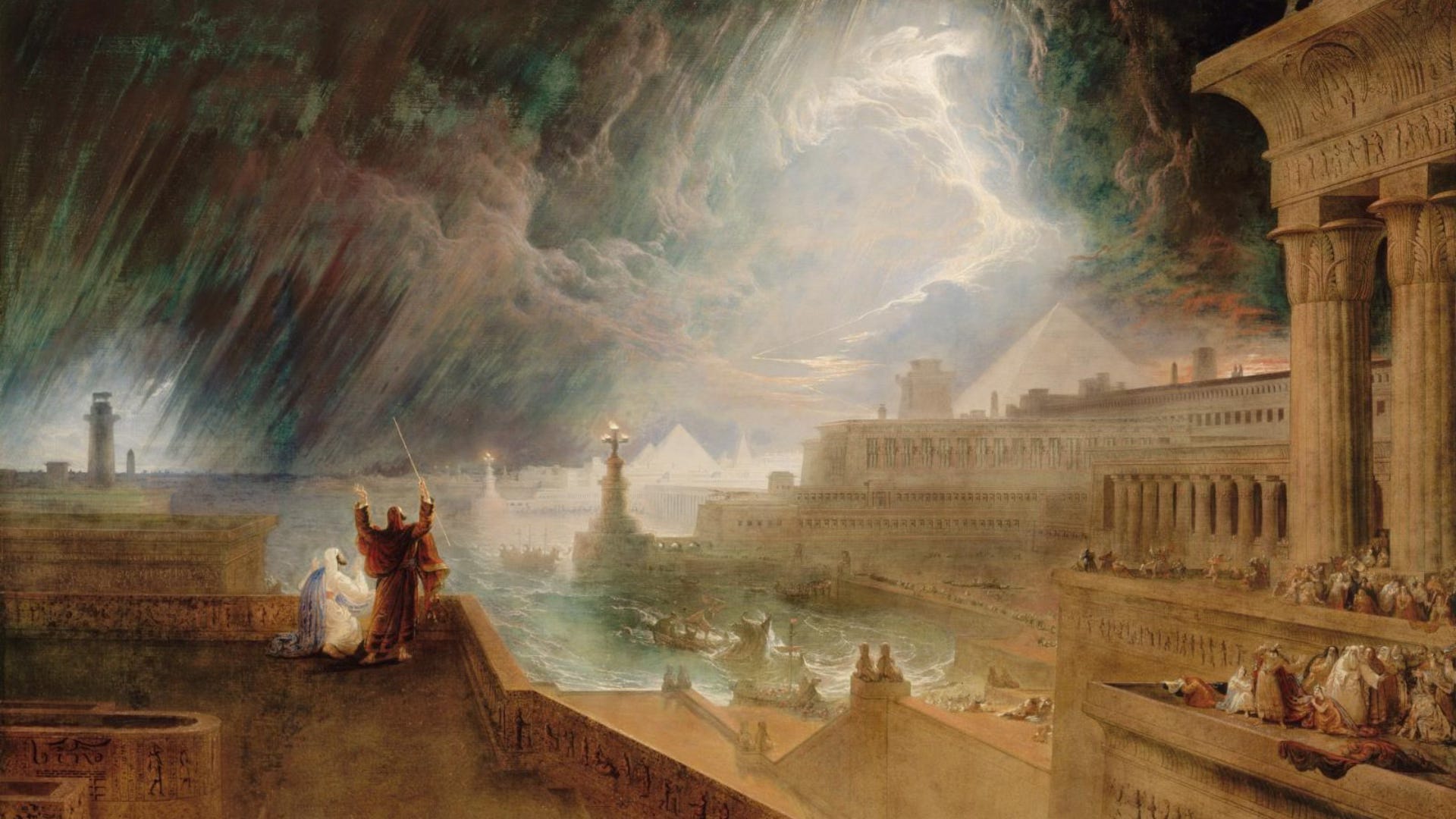
From frogs to gnats to flies to locusts, each of the cataclysmic plagues that befall the Egyptian landscape serves to expose the frailty of the Egyptian pantheon. None of their gods and goddesses could hold a candle to Yahweh,1 a point which he makes abundantly clear through the onslaught of signs and wonders (Exod. 12:29; Num. 33:4; cf. 1 Sam. 4:8). “In a very real sense,” Michael P. V. Barrett notes, “the plague assaults against Pharaoh exposed the nothingness of the entire pantheon. Yahweh’s humbling Pharaoh put the Egyptian gods in their place.”2 God’s “great acts of judgment” were meant for both Egypt and Israel to finally recognize the devastation that those other gods bring. J. Alec Motyer puts it this way:
We are intended to see the nine acts as quite the opposite of chance or any haphazard occurrence. They were designed and planned as a whole with the aim not only of edging Pharaoh to the point of releasing the people, but also presenting proof to Pharaoh and Israel that the Lord is God (Exod. 7:17; 8:10, 22; 9:16; 10:2).3
At the same time, though, there’s a poignant message within these plagues for Pharaoh himself. “They were designed and planned,” Motyer continues, “as a whole with the aim not only of edging Pharaoh to the point of releasing the people, but also presenting proof to Pharaoh and Israel that the Lord is God.”4 In fact, plagues four through nine exhibit a tragic decline in Pharaoh’s heart and life, one that we can’t afford to miss.
1. When God Confronts the Exalted Self
When God calls Moses to warn Pharaoh about the impending plague of flies, he’s also directly addressing Pharaoh himself, motioning him to admit that there’s no higher authority in all the earth other than Yahweh (Exod. 8:20–23). “Pharaoh’s power was great,” Barrett continues, “but God’s was infinitely greater.”5 This becomes even more evident when Moses is sent to announce the seventh plague:
Then the Lord said to Moses, “Rise up early in the morning and present yourself before Pharaoh and say to him, ‘Thus says the Lord, the God of the Hebrews, “Let my people go, that they may serve me. For this time I will send all my plagues on you yourself, and on your servants and your people, so that you may know that there is none like me in all the earth. For by now I could have put out my hand and struck you and your people with pestilence, and you would have been cut off from the earth. But for this purpose I have raised you up, to show you my power, so that my name may be proclaimed in all the earth. You are still exalting yourself against my people and will not let them go. Behold, about this time tomorrow I will cause very heavy hail to fall, such as never has been in Egypt from the day it was founded until now.”’” (Exod. 9:13–18)
If it wasn’t clear before, the plagues leave little doubt that Pharaoh’s prideful heart is in the Lord’s crosshairs (Exod. 9:17). Even so, this narrative is no mere historical one-off, nor is it a story that we can safely observe at a distance. These scenes, like every other syllable in God’s Word, are “living and active” (Heb. 4:12), which means they’re meant to expose the hardness of our hearts as well. Indeed, the record of the plagues that befell Egypt summons us to witness the danger of resisting the Lord, to behold the wonder of his mercy, and to receive his remedy that transforms even the hardest of hearts.
2. The Enigma of a Hardened Heart
The first allusion to Pharaoh’s “hard heart” occurs in Exodus 4:21, where God warns Moses of the resistance he can expect to hear from the autocrat of Egypt. From Chapter 7 through Chapter 10, though, there are over a dozen references to the hardness of his heart (Exod. 7:3–4, 13–14, 22; 8:15, 19, 32; 9:7, 12, 35; 10:1, 20, 27), with the perennial question being, Was this something done to him or something he did to himself? Did God harden Pharaoh’s heart or did he harden his own heart? Well, the unhelpful, albeit true, answer is yes to both. Scripture attributes the Pharaoh’s steely, stubborn demeanor both to his bloated ego and self-importance and to the finger of God on his life. This, of course, has embroiled theologians in considerable debates about free will, predestination, and where human responsibility fits into all of that. And while I don’t presume to have a robust solution for that conundrum, neither do we have to explain away or avoid the tension this naturally creates.
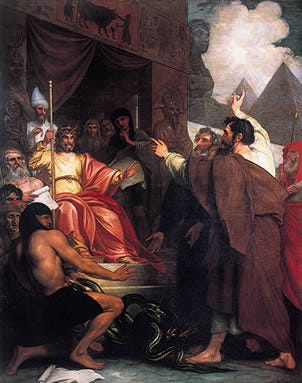

The fact of the matter is, Pharaoh hardened his own heart through his own conscious decision-making (Exod. 8:15, 32), but it was also hardened by a work of the Lord on him and among him (Exod. 9:12; 10:1, 20). Instead of getting lost and mired in the metaphysics and mystery of it all, I think it’s helpful to understand this as Pharaoh choosing pride, and God allowing his pride to run its full course. “In hardening his heart,” says Barrett, “God simply let Pharaoh be Pharaoh.”6 It’s reminiscent of what the apostle Paul says in his letter to the Romans, where he suggests that “God gave mankind up” to its own lusts (Rom. 1:24). Since the hearts of humankind were given over to impurity and everything that’s contrary to God’s nature, he gave them over to what they had already said in their hearts and by their actions they wanted (Rom. 1:28). To be sure, heaven’s most piercing judgment is when we’re released to chase after all our “dishonorable passions,” uninhibited.
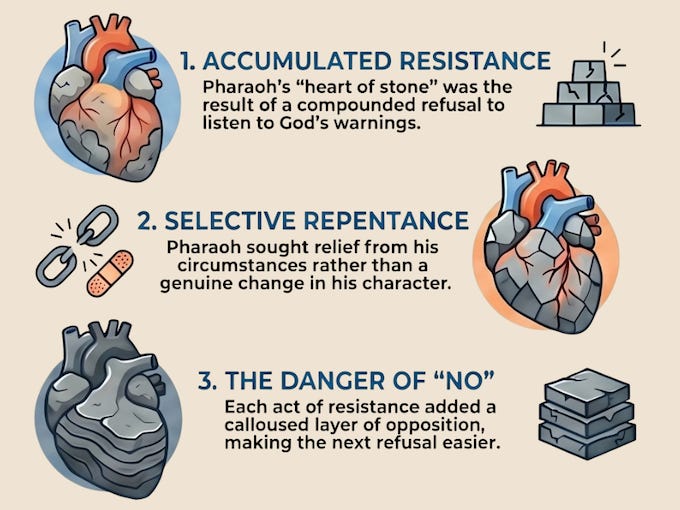
In many ways, this is what transpires with Pharaoh. His posture is one of blatant defiance. After all, he’s the pagan king of a pagan nation, whose closest advisors are occultist counselors. This is just to say that Pharaoh isn’t a neutral party, nor is his story one of sudden rebellion. Rather, it’s one of accumulated resistance and compounded refusal to listen to God and the messengers who brought God’s words to him. Despite his affinity for idols, hostility for divine authority, and enmity with the Lord, Pharaoh tragically and dreadfully declines opportunity after opportunity to open his eyes to the truth. Despite “multiple offers to comply with God’s demands,” Barrett continues, “Pharaoh refused, and each refusal hardened his heart a bit more. His heart remained insensitive because he did what he wanted to do, and God did not stop him from doing it.”7
3. Selective Repentance and the Anatomy of Decline
Accordingly, every time we come across Pharaoh’s “hard heart,” we should recognize it for the tragedy that it is, because the plagues that afflicted his nation weren’t merely judgments; they were invitations to repent. And although he appears to do just that a few times throughout this sequence, each so-called “change of heart” constitutes little more than an act of “selective repentance,” where he attempts to insert his will into the equation, plunging himself, his household, and his entire kingdom further into ruin (Exod. 8:24). For instance, after okaying Moses’s latest request for Israel’s freedom to sacrifice to their God, he insists that they do so according to his terms and stay “within the land” (Exod. 8:25). This, of course, defeats the purpose, leading Moses to refuse Pharaoh’s proposal, especially since he knows that they were to do only as the Lord told them to do (Exod. 8:27). But after some more himming-and-hawing, and empty promises, the flies are removed, as is Pharaoh’s compliance. “Pharaoh hardened his heart this time also, and did not let the people go” (Exod. 8:32).
A similar sequence occurs during the seventh plague, in which an unprecedented hail storm rains down on the land (Exod. 9:23–25), which seems to bring Pharaoh to his knees (Exod. 9:27–28). Moses doesn’t buy it, calling out the king for his supposed contrition, only to be proven right yet again, as Pharaoh’s remorse fades along with the thunderhead following Moses’s prayer. All he was after was relief from the torrential downpour of hail, and when he got that, he chose to sin (Exod. 9:34). And would you believe this same cycle happens once again? After the eighth plague blankets the Egyptian countryside with “such a dense swarm of locusts as had never been before, nor ever will be again” (Exod. 10:14), Pharaoh anxiously asks Moses to ask his God for forgiveness, only to yet again default on his word:
Then Pharaoh hastily called Moses and Aaron and said, “I have sinned against the Lord your God, and against you. Now therefore, forgive my sin, please, only this once, and plead with the Lord your God only to remove this death from me.” So he went out from Pharaoh and pleaded with the Lord. And the Lord turned the wind into a very strong west wind, which lifted the locusts and drove them into the Red Sea. Not a single locust was left in all the country of Egypt. But the Lord hardened Pharaoh’s heart, and he did not let the people of Israel go. (Exod. 10:16–20)
This sequence is both tiresome and tragic, offering us a searing look at the anatomy of a hardened heart. Each “no” gets easier and easier to say. Each declaration of resistance adds yet another calloused layer of opposition to the heart, until, eventually, divine opportunities to repent go largely ignored, and all you’re after is relief from whatever troubling circumstance you find yourself in. The point is that contrition born out of convenience won’t last. True repentance comes from conviction and confession, and the recognition that what you need isn’t a change of circumstances; it’s a change of heart.
4. Mercy in the Midst of Judgment
What’s so compelling about the plagues is that not only do they show how hard Pharaoh’s heart was, but they also show how merciful God’s heart is. Even though this might not be apparent, at first, this whole ordeal could’ve been over after only one plague. Pharaoh’s initial resistance to God and his word could have, and probably should have, resulted in him being snuffed out. Indeed, this is precisely what the Lord says in the build-up to the seventh plague. “For by now,” God divulges, “I could have put out my hand and struck you and your people with pestilence, and you would have been cut off from the earth. But for this purpose I have raised you up, to show you my power, so that my name may be proclaimed in all the earth” (Exod. 9:15–16). The fact that God “could have” wiped Pharaoh’s name from the face of the earth, but didn’t, is irrefutable proof of his mercy and patience.
After all, what is mercy? It’s not getting what you rightly deserve, which means Pharaoh has been swimming in mercy for ten chapters at this point. His constant backpedaling, dishonesty, empty promises, and shallow remorse should’ve earned him the verdict of being “cut off,” and yet, God stays his hand. It’s mercy all the way through and all the way down, which reshapes our entire approach to this narrative. This isn’t the Lord losing his temper with Egypt ten times over; it’s the Lord revealing both the depths of human hubris and the infinitely deeper depths of his mercy. Every encounter with God’s messengers was yet another occasion for Pharaoh to humble himself before God alone. All those audiences with Moses and Aaron, all the warnings, all the plagues, and even all the pauses between the plagues are tokens of Yahweh’s merciful restraint.
Consequently, the plagues are effectively a divine display of just how long-suffering God is, which ought to leave us speechless. He’s demonstrating to Pharaoh, Israel, and us what lies in his heart of hearts. As the prophet Micah tells us, the Lord doesn’t “retain his anger forever, because he delights in steadfast love” (Micah 7:18). “I have no pleasure in the death of anyone, declares the Lord God,” through the prophet Ezekiel, “so turn, and live” (Ezek. 18:32). He is “patient toward you,” the apostle Peter echoes, “not wishing that any should perish, but that all should reach repentance” (2 Pet. 3:9). Mercy isn’t lenience, though, and the fact that God is “rich in mercy” (Eph. 2:4) doesn’t mean that he overlooks sin. Humanity’s sins are dealt with in the person of Jesus on the cross, which means that, in the abundance of his kindness toward us, he gives us space to repent. Mercy, in other words, is the prolonged cessation of judgment to bring about repentance (Rom. 2:4).
And you’d think that Pharaoh would learn his lesson after one plague, let alone ten! This is, essentially, God’s question to him near the onset of plague number eight. “How long are you gonna keep this up?” the Lord inquires (Exod. 10:3). There even comes a point where Pharaoh’s own servants wonder when their king was going to admit defeat and cut his losses (Exod. 10:7). But every time it appeared Pharaoh was about to fall to his knees, and into mercy, he let those moments slip through his fingers (Exod. 10:8–11), deepening his tragic descent into pride. With all of Egypt at a standstill after being covered in a darkness so thick you could feel it (Exod. 10:21–23), and after yet another round of empty promises, Pharaoh arrives at his point of no return. “Get away from me,” he bellows at Moses, “take care never to see my face again, for on the day you see my face you shall die” (Exod. 10:28). This climactic act of resistance sees him sever all ties from the only one who could speak life into his darkness. Shutting Moses out meant shutting God and his mercy out.
5. The Only Cure for Hearts of Stone
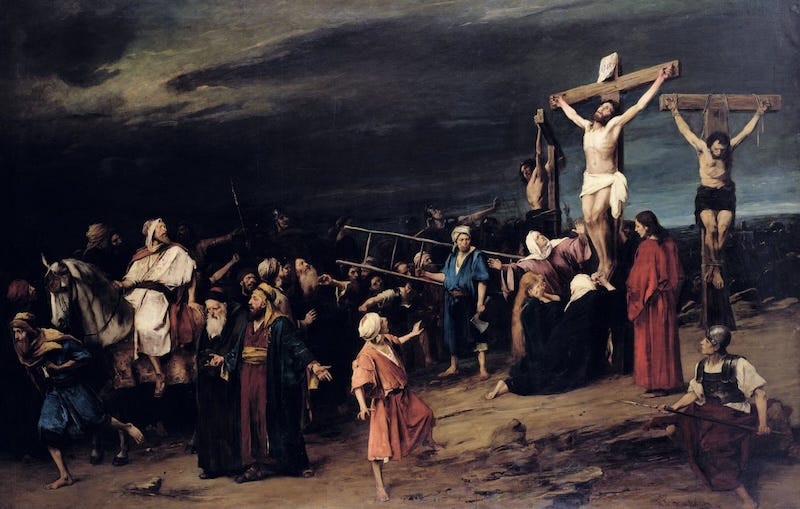
If Pharaoh’s story shows us the tragedy of a hard heart and the mercy that meets it, it also leaves us longing for a remedy. After all, Pharaoh isn’t the only one with a heart made of granite. So, what hope is there for hard hearts like Pharaoh’s and ours? What’s the cure? There’s only one remedy for hearts of stone: Someone who can transform them. That Someone, of course, is the Christ of God, who offers something immensely better than a second chance. He gives us a new heart. “It is only as God intervenes and replaces the hard and stony heart with a new heart of flesh,” Barrett concludes, “that deliverance from self and sin is possible.”8 The gospel of God, in other words, is the announcement of divine heart surgery:
Therefore say to the house of Israel, Thus says the Lord God: It is not for your sake, O house of Israel, that I am about to act, but for the sake of my holy name, which you have profaned among the nations to which you came. And I will vindicate the holiness of my great name, which has been profaned among the nations, and which you have profaned among them. And the nations will know that I am the Lord, declares the Lord God, when through you I vindicate my holiness before their eyes. I will take you from the nations and gather you from all the countries and bring you into your own land. I will sprinkle clean water on you, and you shall be clean from all your uncleannesses, and from all your idols I will cleanse you. And I will give you a new heart, and a new spirit I will put within you. And I will remove the heart of stone from your flesh and give you a heart of flesh. (Ezek. 36:22–26)
What Pharaoh refused to do, and what we often fail to do, Christ does for us. Where we harden ourselves, Jesus humbled himself. Where we follow Pharaoh’s example and say, “Who is the Lord that I should obey him?” Jesus says, “I have come down from heaven, not to do my own will, but the will of him who sent me” (John 6:38). Through his obedience, even unto death, every sinner is invited to be made new and receive a new heart. The good news is that the Heavenly Father remedies hard hearts, not by striking us down, but by sending his only Son to be struck down in our place, taking on himself the wrath we deserved and giving us mercy in return. Mercy in the form of flesh. Mercy that he never tires of giving.
There is no other god except him (Exod. 7:17; 8:10, 22; 9:14, 29; 10:2; Isa. 41:20; 43:10; 45:3; 49:23; 60:16; Ezek. 36:23).
Michael P. V. Barrett, The Gospel of Exodus: Misery, Deliverance, Gratitude (Grand Rapids, MI: Reformation Heritage Books, 2020), 102.
J. Alec Motyer, The Message of Exodus: The Days of Our Pilgrimage, Revised Edition, The Bible Speaks Today (Downers Grove, IL: InterVarsity Press, 2021), 99.
Motyer, 99.
Barrett, 87.
Barrett, 97.
Barrett, 98.
Barrett, 98–99.