


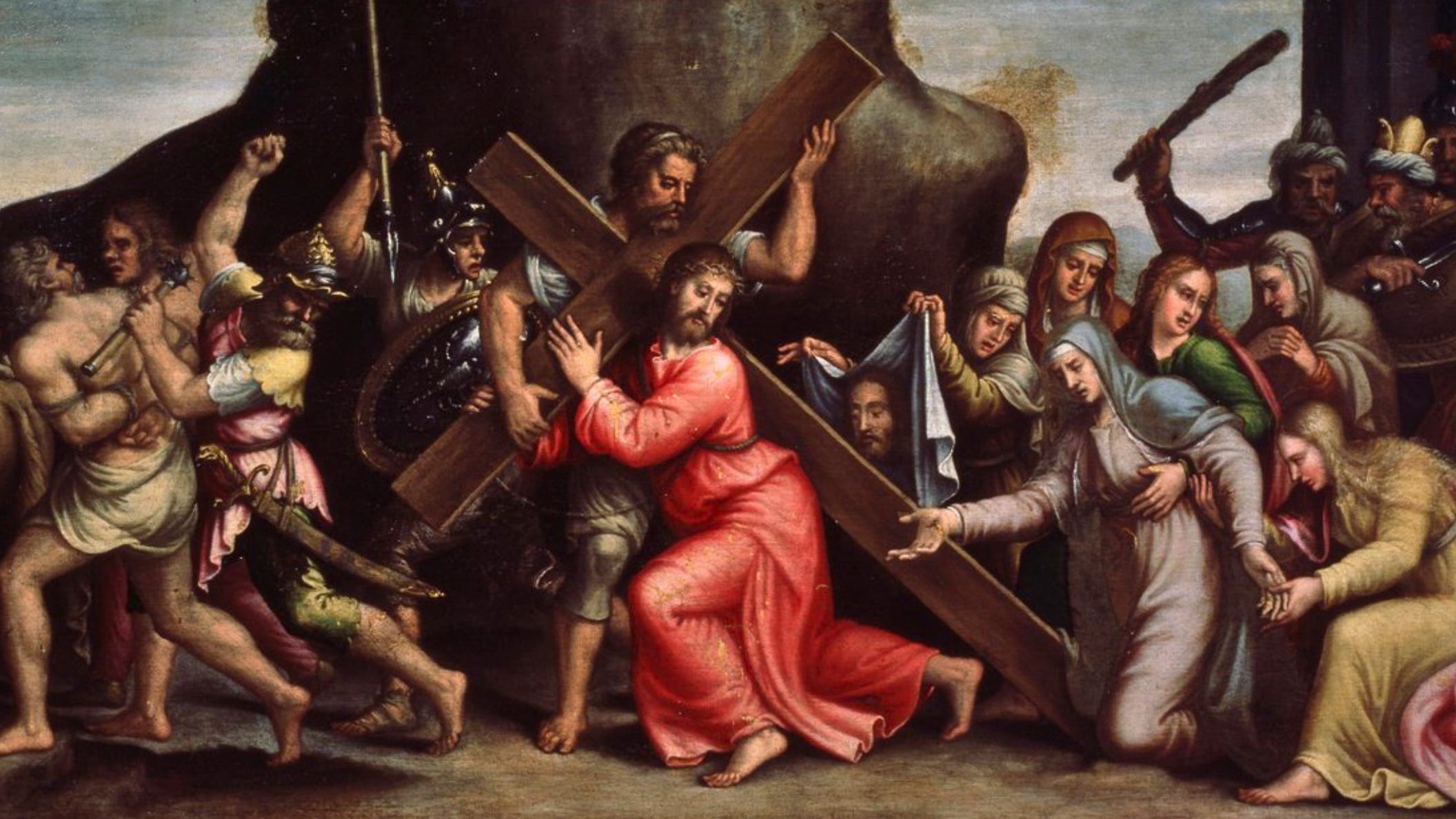
I love that quote that’s often attributed to St. Augustine about the cross serving as Satan’s mousetrap. I’ve used it a few times in various venues (here, here, and here, for example), and each time, I’m enthralled by the preacher of Hippo’s ability to capture the sudden cosmic surprise of the cross. Our foe, spiritual though he is, isn’t omniscient. The will and ways of the Lord are beyond his searching. Thus, as his nemeses closed in around him in an ever-thickening plot, Jesus remained undisturbed, despite the betrayal and convoluted scheme that led to his conviction, not because he was ambivalent to what was unfolding in front of him or around him, but because he was aware of the deeper purposes of the Godhead that were at that very moment converging.
In the future, though, I may opt to use the following excerpt from the late James S. Stewart, a minister of the Church of Scotland, who, in his book The Strong Name, conveys the same Augustinian imagery of the evil one being caught in his own snare. Here’s how he puts it:
It is a glorious phrase — “He led captivity captive.” The very triumphs of His foes, it means, He used for their defeat. He compelled their dark achievements to subserve His ends, not theirs. They nailed Him to the tree, not knowing that by that very act they were bringing the world to His feet. They gave Him a cross, not guessing that He would make it a throne. They flung Him outside the gates to die, not knowing that in that very moment they were lifting up all the gates of the universe, to let the King come in. They thought to root out His doctrines, not understanding that they were implanting imperishably in the hearts of men the very name they intended to destroy. They thought they had God with His back to the wall, pinned and helpless and defeated: they did not know that it was God Himself who had tracked them down. He did not conquer in spite of the dark mystery of evil. He conquered through it. He led captivity captive.1
Quoting Psalm 68:18 — “You ascended on high, leading a host of captives in your train” — which the apostle Paul later cites as well (Eph. 4:8; cf. 2 Cor. 2:14–17; Col. 2:13–15), Stewart communicates the incongruity of the cross, where what was intended to bring about death and destruction actually culminated in life and salvation. Judas’s duplicity, Pilate’s passivity, and Rome’s cruelty might’ve seemed like the worst of all defeats in history writ large. No one could fathom the shame and embarrassment of it all, especially for those who’d associated with Jesus and vouched for him all those years prior. Yet, there he was, the object of ridicule and the epitome of disgrace, pegged to a Roman torture device, with his own people spitting on his name.
But the darkness and horror of that scene didn’t really capture what was really going on. Because all the while, “the definite plan and foreknowledge of God” were unfurling, with the crucified Christ at the very center of it all (Acts 2:23). That’s where he always is. All the threads of space and time intersect on a hill called Calvary, where a Rabbi from Nazareth was executed. But what looked like failure and ruin was, in fact, the source of faith and redemption. Hell, I suppose, rejoiced too soon. Because grace always wins.
Grace and peace to you.
James S. Stewart, The Strong Name (Edinburgh: T. & T. Clark, 1956), 55.