



A common temptation afflicts us all whenever we arrive at the end of one of the New Testament epistles, which coaxes us to skim if not altogether skip the author’s closing remarks. Paul, in particular, is a victim of this, especially when he starts rattling off a laundry list of names, greetings, and what appear to be mundane requests. For instance, during the close of his second letter to Timothy, Paul insists that his protégé bring the cloak that he left in Troas when he comes to visit him in prison (2 Tim. 4:13). Another good example of this occurs in Romans 16, where, in the span of sixteen verses, the apostle mentions no less than twenty-six other individuals, most of whom remain largely unknown to us. A similar feature appears in the conclusion of the letter to the Colossians, where even amid all the well-wishes, the text is laced with a poignant sense of “what’s next” (cf. Col. 4:7–17).1
1. Facing What’s Next
Within this catalog of names lay a bevy of key details that suggest there is still more ministry to be done, in particular when Paul admonishes Archippus to “fulfill [his] ministry” (Col. 4:17). This, of course, is the same Archippus who pops up in Philemon 1:2, whom the apostle refers to as a “fellow soldier.” In short, Archippus was the interim pastor in Colossae while Epaphras visited Paul in Rome, which is the story that’s conveyed in the letter to Philemon. Nevertheless, just as Paul received his gospel from the Lord and dispatched the same to Timothy (2 Tim. 4:5), so, too, had Archippus been given the same charge. In other words, the health and vitality of the church depends on Timothys and Archippuses carrying out their task to declare the mystery and grace of the word of Christ, without ceasing.
Furthermore, Paul reveals that Tychicus and Onesimus (again from the letter to Philemon) are both being sent to them with words of encouragement. In a profound way, they were commissioned to convey Paul’s heart for the Colossians since he couldn’t be there personally. Even still, he perceived the burgeoning hardships they were facing. The extant difficulties and controversies at Colossae were merely a taste of what was to come. Paul was no dummy — he was well aware that the problems with the Colossians weren’t confined just to them. Thus, he instructs the elders at Colossae to share their letter with the Laodiceans, and vice versa (Col. 4:16). This, to be sure, isn’t because Paul fancied himself a silver-tongued writer. Rather, he wants these words dispensed precisely because they’re not his own; they’re God’s. Paul was merely the conduit by which the divine message of grace and truth was communicated to God’s people.
Accordingly, both then and now, the church only endures because of the preponderance of the word of Christ. Indeed, only as that Word dwells “richly” (πλουσίως) in the hearts and lives of those who belong to the Lord will the church be able to navigate “what’s next.” But in light of everything he has said up to this point in the letter, what does Paul expect from them? What does he want them to do? What do his closing remarks have to do with us? As we face a future that is equally unknown, how can we traverse “what’s next”? The answer is not as complicated as you might think.
2. The Posture of Dependence
Unsurprisingly, Paul begins with the most pressing need of every age and hour — namely, prayer (Col. 4:2–3). As the Colossians faced daunting days ahead, they would only be able to do so as they continued at all times in prayer, a sentiment that echoes what Paul said to the Thessalonians years prior (1 Thess. 5:17). The expectation, though, isn’t for the Colossians to cloister themselves off from the rest of the world like monks to petition the Lord 24/7. Rather, this is more about the posture of their hearts. To put it another way, he is drawing attention to the practice of prayer so that they realize just how prevalent the need for it is. “We need to pray,” H. A. Ironside once said, “as much as we need to breathe.”2 Prayer, you might say, is the most important of all the Christian disciplines, not the least of which because Christ himself fully embraced its necessity.
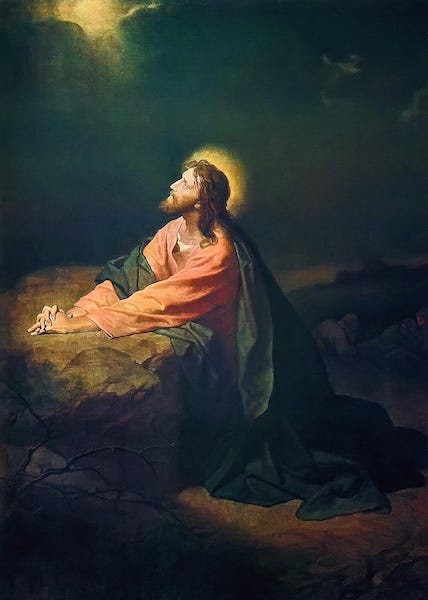
Throughout the Gospels, we are treated to numerous instances of the Incarnate Lord embodying a posture of “continuing steadfastly in prayer.” He prayed before the feeding of the 5,000, and after it, too. He prayed before he chose the twelve apostles. He prayed before his transfiguration. He prayed before he asked his followers who he was. And he prayed before, and during, his crucifixion. He not only told his followers how to pray, but he also showed them, as he modeled a life of prayer, which is a life of dependence. Indeed, the prevailing benefit of prayer is that it compels you to acknowledge how dependent you are. Contrary to what you think or want to believe, you aren’t sufficient in and of yourself. You are a creature whose physical and spiritual life is reliant on Someone Else. And that’s sort of the point: prayer is the very breath of faith. It’s the expression of your trust in the will and word of God reiterated back to God himself.
This is likely why prayer is often the first casualty of our increasingly busy schedules — namely, because no one’s eager to admit that they aren’t as self-reliant as they think they are. Who has time for it anyway? Our calendars are full; who has time to pray? Who has the time to just sit in the quiet and not really “do” anything? Paul’s exhortation is remarkably counterintuitive, because instead of stressing the need to “defend” the gospel with loud, bombastic shows of force, he insists that the church’s chief priority is dependence, using Epaphras as an example (Col. 4:12–13). Even though he has been away, he hasn’t been idle. Far from it. He was “hard at work” for them, “struggling” for them, and going to war for them “in his prayers.” Rather than relying on the latest gimmicks Jerusalem had to offer or clinging to his own capacity, Epaphras was following Paul, who was following Christ’s example of dependence. He was praying about it, over it, and through it. He was continuing steadfastly in prayer.
While some folks are clamoring for the church of today to do this, that, or the other thing as these days grow increasingly tenuous on all fronts, the greatest and profoundest practice the church could ever do is get on its knees and pray. As R. C. Lucas trenchantly notes, “It is in a prayerless church that the enemy can best do his work of disruption.”3
3. Trusting God’s Hidden Hand
When Paul exhorts the Colossians to pray, he also specifies what they should pray for — in particular, for he and Timothy to have an open door “to declare the mystery of Christ” (Col. 4:3). As a steward of “God’s mystery, which is Christ” (Col. 2:2), Paul understood that his priority was to make God’s words “fully known” (Col. 1:25). But now that he was sitting in a Roman jail cell, under imperial guard, that commission felt far less feasible. Practically speaking, the door of ministry had been firmly shut, with the prospect of his release being slim to none. But Paul’s faith was tethered to something far better than what human eyes could observe — namely, he clung to the fact that the only one who could do something about his incarceration was the one who allowed him to be there in the first place.
Instead of cajoling the Colossians to start rioting or asking each of them to write furious op-eds to their senators about how unjustly he was being treated, he simply asks them to pray, depending on the God of all grace, “to open a door.” Although I’m sure he was eager not to be in a jail cell any longer than he had to be, his prayer wasn’t for his own freedom, but for an open door for “the word of the truth, the gospel” (Col. 1:5). Even as he sat behind bars during the “prime” of his ministry career, Paul’s resolve for the gospel wasn’t dampened. His most earnest desire was to preach the words of Christ, shining a bright spotlight on the gracious announcement of hope for sinners in the blood of the Crucified One. What’s so fascinating is that God providentially does answer Paul’s prayer, just not in the way he, or anyone else, for that matter, expected.
4. The Open Door of Providence

In this letter to the church at Philippi, Paul sends word about his imprisonment, and contrary to what anyone might’ve anticipated, he notes how his incarceration hasn’t hindered the gospel at all, not in the least. Rather, it has “served to advance the gospel” (Phil. 1:12–14). The “open door” that Paul requested prayer for was opened by Christ’s Spirit, as the hearts of those in charge of keeping him locked up were opened. Even though Paul might’ve been a captive of Rome, all that really means is that he had a captive audience to hear the truth about what Christ did for them. Accordingly, God’s providence rarely, if ever, looks like things working out how we want or expect. More often than not, God’s providence means things working out so much better.4 Instead of Paul getting released, not only is the gospel echoing in the halls of a Roman prison, but also the church is privy to God’s written word, as the so-called “Prison Epistles” (Ephesians, Philippians, Colossians, and Philemon) all bear witness to the open door of God’s word of grace.
Consequently, when Paul asks the Colossians to pray, he’s inviting them to trust in the fact that the Lord who was sovereign over their salvation is the same Lord who is sovereign in every circumstance. This, to be sure, is difficult to see in the moment. Trusting that God is providentially working things out for the better isn’t easy when you’re in prison, or when the oncologist says your cancer is back, or when the promotion you were expecting goes to someone else, or when the roof over your head caves in, literally and figuratively, or when everything you figured was a sure bet turns out to be a losing hand. Where’s God’s providence in those times? Is it still there? Or does it ebb and flow?
The abiding testimony of the Word reminds us that, contrary to what’s seen, there is a hidden providence at work, all the time. It may be hidden in pain, heartache, and frustration, but it’s still there. This is what allowed Joseph to say, “As for you, you meant evil against me, but God meant it for good” (Gen. 50:20), and the prophet Shemaiah to similarly say, “This thing is from me” (1 Kings 12:24). It requires faith even beyond what we could ever muster to believe that this is true, which is why it’s so critical that we “continue in prayer.” We pray because we trust in God, depending on him and his word, and the more we trust him, the more we pray.
5. Salted Speech and Gracious Steps
All that praying and trusting in God’s gracious providence puts us in a position to do what the Lord told his apostles to do — namely, to go and “make disciples of all nations, baptizing them in the name of the Father and of the Son and of the Holy Spirit [and] teaching them to observe all that I have commanded you” (Matt. 28:19–20). That moment just before Christ’s ascension was a literal “what’s next” moment. Luke later tells us that the apostles were so in awe of what they saw that an angel had to come down to shake them out of their daze (Acts 1:9–11). A similarly-themed commissioning word is given by Paul to the Colossians when he writes, “Walk in wisdom toward outsiders, making the best use of the time. Let your speech always be gracious, seasoned with salt, so that you may know how you ought to answer each person” (Col. 4:5–6).

Effectively, the apostle lets it be known that there was still more ministry to be done, still more “outsiders” to bring inside, and still more souls to be “made alive” by the gospel. It’s the church’s responsibility to walk in such a way that “outsiders” aren’t kept on the outside, which is why Paul exhorts them to “walk in wisdom” and talk “in grace.” All too often, individuals are left on the outside of the church because of (1) the way the folks on the inside are treating each other or (2) the way the folks on the inside respond to those on the outside. “Christianity,” Alexander Maclaren once wrote, “has too often been misrepresented by its professors, who have looked down upon those that are without with supercilious and unchristian self-complacency.”5 In one fell swoop, Paul addresses the pitfalls of infighting and exclusivity that ruin the church’s witness. There’s no time for those in the church to be bickering with each other or biting one another’s heads off over worship styles, Bible translations, and entertainment choices, especially when there are folks you encounter on a daily basis who are still “outsiders” who need to be brought in.
The incorporation of sinners into the covenant community happens when the church’s words are “seasoned with salt” (Col. 4:6). Salt, of course, isn’t merely a “food enhancer”; it’s a preservative agent. Meats that are cured with salt can have a shelf-life of months or even years, protecting them from spoilage and other harmful bacteria. In other contexts, salt can be used to clean wounds, providing a healing burn to prevent infection. When Paul says that the church’s speech be “seasoned with salt,” he isn’t suggesting that we bludgeon folks in the head with religion or that we go picketing every chance we get. Rather, it means we preach God’s law and God’s gospel unashamedly and unhesitatingly. “The pulpit,” R. C. H. Lenski comments, “needs wisdom, the grace and the salt of the gospel. The food it offers is often too cheap in both content and seasoning.”6 The saltiness of the church’s message means that we can be honest about what God’s Word reveals — namely, that no amount of self-improvement or self-help can save anyone. Ours is a message that compels us to proclaim the words of God that kill and “make alive” (2 Cor. 3:6). After all, the only hope any of us has is found in the wounds of the Crucified One.
Paul’s closing words aren’t skippable. Rather, they remind us that “what’s next” is never a truly known commodity. The future is never ours to control or intuit, which is why prayer is so crucial — not because it twists God’s arm, but because it untwists our hearts. In so doing, we learn to trust in providence, not because it guarantees an easy road, but because it assures us that no road is bereft of grace. When Paul says “Grace be with you” (Col. 4:18), he isn’t merely signing off; he’s repeating the promise that undergirds all of our days (Matt. 28:20), that there is one who is with us, to the end of the age.
For what it’s worth, I take Paul’s inclusion of Mark in verse 10 as evidence of his reconciliation with Barnabas, a subtle hint that what he wrote about in the previous chapter (Col. 3:12–13) had been put into practice (cf. Acts 15:36–41).
H. A. Ironside, Lectures on the Epistle to the Colossians (New York: Loizeaux Bros., 1943), 166.
R. C. Lucas, The Message of Colossians & Philemon: Fullness and Freedom, The Bible Speaks Today Series (Downers Grove, IL: InterVarsity Press, 2020), 172.
I like how my friend Griffin Gooch puts it when he writes, “If we aren’t getting the answers we’re hoping for, it’s not because of His lack of care, but likely for some reason that transcends our comprehension.” By the way, if you somehow missed it, you should stop what you’re doing and read Griffin’s essay “What’s the Point of Prayer?” It’s phenomenal.
Alexander Maclaren, Expositions of Holy Scripture, Vols. 1–17 (Grand Rapids, MI: Eerdmans, 1944), 14.2.143.
R. C. H. Lenski, The Interpretation of St. Paul’s Epistles to the Colossians, to the Thessalonians, to Timothy, to Titus, and to Philemon (Minneapolis, MN: Augsburg, 1961), 195.
Beautiful. Love this one Brad!
Thank you! 👍