


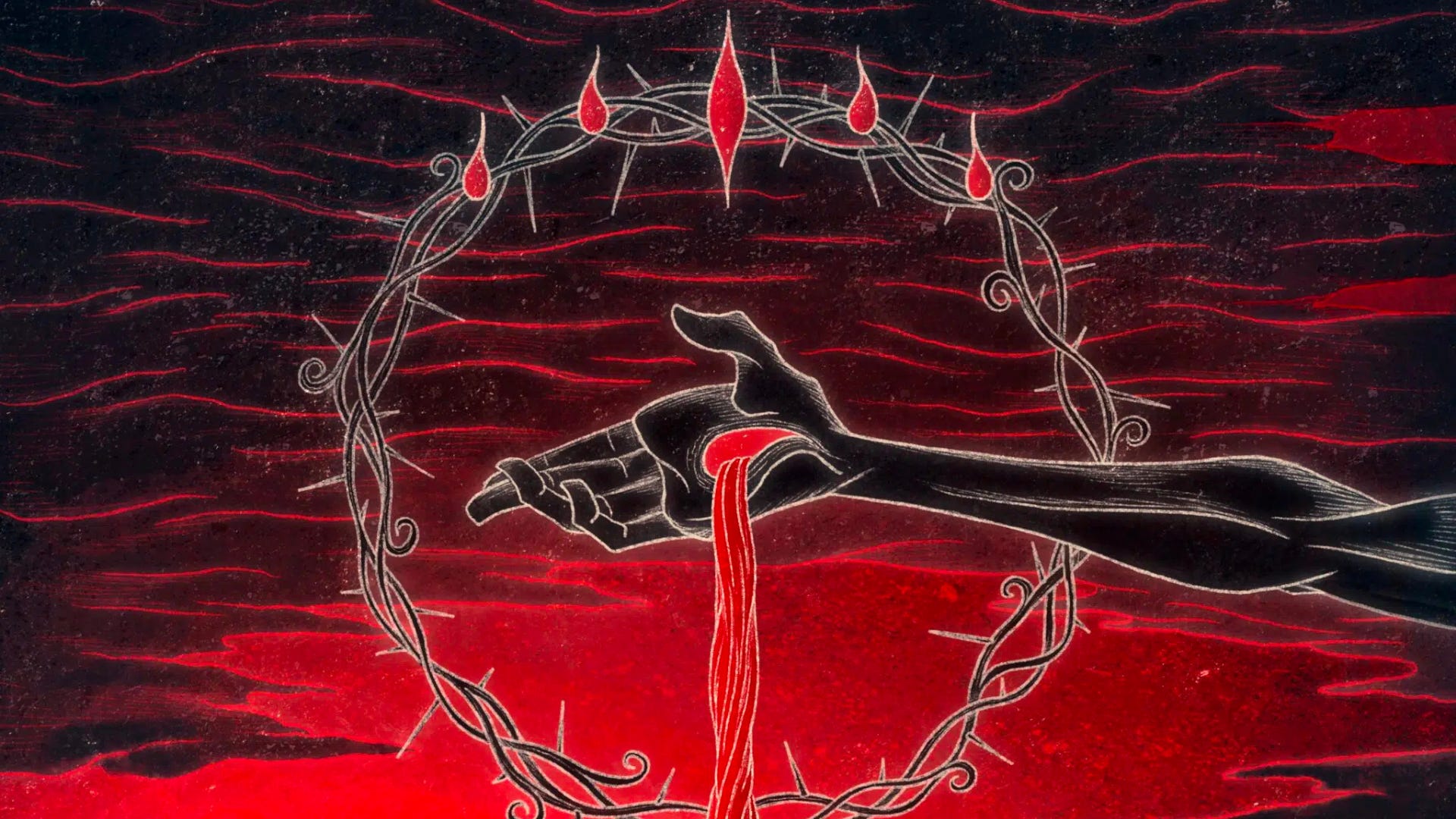
Having recently preached through the middle chunk of Exodus, where the Lord enumerates the program by which his people are brought into communion with him, the recurrent sacrifices that played such a significant role in Israelite life are on my mind. When reading the Old Testament, it’s hard not to come across the ritual slaughter of bulls or lambs, a feature that often makes some modern evangelicals squeamish. The thought of slitting the throat of Mary’s little lamb is unsettling enough, but doing so daily, and twice a day at that, makes me more than glad to be living in the twenty-first century. And yet, by the same token, no matter what era of history in which they exist, Christians cannot escape the blood.
Time precludes me from cataloging them all, but suffice it to say, the church has an affinity for hymns and songs that laud the blood of Christ. Just off the top of my head, I’m thinking of “Nothing But the Blood,” “There Is Pow’r in the Blood,” and “The Blood Will Never Lose Its Power.” As strange as it may seem for folks to be assembled and sing in unison about blood being shed and flowing like a crimson river, it’s not without reason. The writer of Hebrews says it plainly: “Without the shedding of blood there is no forgiveness of sins” (Heb. 9:22). But this isn’t a hallmark of the New Testament; this has always been true of those who belong to the Father.
In Exodus 24, prior to Moses receiving the blueprints for the Tabernacle and the SOPs for the priests, God’s covenant is ratified in one of the most striking displays of the gospel in the Old Testament. After constructing an altar and burning oxen on it as offerings to the Lord, Moses takes a bowl of blood and douses the altar with it before taking another bowl and sprinkling the people with it (Exod. 24:6–8). Of course, at first, yuck. But also, whoa! Both the altar where God’s people commune with God and the people themselves are covered in the same sacrificial blood, thereby rectifying whatever breach might have existed beforehand. The people’s failure to measure up to the Father’s holy demand, as announced in the Decalogue, is resolved in blood being shed for them.
However barbaric this ceremony might seem to our modern predilections, its ingredients are pure gospel. Without it, the gospel wouldn’t make much sense. Nineteenth-century pastor and theologian Alexander Maclaren once said that the “drenching of the altar with gore is either a piece of barbarism or a solemn symbol of the central fact of Christianity no less than of Judaism, and a token that the only footing on which man can be received into fellowship with God is through the offering of a pure life, instead of the sinner, which, accepted by God, covers or expiates sin.”1 Put differently, to understand the Old Testament ritualism of Exodus and Leviticus, read the New Testament letter to the Hebrews.
The gory scenes that accompanied altars and offerings weren’t to satisfy a sadistic Hebrew bloodlust; they preached something. Every sacrifice was a sermon, a signpost that motioned the worshipers’ gaze forward, to the one who would eventually make good on every promise of every altar and every sacrificial lamb. In that sense, we can and must draw a straight line from Exodus 24 to the cross, from Moses to Jesus and the new and better covenant he inaugurates in his death and resurrection. Maclaren continues:
The ritual of the first covenant transcends the strictly retributive compact which it ratified, and shadows a gospel beyond law, even the new covenant which brings better gifts, and does not turn on ‘do,’ but simply on the sprinkling with the blood of Jesus . . . The blood which Moses sprinkled gave ritual cleansing, but it remained outside the man. The blood of Jesus gives true purification, and passes into our veins to become our life. The covenant by Moses was ‘do and live’; that in Christ is ‘believe and live.’ Moses brought commandments, and on them his covenant was built; Christ brings gifts, and His covenant is all promises, which are ours on the simple condition of taking them.2
The blood that drenched altars in the wilderness of Sinai ultimately finds its meaning on a hill outside the city, where the true and better Lamb gave himself up to die for the sake of you and me (Heb. 13:12). That isn’t gore for the sake of gore. This is the pathway to peace, pardon, and communion with God the Father. Where the old road was paved with “Do and live,” Christ comes with a different word on his lips, “Believe and live.” His is the blood that does what it says, washing over us, remitting sin, and becoming our very life. And we sing about it, not because we’re morbid, but because we’ve been reconciled by blood that’ll never lose its power, precisely because the one who shed it never loses his.
Grace and peace.
Alexander Maclaren, Expositions of Holy Scripture, Vols. 1–17 (Grand Rapids, MI: Eerdmans, 1944), 1:2.121.
Maclaren, 1:2.123–24.