


A version of this article originally appeared on the Brainerd Institute for Rural Ministry.
Within Jeremiah’s call to ministry, we are given a glimpse at God’s sovereignty over all things, including Jeremiah’s own life and destiny. Despite all the ups and downs of Jeremiah’s nerve in light of what he was tasked with preaching, and when he was summoned to preach it, and to whom, his ability to keep on keeping on, as it were, was downstream of both the fact that his message was comprised of the words God was putting into his mouth (Jer. 1:9) and that his Lord had chosen him for this assignment long before he was born.
“Before I formed you in the womb,” the Lord declares to him, “I knew you, and before you were born I consecrated you; I appointed you a prophet to the nations” (Jer. 1:5). Even as his limbs and ligaments were being formed in his mother’s uterus, God already had a purpose for Jeremiah’s life that he was eager to shape him into. The forming, consecrating, and appointing nomenclature gesture toward an artisan turning clay on a potter’s wheel (cf. Jer. 10:16), appearing throughout Jeremiah’s sermon, where he deploys the same analogy (Jer. 18:6, 11).
Therefore, even though Jeremiah might not have chosen this prophetic office for himself, he could rest assured that God had chosen him for it.1 As opposition and antagonism mounted, even from among his own peers, as distress calcified into despair, and as hope turned to ash, filling Jeremiah’s heart and soul was the gracious reminder that God himself had equipped him for precisely this moment. “In the midst of this episode of human frailty,” William H. Duke, Jr. says, “came the calm but firm assurance from God that Jeremiah would be able to do what he was being called to do . . . The hope and courage of Jeremiah’s call found their impetus in the sovereign call of God alone.”2
Instead of riding the coattails of his own credentials or boasting in his rhetorical might or religious pedigree, Jeremiah was invited to find ironic consolation in the fact that nothing suited him for this task other than the fact that the Lord had made him suitable for it. All the inadequacies that might otherwise cause him to recoil — age, experience, timidity (Jer. 1:6–7) — are sufficiently swallowed up in a wave of mercy. Early twentieth-century Canadian-American preacher H. A. Ironside once put it like this: “It is not, therefore, brilliant men whom He depends on, nor men of self-sufficiency and self-confidence, but it is ever His delight to fill the empty vessel and then use it to suit Himself.”3
Or, if you’ll excuse the rather trite truism, God doesn’t call the qualified; he qualifies the called.
A pastor’s ability to carry out that to which God has called him isn’t contingent on his capabilities. Rather, the pastoral office hangs on God filling us and fitting us, by his Word and Spirit, and employing us as he so desires. We are the clay in the potter’s hands, which is shaped and molded as the Artisan sees fit. This, to be sure, doesn’t immediately evaporate all of your deep-seated fears and worries. It surely didn’t for Jeremiah, who earned himself the nickname “The Weeping Prophet.” But the point is that God knew all of this — he knew the stuff with which Jeremiah was made. After all, he made him.
This is why God takes to reassuring his despairing prophet with a profound object lesson:
And the word of the Lord came to me, saying, “Jeremiah, what do you see?” And I said, “I see an almond branch.” Then the Lord said to me, “You have seen well, for I am watching over my word to perform it.” (Jer. 1:11–12)
The point behind this vision is likely lost on us, mostly because few of us are Hebrew scholars (this author included), which means we aren’t as attuned to the wordplay that’s happening here. In Hebrew, “almond” and “watch” are only distinguishable by one letter, a linguistic coil that is tightened even further once you realize that almond trees were symbolic of the arrival of spring. Blooming in late winter, almond buds preached to those who watched them, conveying the end of one season and the beginning of another. And the point is, as those who watch and wait for the first almond sprout to signal the end of the bitter cold, so does God watch over his word with the same level of attentiveness, ensuring every syllable of it comes to pass. Steve Kruschel’s comments prove helpful here:
We give ourselves too much credit when we think that the gospel ministry stands and falls because of our own strength and weaknesses. The word stands powerful by itself! And yet in his infinite love, the Lord has chosen to use us, sinful human beings, to carry that powerful message. The word of the Lord remains ever powerful, even when you are not.4
The Word of God is being watched over by the God of the Word, who ensures and attends to its fulfillment. What a relief to know that the effectiveness of Jeremiah’s ministry was never tethered to his sufficiency or proficiency, but to the God of all-sufficient grace, whose words never return void (Isa. 55:11). And the same is true for yours as well. Your sphere of ministry might look different from the megachurch pastor down the road. But your calling is no less important, and the God who called you is no less sufficient for you, right where you are, especially for you who are laboring in those overlooked places.
It’s no accident that God called you to be where you are, even if that might be in a place full of rolling fields, small towns, and the annual aroma of manure wafting through the air. Even there, the gospel is urgent, the souls valued, and the Word is enough. As daunting and difficult as rural ministry can be, God is keen on calling preachers, especially inadequate ones, to go precisely there, to the communities most folks drive past on the interstate, because even there, he is with them. Even there, his Word can blossom into flourishing faith.
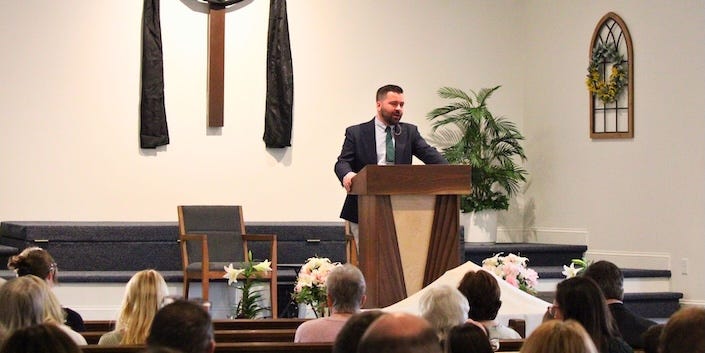
I can still remember where I was when I sensed God was calling me into pastoral ministry. You see, like another prophet who was fond of running, I had been resisting that call for a while. Similar to Jeremiah, though, I grew up around the Word. Sunday school is just part of my DNA. That’s what happens when your dad is a pastor and both your grandfathers were pastors. But for whatever reason, I didn’t want that for my future, at least at first.
I suppose I was tired of hearing all the comments from churchgoers assuming my future for me. That, of course, I’d be a preacher just because my dad was. So I ran. I entered undergraduate school, majoring in humanities, before switching to a health and fitness focus (which is laughable if you look at my body now), I guess, with the intent of being a coach somewhere. But all the while, I was grappling with what I knew to be true: that God had other plans for me. And more to the point, all the while, God was hot on my heels, like the hound of heaven that he is.
All of this, by the way, coincides with meeting my wife, Natalie, since, as it happens, she was a health and fitness major, too. After we met on the sidewalk and started dating, I eventually told her about how I was wrestling with what my future was. And it was at that year’s Bible Conference (which that particular university has in lieu of Spring Break) when I finally gave up. I stopped running. I switched my major to youth ministries the following semester, and Natalie proceeded to tell me that she also sensed a call to marry a preacher, and the rest is history.
Lord willing, I will surpass the seven-year mark at the church where I serve, which is happily rural. What has sustained me is not that much different from what sustained Jeremiah so long ago — namely, the grace of knowing that God didn’t make a mistake when he called Jeremiah to preach. Although what most might refer to as “success” was hard to come by, God’s Word prevailed because of the God who watches over it.
Perhaps you’ve sensed a similar call on your life but have resisted it due to how unqualified you feel or how forgotten your corner of the world may seem. The good news is that God hasn’t made a mistake with you either. The Potter hasn’t pulled his hands away from the clay. The almond tree blossoms, and the Word prevails, because of who is watching over it.
“This was not a task that he had chosen but a task for which God had chosen him.” Christopher J. H. Wright, The Message of Jeremiah: Against Wind and Tide, The Bible Speaks Today, edited by J. A. Motyer (Downers Grove, IL: InterVarsity Press, 2014), 50.
William H. Duke, Jr., “Jeremiah 1:4-18,” Interpretation 59.2 (2005): 185.
H. A. Ironside, Notes on the Prophecy and Lamentations of Jeremiah (Neptune, NJ: Loizeaux Bros., 1986), 16.
Steve Kruschel, The Pastoral Prophet: Meditations on the Book of Jeremiah (Irvine, CA: 1517 Publishing, 2019), 10–11.
Helpful and encouraging!
We are as a church needing a lead pastor our elders asked that we collectively pray more earnestly about this need.
Maybe he’s out there running from the call or resisting it.
I trust our Good Shepherd knows what he is doing!
We are a semi- rural congregation.
Established baptist reformed
If you know anyone who is looking for a pastoral position
Second Baptist Church
Mt Vernon, Illinois
Please pray for His good will to be done.