


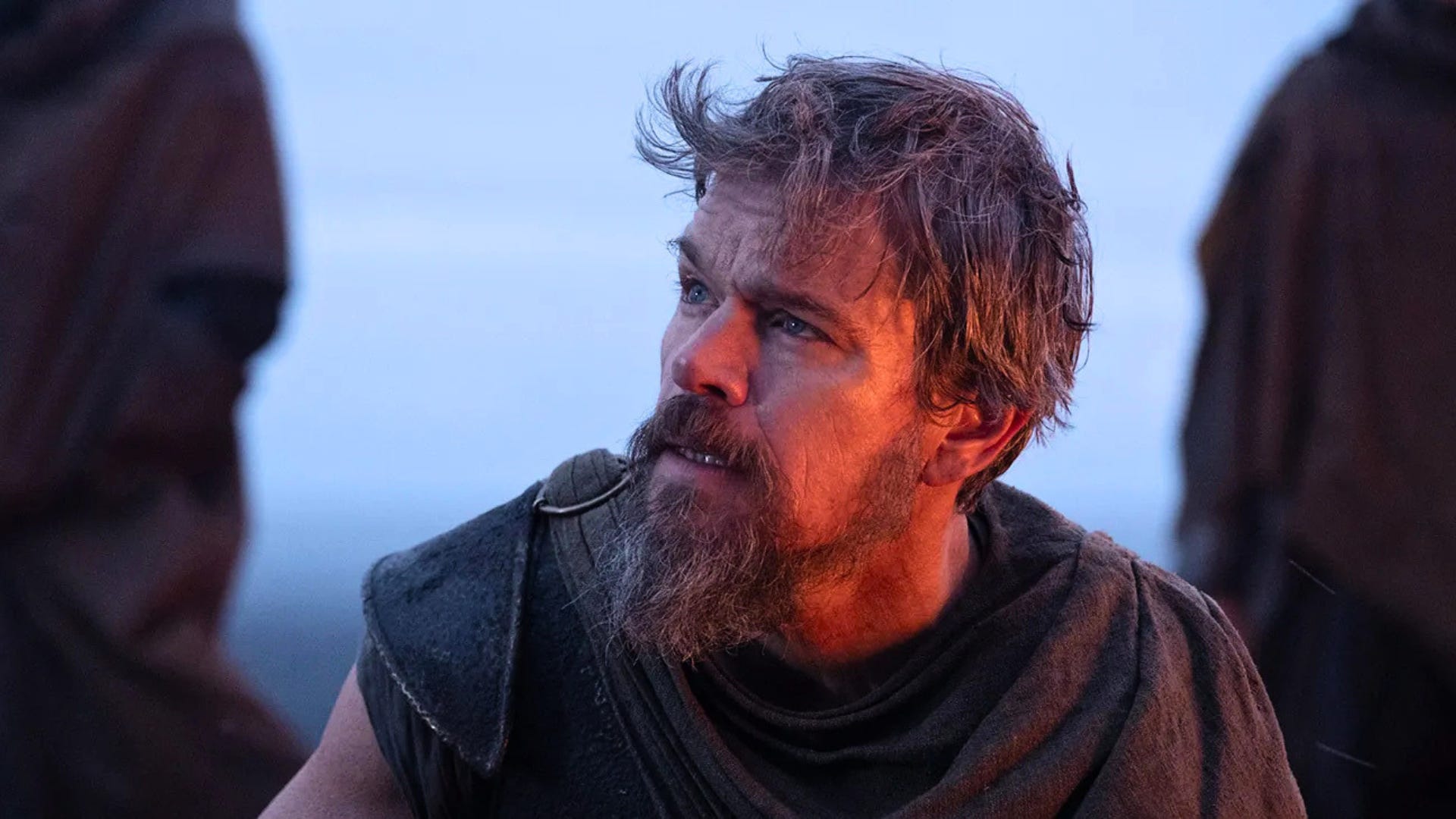
A few weeks ago, I shared some of my initial thoughts on Christopher Nolan’s latest cinematic venture, The Odyssey, which is an adaptation of Homer’s classic poem of ancient Greek myth of the same name. Having watched Nolan’s film for a second time between now and then (in IMAX, no less!), I can vouch for the fact that The Odyssey is not only a masterful piece of filmmaking, but also cements Nolan’s status as one of the great filmmakers in history, let alone this century. As a craft, movie-making is an art form, which means the standards by which it is judged are mostly subjective. Not everyone is going to like or enjoy the same movies. That’s sort of the point.
For example, I know some folks who thoroughly enjoy Wes Anderson’s filmography, with such entries as The Royal Tenenbaums, Fantastic Mr. Fox, and The Grand Budapest Hotel, among others. I have no qualms in saying that I do not enjoy Anderson’s films at all. My wife and I attempted to watch Moonrise Kingdom back in the day, but the Wes Anderson schtick just never stuck with me. I’ve never seen another movie he’s made. And I think that’s okay. In fact, I know that’s okay. That’s art. Different artists create different things that speak differently or mean different things to different people. But if there’s one thing I’ve noticed after twenty-odd years of arguing about movies with my friends (you know who you are), it’s that the majority of those “fights” aren’t really about production value, dialogue, or action sequences, but about what we think movies owe us.
1. I’m a Nolan Guy
For one reason or another, I’ve always had an affection for Christopher Nolan’s oeuvre. I was blown away when I saw Batman Begins in 2005, and the gritty way he reimagined that character. It is, to this day, one of the better origin stories you’ll see. His sequel, The Dark Knight, only solidified my fandom even further, especially the serious way in which he treated a comic book character’s plot and plight. There were real stakes and a real love of the craft of filmmaking evident in the way Nolan told those stories. He wasn’t just out to make a buck or make something cool. He was out to make something meaningful. That took you somewhere, told you something, and made you feel something. And maybe even changed your mind.
It was 2010, though, when I became a through-and-through “Chris Nolan fanboy,” unashamedly so, with the release of his long-gestating original film, Inception. I’ve told this story previously, but one of the reasons that film made such an impact on me is not only because of its spectacular thrills, but also because it marked my first foray into theater-going. I have a real sense of nostalgia for Dom Cobb and his dream-within-a-dream capers. My wife and I sat down to watch it again for, I don’t know, something like the thirtieth time recently, and it’s just as resonant now as it was then. I’ve often said that the blessing and curse of Inception as my first movie in such a venue is that every subsequent film I see in theaters is judged by that experience. And nothing has quite lived up to it, not even in 2026.
But this is an already-too-long preface to what I really want to talk about, which is The Odyssey, an epic film that will more than likely win a slew of awards and earn Nolan his second Best Picture Oscar, and will also mostly be remembered for the ways its premiere was mired in controversy and boycotts. At least, that’s what certain pockets of the Internet are going to choose to remember.
2. The Storm Before the Storm
Since the very first still of Matt Damon’s Odysseus was released, a bevy of online commenters were lamenting the lack of historical accuracy and general “uninspired” look that seemed to be present in Nolan’s follow-up to his award-winning masterpiece, Oppenheimer. Folks were quick and eager to judge The Odyssey based on a single image extracted from its context. However, this was nothing but the calm before Poseidon’s storm, the breeze that precedes the Zeus-sized thunderhead of vitriol that was to come as more and more details emerged about Nolan’s adaptation of this beloved piece of literature.
From Lupita Nyong’o’s casting as Helen of Troy to Damon’s aforementioned portrayal of Homer’s mythic hero to Zendaya’s Athena to Tom Holland’s Telemachus to Elliot Page being cast at all, each new production update on The Odyssey was met with resistance and takes and irate commenters telling everyone else how horrible Nolan’s movie was going to be. I won’t lie, even I was caught up in the hysteria, especially after some of the initial trailers were released for mass consumption. What should’ve been a triumphant moment as one of the most epic stories in human history was finally getting an equally epic treatment on the big screen turned out to be a moment when social media managers are glad that the YouTube dislike counter defaults to “off.”
The Odyssey’s teaser trailers and previews were criminally ratioed, with everyone citing the same things: terrible casting, horrible production design, and a general air of “woke” encroachment. Admittedly, every trailer I saw for The Odyssey seemed to be missing a certain je ne sais quoi, a certain something. Every preview felt flat and uninteresting, even for a Nolan diehard like me. After two viewings of the actual film, though, I can definitively say that the trailers don’t do it justice. Not at all. I’ll do my best to refrain from going on a long rabbit trail about movie trailers and how many bad ones there are in the marketplace. Needless to say, the marketers didn’t really do any Nolan any favors, as they succumbed to the all-too-typical pitfall of showing too much.
Homer’s Odyssey isn’t necessarily a story that needs introduction. Nor do general audiences need to be sold on buying tickets to see Christopher Nolan’s latest big-screen adventure. I’m no marketer or public relations person, but the combined cachet of source material and man behind the camera should’ve resulted in far more ambiguous and mysterious previews leading up to the film’s release. Instead, we were given a slew of out-of-context images that only fueled the fires of opposition and assumption. What’s hilariously ironic to me is seeing all the critics who thought Elliot Page had been cast as Achilles and couldn’t believe how “woke” Nolan had become have to eat crow after that assumption turned out to be flatly untrue.
3. All Takes, No Consensus
But before I get too far over my skis, if I’m not already, I have to admit that I’ve never familiarized myself with Homer’s original epic (sue me!). No, I’ve never sat down to read a 600-page classical Greek poem. What can I say, I was homeschooled. But anyways, I’m not here to necessarily litigate a film’s fidelity to a literary text. The Odyssey, despite how it might seem or sound in certain corners of the Internet, isn’t the first film to adapt a piece of literature and make changes to the source material. Case in point, one of the most beloved trilogies of all time, Peter Jackson’s The Lord of the Rings, made way more changes to J. R. R. Tolkien’s beloved Middle-earth tales, and yet is still regarded as the consummate example of how film adaptations succeed. In other words, the fallout from The Odyssey might reveal more about us — and our moment — than anything else.
I’ve read more than a dozen takes on how to think about this version of Homer’s epic poem, all of which fall on some sort of spectrum of appreciation or loathing. In an article for First Things, Anatoly Grablevsky called it “rudderless.” Jake Adkins, over at Mere Orthodoxy, understood it as a “reintroduction” to an “enchanted cosmos.” Stephanie Zacharek, for Time, called The Odyssey an “eye-glazing dud of a movie.” Richard Brody, writing for The New Yorker, said that Nolan’s film “turns an epic poem prosaic.” Chris Evangelista, who reviewed the film for SlashFilm, called it a “grandiose” achievement that was, at times, both “exhilarating and exhausting.” And despite hailing it as “three hours of cinematic excellence,” Dr. Nijay Gupta ultimately considered The Odyssey to have failed in its effort to adapt the essence of Homer’s original epic.
There was no shortage of theologized or politicized takes as well. In Esau McCaulley’s reflection on The Odyssey for Holy Post Media, he reckons with the film’s connective tissue to our own modern political climate. Brett McCracken’s article for The Gospel Coalition laments the “apparent magic” of Nolan’s ancient Grecian world, where the gods are a “quieter, mostly unseen presence.” Paul Marchbanks, for Christianity Today, understands the film as a poignant reminder “of what we lose when we abandon kindness.” Griffin Gooch traces a similar thread. Owen Strachan wrestles with the flawed yet faithful themes present in Nolan’s work. And, for what it’s worth, Micah Mattix compiled a few other opinions over on his Prufrock newsletter, too.
4. That’s Not My Odysseus
The point, I hope, is well taken: by and large, we don’t know what to do or what to think about The Odyssey, at least this version of it. Some insist it’s the definitive retelling of Homer’s epic, while others have dubbed it a piece of “woke” trash. This was most glaringly evident in the varied opinions of DailyWire co-workers Ben Shapiro and Matt Walsh, both of whom were very outspoken about their respective perspectives on Nolan’s latest venture. While the former largely gave it praise, despite some inherent flaws, the latter decried the movie since it “transports [the viewer] into the mind of a liberal woman in 2017.” At least as he understood it.
Walsh, of course, is referring to the 2017 translation of Homer’s poem by Emily Wilson, who, despite preserving some of the original features of the Greek epic, also decided to incorporate modern syntax and vocabulary. Critics of Wilson’s project were quick to notice other characteristics as well, many of which were deemed anachronistic or even heterodox,1 leading her translation to be dubbed the “Feminist Version” of Homer’s work. Whether or not that’s entirely true, I can’t say since I haven’t read it myself.
But if you take the time to read all those hot takes in conjunction, what you begin to notice is that rarely are the critiques about style or technique. No one’s impugning Christopher Nolan’s ability to block a shot — with a 70mm IMAX camera no less — or his obsessive need to capture everything the old-fashioned way. As an auteur, he’s already solidified his reputation in the form, and The Odyssey is a prime example of that fact. Everything from the cinematography to the editing to the sound design to Ludwig Göransson’s score is a masterclass in filmmaking. It’s been a long time, perhaps since Master and Commander, that we’ve seen such exceptional seafaring escapades captured on film. But what’s driving most of the chatter surrounding The Odyssey is the sentiment, “That’s not my Odysseus.”
5. Heroes Who Fail
Christopher Nolan’s Odysseus is a complicated hero, which, for whatever it’s worth, is mostly true of Homer’s version. There is no pristine heroism in Homer, even if we’ve come to believe there was. The Odysseus of ancient myth portrays a war hero who’ll just as easily lie to get out of a jam as he is to put an arrow through your heart. As much as we might laud his heroics, Odysseus is still a man who is impulsive, manipulative, boastful, and spends years in the beds of goddesses while his faithful wife hopes beyond hope that, somehow, someday, he returns. In other words, the purity of “That’s not my Odysseus” largely emerges from an archetypal hero that never existed in the source material in the first place.
There are shades of, dare I say it, Luke Skywalker circa The Last Jedi in Nolan’s Odysseus, which, I know, ostracizes and pushes some folks away. I begrudgingly make that connection due to the negative juju that often nips the heels of even mentioning that movie, but I can’t help it. What Rian Johnson did with everyone’s favorite laser-sword-wielding hero is sacrilege for some, okay, a lot of you. But, in a vacuum, all things considered, I’m way more in favor of seeing a jaded Jedi come to grips with his failures after he’s been through some stuff and what that means for him, his identity, and for those who depend on him. Folks didn’t want to see that, though. They wanted a Luke who was steely-eyed and emotionless, who kicks a ton of Stormtroopers’ butts without even breaking a sweat. But that’s not what we got.
Sure, I can’t defend Luke sloppily slurping milk he just extracted from an alien creature’s udder. But I can and will defend the trajectory of his character. And before you say, “That’s not my Luke Skywalker,” I don’t really care all that much. What draws me so much to Luke in The Last Jedi is precisely his flaws and the ways he overcomes them. As everyone’s favorite pointy-eared Jedi tells him, poignantly, “Pass on what you have learned. Strength. Mastery. But weakness, folly, failure also. Yes, failure most of all. The greatest teacher, failure is.” I’m drawn to that because that’s real. That’s life. That’s me.
6. Paragons and Mirrors
While flawless heroes can be admired, they can’t necessarily be trusted. We can only look up to them, applaud their feats, and aspire to emulate their heroics, all the while knowing that those exploits are beyond us. They’re not true to life. They don’t meet us where we are. And I get it, some just want to go see a movie that provides an escape from all that, from where they are. But films that stand the test of time — and the jury’s still out if this’ll be true of The Odyssey — are those that say something, mean something, and make you feel something. And many of the best have qualities that you can recognize — failure most of all — which is what closes the distance between archetype and equal.
The question The Odyssey, The Last Jedi, and other films like them raise is this: Why do we crave unflawed heroes so badly? Perhaps it’s because heroes who fail, who have flaws, aren’t so much paragons as they are mirrors. And we can’t stand to see what we see in that reflection. If you’ll forgive the theologizing for a second, the longing for a pure hero makes a lot more sense when the narrative of the Bible is kept in view, and we come to grips with the fact that our craving for an impeccable hero is but a memory of Eden’s fiasco, when what was “very good” was shattered by the intrusion of sin and death. And ever since, we’ve been trying to pick up the pieces, or looking for someone who can.
Odysseus’s journey, as Nolan portrays it, of victory, regret, grief, revenge, and catharsis is made of similar material. From lauded king and celebrated warrior to troubled man, coping with the can of immoral worms he’s unleashed on the world, the aggrieved Odysseus is not only relatable but tangible. This, by the way, is why cinematic adaptations of Superman always fall short. When, ironically enough, Christopher Nolan’s name got attached to executive produce a new Superman movie, folks were buzzing about the potential of getting a gritty, down-to-earth realization of the comic book industry’s most iconic character. Whether or not Zack Snyder succeeded in that with Man of Steel is up for debate.
And although I lean more in Man of Steel’s favor than most, the issue with cinematic depictions of Superman has little to do with tone or his overpowered superpowers. Part of the reason Superman movies never appeal to me is that he’s rarely guilty or put in a position of risk. Whether it’s meteors, villains, or paralytic rocks, most, if not all, of his conflicts remain external. He himself is rarely at fault. There’s plenty of wreckage in his wake — just ask Metropolis — but almost none of it is his doing. All he has to do is swoop in and save the day, again. (This, by the way, is exactly what Man of Steel attempted to correct, to mixed results.) Perhaps what makes the Superman mythos such an impossible nut to crack is that it portrays a god pretending to be a man. And as much as he might get good at pretending, there will always be a distance between him and us.
7. Ruined Men and Zeus’s Law
Heroes who are flawed are compelling precisely because they tell the truth about us, about who we are and where we are. That’s not “woke” revisionism. That’s inspired Scripture. From Genesis to now, we’ve been grappling with the flaws of even the most faithful among us. Abraham lied to kings to save his own skin. Moses became a fugitive of the state after committing cold-blooded murder. David sent a man to his death so he could keep the man’s wife for himself. Peter swore like a sailor that he’d never even met the Rabbi who had an appointment with the gallows. In other words, the Bible itself is full of ruined men who’ve unleashed some of that ruin on the world around them. The reason being so that we’d never mistake them for the hero we really need.
The Odyssey’s not-so-subtle thread that keeps getting tugged is the invocation of “Zeus’s law,” which is shorthand for the Greek code of xenia and the sacred obligation among strangers to be hospitable and generous to one another. If you haven’t seen the film, you might be surprised by the “Do unto others as you’d have them do unto you” motif that pervades the three-hour runtime. At one point, one of the characters suggests the necessity and urgency for xenia arises out of the fact that strangers who knock on your door might just be gods in disguise. Let me just say that I didn’t have “Christopher Nolan invokes Hebrews 13:2” on my 2026 Bingo card. Nolan’s film, as well as Homer’s poem, ultimately hinge on the thin moral line between barbarism and being human.
“Don’t look for gods in men,” Damon’s Odysseus quips, “you’ll just be disappointed.” As cynical as this sentiment might seem, there’s some truth to it, especially if you recall Paul and Barnabas’s experience in Lystra, where, after healing a man, they’re mistaken for incarnations of Zeus and Hermes (cf. Acts 14:8–18). Lystra’s citizens, it would seem, were very familiar with “Zeus’s law” and the disaster that might ensue if they ignored it. But even as priests and patrons bedecked Jesus’s missionaries with garlands and showered them with praise, Paul foils their celebration by divulging that he and Barnabas are just men. “We also are men, of like nature with you,” he retorts (Acts 14:15). “Don’t look for gods in us,” in other words, “but let me tell you about the Living God.”
Paul’s immediate instinct is to exploit the fracas of “apparent magic” and myth-become-fact by directing their attention to the good news of the Truth Myth, of the King who doesn’t merely disguise himself as a man, but becomes one like us. Every hero we’ve ever loved is but an echo, a rumor, of the true and better Hero, whose grace exceeds our failure, whose love binds him to wood, not to survive the siren’s call, but to silence sin and sedition for good.2 This, C. S. Lewis once wrote, is “the heart of Christianity” itself — namely, “myth which is also a fact. The old myth of the Dying God, without ceasing to be myth, comes down from the heaven of legend and imagination to the earth of history.”3
Where Odysseus returned home laden with his own guilt, Christ comes to carry yours for you, to put it away in the grave where his sacrifice makes all things new. The world of fire and ash that Nolan’s mythic hero regrets unleashing isn’t ultimately doomed because there is a Hero who descends from heaven to atone, not for his own misdeeds, but for yours and mine. So instead of looking for gods in men, the good news tells us to look to the Man who is God, who washes the blood off your guilt-ridden hands by shedding his own.
Richard Whitaker, “Homer’s Odyssey Three Ways: Recent Translations by Verity, Wilson, and Green,” Acta Classica LXIII (2020): 3.
So wrote Clement of Alexandria in the second century: “Sail past the song; it works death. Exert your will only, and you have overcome ruin; bound to the wood of the cross, thou shalt be freed from destruction: the word of God will be thy pilot, and the Holy Spirit will bring thee to anchor in the haven of heaven.” Exhortation to the Heathen, §XII.
C. S. Lewis, God in the Dock: Essays on Theology and Ethics, edited by Walter Hooper (Grand Rapids, MI: Eerdmans, 1970), 66.
At one point during his return, Odysseyes was recognized by his bruised heel....
This was a worthy analysis, Bradley! I especially liked your sections on Paragons and Mirrors; Ruined Men and Zeus’ Law. Like you, I was very surprised at the biblical inspiration in the movie. Part of my fascination with Greek mythology (I took a course in college and will watch mythological stories) is because humans of old (and modern day) have been trying to find/explain the evidence of God. Of course, the Greeks had many gods but their gods are much like them—flawed, funny, and utterly ridiculous in their exploits and “divinity.”
But with Christ, God humbles himself and becomes part of our human experience and we don’t have to speculate about His actions and what they mean. He lived, breathed, and broke bread with humans. We have a very real experience with Him rooted in care. We are not at the mercy of His moods because we broke a rule “and ate his cattle grazing on an island because we’re famished” (😅).
The movie definitely hinted at our humanity and human institutions (the siren scene, the politics of a king-less throne (and the perceived power of women), loyalty, sacrifice, and even entertainment (did you catch the connection of rapper Travis Scott being the one to orate the story through poetry?)).
I really liked the movie. As as you know, you can’t please everyone.
Your article needs to published beyond the walls of substack. 🙂