



A version of this article originally appeared on 1517.
The narrative that spans Acts 10 and 11, which runs for nearly seventy verses, relays the striking conversion of a high-ranking military captain and the intricate sequence of events that led to him entrusting his life not to Caesar but to Christ. And yet, as stunning as that may sound, that’s still not the most shocking development contained in this story. As is often the case, these chapters are regarded as Cornelius’s conversion story, but it could just as easily be called Peter’s conversion.1 By that, I don’t mean to suggest that Peter gets “saved” here, but his understanding of God’s salvation in Christ is broadened beyond what he or anyone else could’ve ever imagined.
1. The Scattered Church
Up until about Chapter 8, the gospel of Christ was still relatively confined to Jerusalem. This, of course, wasn’t without warrant since the apostles were specifically told to stay put in that place (Acts 1:4–5; cf. Luke 24:47, 49). But, of course, the good news concerning Christ’s death and resurrection wasn’t supposed to remain in Jerusalem forever. This news was meant for the whole world’s ears (Acts 1:8). And when the zealous Pharisaical extremist known as Saul began “ravaging the church” in the aftermath of Stephen’s murder, the church scattered, and notice to where:
And there arose on that day a great persecution against the church in Jerusalem, and they were all scattered throughout the regions of Judea and Samaria, except the apostles. Devout men buried Stephen and made great lamentation over him. But Saul was ravaging the church, and entering house after house, he dragged off men and women and committed them to prison. (Acts 8:1–3)
Even amid that harrowing season of uncertainty and upheaval, Christ’s words were coming to fruition, as his witnesses spread the word about him beyond the borders of Jerusalem, “in all Judea and Samaria.” The reach of the gospel was widening (Acts 8:4–5), perhaps not in the ways many anticipated, but Luke’s summation of the ministry of the church to that point sounds an awful lot like a bookend to the Great Commission. “The church throughout all Judea and Galilee and Samaria,” Luke records, “had peace and was being built up. And walking in the fear of the Lord and in the comfort of the Holy Spirit, it multiplied” (Acts 9:31).
In other words, Acts 10 and 11 witness the moment the proclamation of the gospel crossed a line pretty much everyone assumed was uncrossable, including Peter. And the church has never been the same since.

2. A Soldier, a Saint, and the Need for a Preacher
Luke begins by introducing us to a man named Cornelius, who was a Roman centurion stationed in Caesarea (Acts 10:1), which was among the most important cities in the first century. Home to a major seaport connecting Judea to the rest of the world, and home to the evolving cultures of Greece and Rome, Augustus Caesar’s namesake city soon became the administrative capital of Rome in Judea. All of which to say, Cornelius’s status was among the highest and most influential in a city teeming with powerful people.
And yet, there was another side to him that surely surprised everyone who knew him. This battle-hardened career military man was known far and wide for his generosity and devotion to Israel’s God (Acts 10:2). Some of his men even go on to describe him as “an upright and God-fearing man, well spoken of by the whole Jewish nation” (Acts 10:22). To say that Cornelius is a complex character is an understatement. It’s difficult to be dogmatic about the extent of his knowledge and the depth of his faith. Whatever he knew or was aware of, it moved him to do something about it, which is saying something.
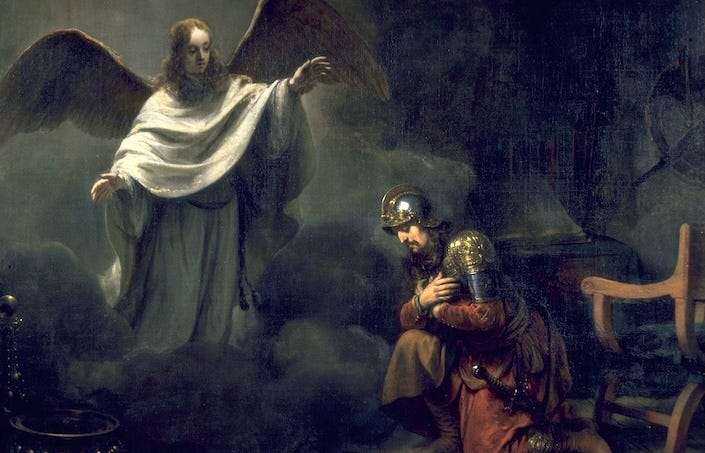
However genuine Cornelius was, it’s apparent, at least to me, that something was still missing from his faith. He desperately needed a preacher, which is precisely what the Lord ends up giving him (Acts 10:3–6). Bursting into his room and interrupting his afternoon tea was an “angel of God,” who greeted him by name and told him that although all his almsgiving and praying hadn’t gone unnoticed, he needed to send for Peter, who happened to be lodging thirty miles south in the town of Joppa. Cornelius wasted no time dispatching one of his men and two servants to go there (Acts 10:7–8).
3. The Vision That Broke Peter’s Brain
Meanwhile, as Cornelius’s men were making their way towards Joppa, Peter went up to the rooftop to pray. Unsurprisingly, he got distracted by the noises his stomach was making. Hunger became more vital than prayer, but while he waited for his host, Simon the tanner, to make lunch, “he fell into a trance” (Acts 10:9–13). Even though, physically speaking, he was still on Simon’s roof, spiritually speaking, he was somewhere else — he was “displaced,” transported, like a daydream.
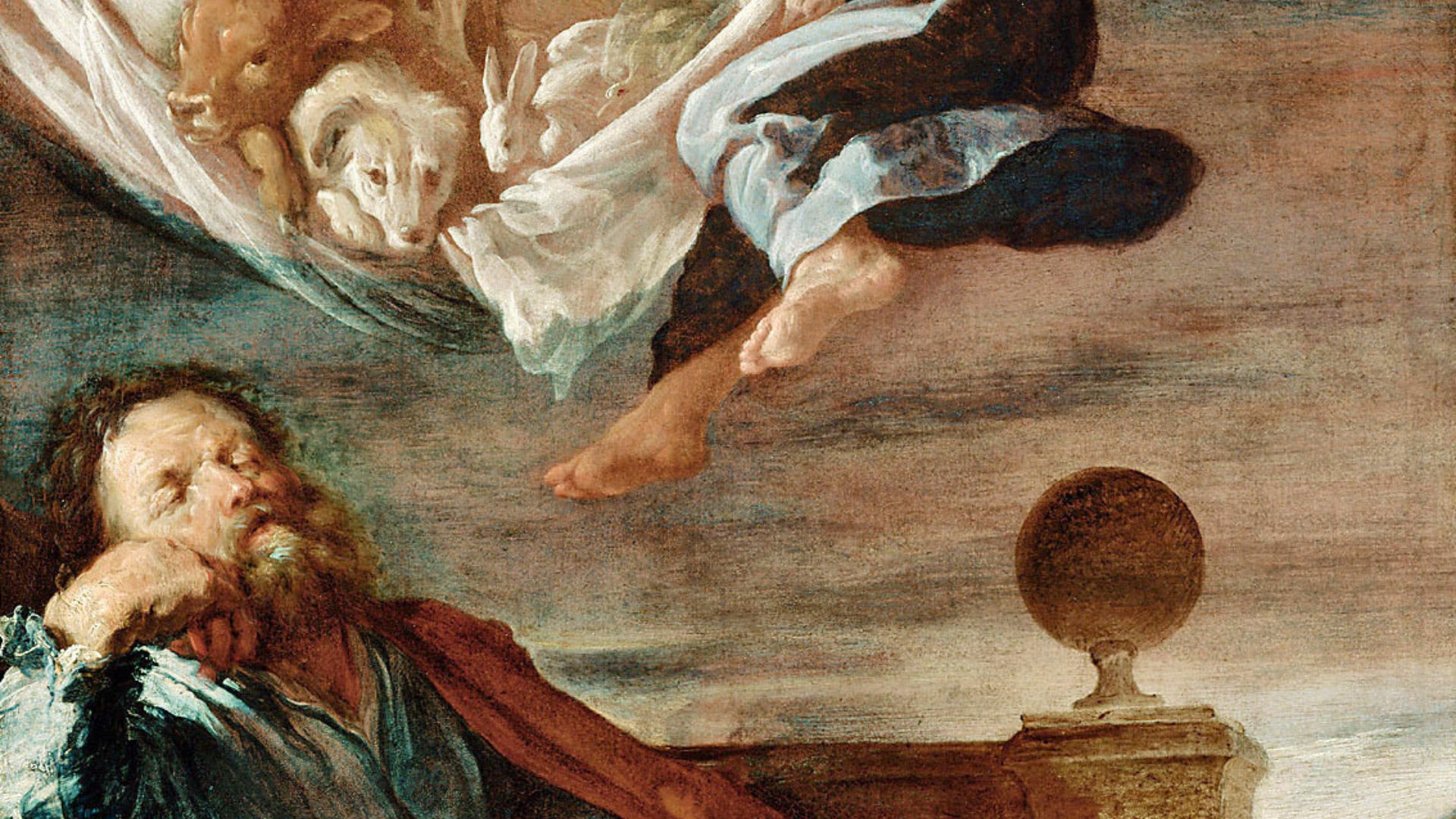
Before him unfurled “a great sheet” or a linen sail, and as it came into view, he noticed all kinds of creatures on it. A miscellaneous hodgepodge of hoofed, scaly, and feathered friends was all seated on the sheet, mingled together. And as he took all this in, he heard a voice telling him to make lunch for himself and enjoy the heavenly buffet. But, being the devout Jew that he was, Peter outright refuses (Acts 10:14), resisting the urge to make a bacon, egg, and cheese bagel for himself. He knew the law; he knew what was required of him. There was a whole chapter in the Torah that detailed what should or shouldn’t be eaten (Lev. 11:1–47), and the mixture of common or unclean creatures in front of him made partaking off-limits.
Peter’s resistance stems from his devotion, perhaps seeing this moment as a test of his faith that he needed to pass. He wouldn’t be made to give in that easily. “Not today, Satan!” But the voice persisted, inviting Peter to freely eat whatever he saw (Acts 10:15–16).2 Seeing and hearing all of this left him utterly befuddled. But as he attempted to figure out what it all meant, at that exact moment, (1) Cornelius’s three men arrived at Simon’s house and (2) the Holy Spirit spoke to Peter (Acts 10:17–20).
In what can only be chalked up to God’s impeccable timing, both Cornelius’s quest for assurance and Peter’s breakthrough were happening at the same time. And the convergence of both occurs when the three men knock on the door and call for Peter by name. Suddenly, it clicked! Three men, three sheets, and the Spirit’s approval to go downstairs and “accompany them without hesitation” (Acts 10:20; cf. 11:10–11). Peter does just, greeting the men and even inviting them “to be his guests” (Acts 10:21–23).
This, in and of itself, is a remarkable development. A company of men in the employ of Rome being unhesitatingly welcomed and housed by a devout Jew is a radical display of hospitality and grace, and that’s only half of it. Peter ends up accompanying the men back to Caesarea, where Cornelius had amassed a sizable audience to hear what the apostle had to say (Acts 10:24–26). And soon after sharing what brought him to Caesarea, Peter eagerly waited for Cornelius to explain why he had summoned him in the first place:
He went in and found many persons gathered. And he said to them, “You yourselves know how unlawful it is for a Jew to associate with or to visit anyone of another nation, but God has shown me that I should not call any person common or unclean. So when I was sent for, I came without objection. I ask then why you sent for me.” And Cornelius said, “Four days ago, about this hour, I was praying in my house at the ninth hour, and behold, a man stood before me in bright clothing and said, ‘Cornelius, your prayer has been heard and your alms have been remembered before God. Send therefore to Joppa and ask for Simon who is called Peter. He is lodging in the house of Simon, a tanner, by the sea.’ So I sent for you at once, and you have been kind enough to come. Now therefore we are all here in the presence of God to hear all that you have been commanded by the Lord.” (Acts 10:27–33)
4. God Doesn’t Play Favorites
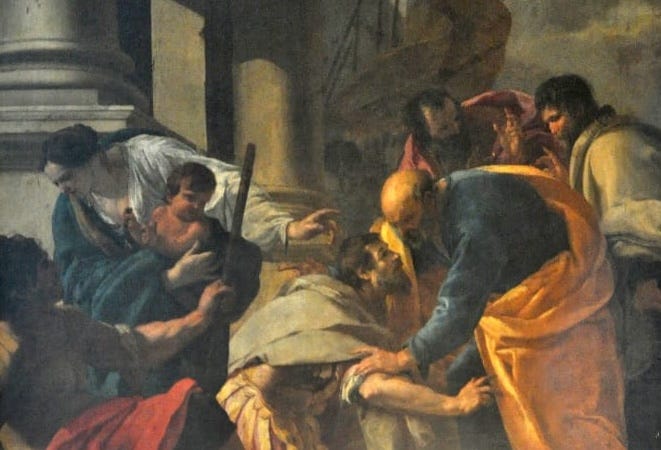
After the surreal events that brought a Roman centurion and a law-abiding Jew under the same roof, what happens next is even more astounding, if you can believe that. Peter opens his mouth and starts preaching a sermon that was filled with an array of radical assertions, not the least of which is when he attests that “God shows no partiality” (Acts 10:34). Despite what had long been promoted by the Pharisees, and what the majority of the Jews relished in, the God of the Word wasn’t a God of favoritism. No smidgen of prejudice resides in his heart. As Peter puts it, “He is Lord of all” (Acts 10:36).
A widespread belief in those days was that the Jews were not only God’s “chosen” people, but also the preferred and superior race. They had “the corner” on God’s favor, or so they thought. And it was this thinking that led to the demeaning and disparaging treatment of the Samaritans and the Gentiles, which was rampant. It was an understood norm of society that “Jews have no dealings with Samaritans,” as John tells us (John 4:9). In fact, when one Samaritan village rejected Jesus, James and John’s first reaction was to wonder why their Lord didn’t call down fire from heaven to “consume them” (Luke 9:52–54).
This level of animosity stemmed from the fact that the Samaritans were “half-breed heathens” who had intermarried with the Israelites during the days of the exile. But despite being “lesser-thans,” they still had every right to relate to or belong to the Living God, who knows nothing of bias based on bloodlines. What Peter was learning in real time was that no race has the upper hand when it comes to God’s favor. The same words of hope and peace that were entrusted to Israel are available to all, to “everyone who believes” (Acts 10:43).
The promises originally given to Father Abraham weren’t confined to one people or place. Rather, they incorporated everyone — “all the nations of the earth shall be blessed” in Abraham’s offspring (Gen. 22:18; 26:4). And as Paul tells us, that “offspring” is none other than Jesus himself (Gal. 3:16), which is why he goes on to say that all of God’s promises to the O.G. patriarch correspond to God preaching the gospel to him (Gal. 3:8). Peter’s sermon in Cornelius’s home follows the same track, upholding Christ himself as the culmination of God’s words to God’s people.
Christ was “the word sent to Israel,” and the world, “appointed by God” to bring peace to the nations by making peace through his self-giving on the cross. He spans the gap between ragged sinners and an infinitely holy God, extinguishing all wrath and paying for all sin, a feat that was accomplished not merely for a select class or category of people but for the whole world (Acts 10:43; 1 Tim. 2:5–6). Notwithstanding one’s background, age, race, gender, intellect, or socio-economic status, there is peace, pardon, and new life free for the taking in the person of Jesus. And the only “condition,” if you can call it that, is that you believe, and by believing receive what he is so eager to give — namely, himself.
This is God’s word to us, his “testimony,” the gospel that he has commanded us to preach (Acts 10:42). Neither Peter nor Paul nor James nor John nor Luther nor we are authorized to tinker with this message, adjusting it to fit our liking. “Only one message has the Lord’s authorization,” R. C. H. Lenski comments. “Any alteration of that message, any substitution for it, is not only empty but, when it pretends to be the Lord’s true message, makes the herald who proclaims it a liar, a false prophet.”3 Indeed, as soon as the church or its leaders begin messing with the message God has entrusted to them, the essence of the message is lost.
As Peter makes clear, preaching ends when the preacher starts telling you either what they themselves want to say or what you want to hear. Either way, God’s words are thrown by the wayside in favor of “something else,” some other message, that’s entirely incapable of cleansing sin or raising the dead. But when the church stays true to the testimony about Jesus Christ, which has been entrusted to them, God has a knack for showing up.
5. The Danger of Tweaking God’s Testimony
When the news about what happened in Caesarea echoed in the ears of “the circumcision party,” they were beside themselves, criticizing Peter sharply and publicly (Acts 11:1–3). According to their by-laws, the foremost apostle had perpetrated a series of violations against Jewish tradition and custom, fraternizing and fellowshipping with those who were deemed “off limits.” Not only did he show an unmitigated level of hospitality toward Gentiles, but he also received their hospitality in return. “The circumcision party,” who also had a number of run-ins with Paul (Acts 15; Gal. 2:12; Titus 1:10), couldn’t fathom the audacity of Peter’s actions, entertaining and evangelizing an assembly of undesirables.
These self-righteous influencers are the epitome of what happens when God’s testimony gets twisted, when human beings go beyond God’s words to add qualifications and stipulations that never existed. Suddenly, you’re no longer rejoicing when the gospel is received and believed. Instead, your only concern, the only thing you can focus on, is all the broken protocols and severed traditions. And it’s precisely this brazen sense of self-righteous superiority that the gospel puts to bed.

6. The Ragged Church
What Peter stunningly came to realize, and what he is now boldly proclaiming, is that the gospel knows nothing of hierarchies. There is no ranking system of worthy versus unworthy, clean versus unclean people. The only category of human being with which the gospel deals is sinners, and that’s all of us; sinners are all that there are (Rom. 3:9–12, 23). Accordingly, Peter’s vision wasn’t really about how pork rinds and scallops aren’t off the menu anymore. Rather, it was to show him and us what the church is supposed to look like.
Like the sheet that filled Peter’s view, the church is home to people “from every corner of the earth” (Acts 11:5). The Body of Christ is filled with people from every race, region, and rank (Rev. 5:9–10), including those once thought to be outsiders and beyond the reach of grace. They, too, can rejoice in the good news of peace through Jesus Christ. No matter how ruined or ragged, corrupt or compromised, a sinner may seem to our eyes, the moment any sinner believes in the gospel, they belong at Christ’s table.
Far from being a club for the morally polished, politically correct, socially acceptable, or religiously impressive, the church is and always has been an assembly of sinners who’ve been absolved by what they hear and receive. This means that there’s no such thing as being too far gone or too dirty or too broken or too addicted or too ashamed to belong. “No poor sinner in all the world,” H. A. Ironside once wrote, “need feel he has gone so far there is no salvation for him.”4 The good news tells us that God’s Son willingly bore the unclean label so that we could be declared clean. He was cast out so that we could be welcomed in. He was forsaken so we could be received. The unfit and the unworthy are free to have a seat at his table, not because they’ve straightened themselves out, but because his blood has reserved them a seat.
“The principal subject of this chapter is not so much the conversion of Cornelius as the conversion of Peter.” John R. W. Stott, The Message of Acts: The Spirit, the Church & the World, The Bible Speaks Today Series (Downers Grove, IL: InterVarsity Press, 1990), 186.
This, by the way, was something Jesus taught years before during a dispute with the Pharisees (Mark 7:14–19), but it was only crystallizing in his heart and mind.
R. C. H. Lenski, The Interpretation of the Acts of the Apostles (Minneapolis, MN: Augsburg, 1961), 427.
H. A. Ironside, Lectures on the Book of Acts (Neptune, NJ: Loizeaux Bros., 1967), 272.