


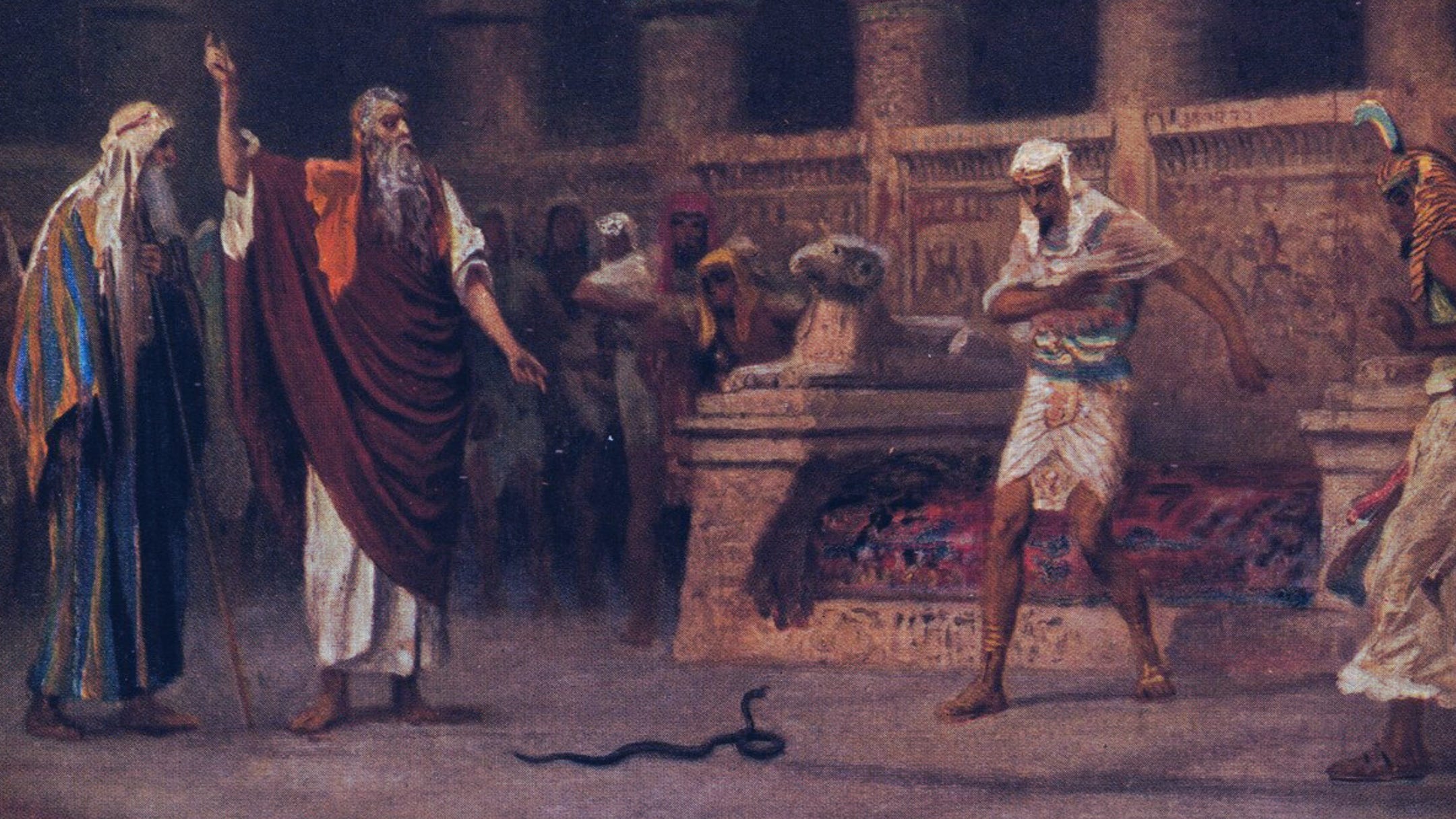
The narrative of the plagues is, perhaps, one of the most compelling supernatural sequences in Scripture. Countless scholars and historians have attempted to explain these events through natural, albeit rare phenomena, leaving one to conclude that Egypt underwent the worst string of natural disasters in recorded history. It’s better, then, to understand the plagues as “judgments” carried out by a divine sovereign, since that is what God reckons them to be (Exod. 6:6; 7:3–4). Even better than that, though, might be to view the “ten plagues” as “eleven signs” or revelations of the divine, since each one uniquely and strikingly unveils the nature and character of God. While much of our attention naturally focuses on the frogs, the flies, and the water turning into blood, and rightly so, we mustn’t hurry past the prelude to all those signs of judgment, which is what the scene with the staffs turning into serpents is (Exod. 7:8–13).
1. Heavenly Combat in Pharaoh’s Court
This moment, to be sure, concerns something much deeper and much more trenchant than merely an encounter between the king of Egypt and his runaway prince. It isn’t even primarily about the kingdom of Egypt versus the enslaved nation of Israel. Rather, this scene in the courtroom of Pharaoh is a stage upon which the Lord Almighty reveals his power over all things, even those who are in league with the Evil One. “This is heavenly combat,” John D. Currid asserts, “that is, a war between the God of the Hebrews and the deities of Egypt.”1 Much like the tragedy in the Garden (Gen. 3) and the temptation in the wilderness (Matt. 4), this occasion puts in stark relief the eternal conflict between God himself and the prince of the power of the air, the devil. Deeper than any political, ethical, or moral conflict is the spiritual war that is being waged all around us, the primordial struggle between the Creator and “that ancient serpent” (Rev. 12:9), who roams this world like a lion (1 Pet. 5:8), deceiving and [enslaving] the souls of humankind.
That serpent is Satan, the one who engulfs men’s and women’s lives, ensnaring them with lust, greed, power, pride, and all that feeds the appetite of the self. His is a “gospel” of self-absorption, self-interest, and self-salvation. He desires nothing more than to warp what God has created beyond recognition by turning everything inward. This he accomplishes through the subtle and seductive art of imitation. The devil is no creator; he is the ultimate con-artist, though. He takes what God has made and twists it, turning holiness into self-righteousness, freedom into licentiousness, love into lust, wisdom into pride, and worship into self-obsessed emotion. While he cannot and will not deny God’s existence or openly contradict his words, since he knows he can’t win that battle, he strives to distort God’s goodness. His mission remains blinding the minds of the unbelievers by keeping them from seeing the light of the gospel (2 Cor. 4:4).
2. The Counterfeit Kingdom
Satan’s strategy has always been to parody the Light of the World by offering his own dim glow of hollowed-out truth, a tactic that can be traced from Eden to Egypt to first-century Jerusalem. In many ways, what transpires in front of Pharaoh is the Old Testament version of what occurs in the Gospel of John, where Jesus lifts the veil to expose to whom the Pharisees belong. Even though the religious aristocracy claimed firm allegiance to Abraham and Moses, Jesus insisted that their spiritual father was none other than “the father of lies” himself, the devil (John 8:44). They might’ve had scrolls of the Torah under their arms and in their heads, but by resisting and rejecting Jesus, they were effectively rejecting God himself (John 8:42–43, 47).
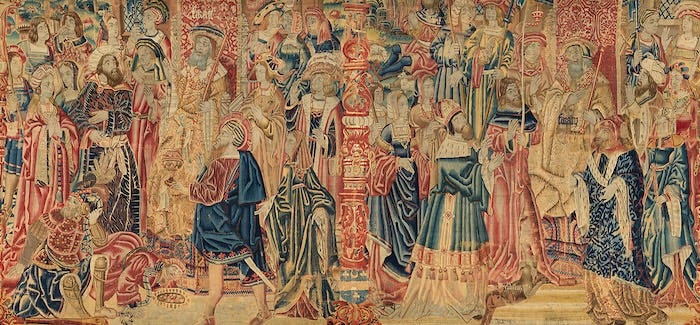
Even if Pharaoh and his goons weren’t fully aware of it, by resisting Moses and Aaron, they were in league with Satan, marching in step with his malignant schemes. By refusing to let God’s people go, he was complying with the kingdom of darkness and yielding to the will of the Evil One, which helps us understand what was at stake when Moses and his brother entered Pharaoh’s throne room for the second time. It wasn’t merely the freedom of a nation unjustly enslaved by a vindictive tyrant; it was the will and word of Yahweh versus the wiles of the devil. After all, the Lord had promised his people that they’d dwell in a Land of Promise, free from the overreach of despots. So, would God live up to his word? Would his people be free after all? Or would the king of Egypt keep them under his thumb? Would God’s word prove true? Or would it be just another myth? A tale lost among the sands of time?
Of course, even though it looked perilous from Moses and Aaron’s perspective, as it often does for us, Yahweh was in complete control throughout this entire ordeal. Nothing took him by surprise, neither Moses’s weakness, Israel’s faithlessness, nor Pharaoh’s defiance. This is a seminal moment, therefore, demonstrating God’s absolute authority over all things and his irrefutable ability to keep his word.
3. Satirizing Egypt’s Power
After re-commissioning Moses and Aaron to go before Pharaoh, again, the Lord offers his servants a little insight on what they can expect, letting them know that Pharaoh was going to demand a “miracle” (מוֹפֵת) as evidence of their authority (Exod. 7:8–9). This request does not mean that Egypt’s kind was open to being convinced. Rather, it seems he was looking to expose Moses and Aaron as “charlatans” traipsing around under the guise of religious ambition when they were nothing more than political idealists. However, God was well aware of the hardness of Pharaoh’s heart, to the point where he knew what protest he would offer and how his servants might confront it — namely, by satirizing one of Egypt’s most revered symbols of royalty, authority, and spirituality.
Then the Lord said to Moses and Aaron, “When Pharaoh says to you, ‘Prove yourselves by working a miracle,’ then you shall say to Aaron, ‘Take your staff and cast it down before Pharaoh, that it may become a serpent.’” So Moses and Aaron went to Pharaoh and did just as the Lord commanded. Aaron cast down his staff before Pharaoh and his servants, and it became a serpent. (Exod. 7:8–10)
It’s no accident that the Lord turns Moses’s staff, which he shares with Aaron, into a snake. Egyptian society was inundated with countless false deities, but the serpent was among the most highly regarded of them all. The crown of Pharaoh was bedecked with a serpent, symbolizing both divine power and protection. By donning a snake-crested crown, they were essentially claiming ultimate supremacy. Imagine how frustrated and gobsmacked everyone must’ve been when two Hebrew nobodies walked in and mocked the very image of what it meant to be Egyptian. Yahweh, through Moses and Aaron, was directly assaulting the emblem of Pharaoh’s identity, might, and authority. And, as you might imagine, Pharaoh didn’t take too kindly to his power being so openly opposed and blatantly called into question, demanding his “wise men and sorcerers” do the same thing (Exod. 7:11).
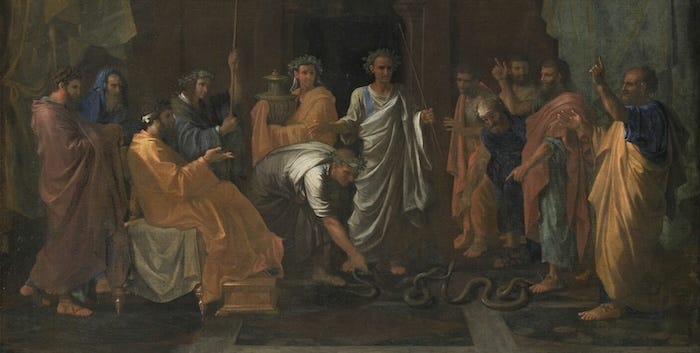

There is a long history of Egyptian magicians figuring into the biblical story (cf. Gen. 41:8). These “sorcerers,” though, were exactly who you think they were: diviners, astrologers, users of witchcraft, and those who dabble in the occult. Pharaoh’s closest advisors were a school of so-called “wise men” who had already flung the door wide open for Satan’s influence. It wasn’t all that surprising, then, that he called on them to mimic Aaron’s dazzling display. But this is where scholars and commentators alike get so hung up on “how” these Egyptian magicians might’ve pulled this off. How were they able to do as Aaron just did and turn each of their staffs into snakes? Was this just some parlor trick? Or did they really perform some magic? Was this sleight of hand or the work of Satan? For my own part, I am firmly in the camp that sees this as the devil at work. But, frankly, it doesn’t matter all that much to the story, since the focus of this scene isn’t “how” these sorcerers did what they did, but what happens next: “For each man cast down his staff, and they became serpents. But Aaron’s staff swallowed up their staffs” (Exod. 7:12).
4. The Staff That Swallowed Serpents
As shocking as it might’ve been for Aaron and Moses to see their “wonder” (מוֹפֵת) replicated by the Egyptians, it was exponentially more shocking for Pharaoh’s wise men to see each of their staffs engulfed by the staff shared by two Hebrew spokesmen. The point wouldn’t have been lost on any onlooker. Whatever perceived power the serpent and those who belonged to the serpent possessed, the God of the Hebrews was more powerful still, serving as a divine rebuttal to Pharaoh’s earlier dismissal (Exod. 5:2). “Pharaoh’s power was great,” Michael P. V. Barrett says, “but God’s was infinitely greater.”2 The God with whom Pharaoh was contending was none other than the I Am, the one who can snatch away humanity’s perceived power in the blink of an eye. When he was done with them, no one would have an excuse not to bow before the God of Israel. This is the prevailing motif behind the ensuing plagues, as God shows the watching world that there is no other God but him (Exod. 7:17; 9:14; 10:2).
Accordingly, by having Aaron’s staff-turned-serpent consume Pharaoh’s staffs-turned-serpents, God offers an object lesson of what is declared through the rest of Scripture:
To you it was shown, that you might know that the Lord is God; there is no other besides him. (Deut. 4:35)
See now that I, even I, am he, and there is no god beside me; I kill and I make alive; I wound and I heal; and there is none that can deliver out of my hand. (Deut. 32:39)
For you are great and do wondrous things; you alone are God. (Ps. 86:10)
I am the Lord, and there is no other, besides me there is no God. (Isa. 45:5)
I am God, and there is no other; I am God, and there is none like me. (Isa. 46:9)
No authority, on earth below or heaven above, can oppose the authority of Yahweh. Ours is a God who is rivaled by none and is supreme over all. Every power, potentate, and demon falls in subjection to him.
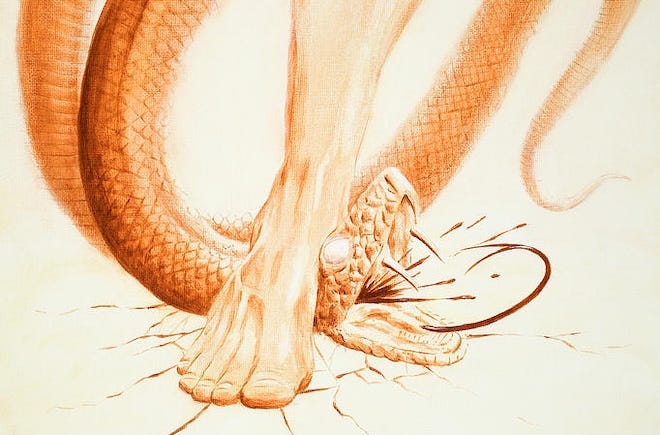
Furthermore, this moment is akin to God’s words being acted out; it’s a prophecy that’s dramatically put into motion. As Michael P. V. Barrett notes, “God’s power over literal snakes was a sign testifying to His power over Satan, the serpent whose head was destined to be crushed.”3 “This ‘sign,’” Arthur W. Pink concurs, “foreshadowed the end of the great conflict.”4 In the courtroom of Pharaoh, we’re shown a glimpse of the ultimate triumph of heaven over sin, death, and darkness, as Aaron’s staff swallowing up the sorcerers’ staffs prefigures the ultimate promise of the gospel, which assures us of the ancient serpent’s defeat (Gen. 3:15). Through the promise of the bruised heel and the crushed serpent, every filthy consequence of the serpent’s lies are swallowed up in the victory God gives us through the person of his Son (1 Cor. 15:54–57). After all, Christ is the one who “disarmed the rulers and authorities and put them to open shame, by triumphing over them in him” on the cross (Col. 2:15).
5. The Gospel That Swallows Death
What Moses and Aaron acted out in Pharaoh’s court has already been accomplished for us on a hill called Calvary. But in a way, it’s a scene that’s rehearsed nearly every time the church assembles. Standing in front of congregations, whose hearts and minds are brimming with news that makes it appear as though evil has the upper hand, preachers are equipped with something far more powerful than the sign of the staff turning into a serpent. They are armed with “the sword of the Spirit, which is the word of God” (Eph. 6:17). The only weapon strong enough to stymie the serpent and his seducing lies is “the word of [our] testimony” (Rev. 12:11), which, now and forever, resounds with the good news that death has lost its sting, sin has been defeated, and Satan’s head has been crushed because Christ walked out of the grave. Therefore, although that ancient serpent might still whisper his doubts into our hearts, the Spirit continually wields the Word that silences him.
John D. Currid, Ancient Egypt and the Old Testament (Grand Rapids, MI: Baker Academic, 1997), 86.
Michael P. V. Barrett, The Gospel of Exodus: Misery, Deliverance, Gratitude (Grand Rapids, MI: Reformation Heritage Books, 2020), 87.
Barrett, 91.
Arthur W. Pink, Gleanings in Exodus (Chicago: Moody Press, 1962), 57.